
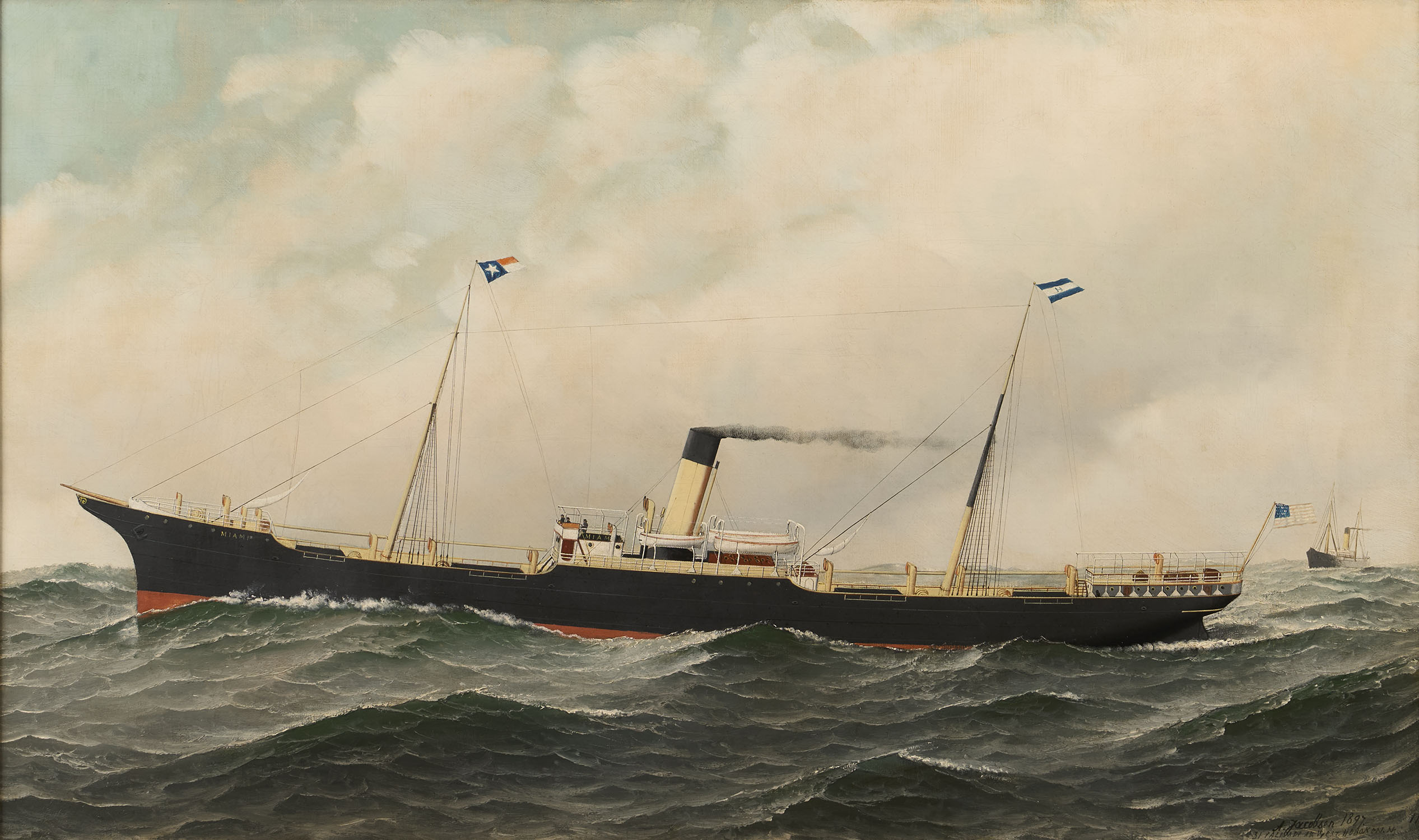
The Miami by Antonio Jacobsen
When curating our selections for the art fairs we attend, we always try to be conscious of bringing paintings that match the show’s location. And with the annual art show in Newport, Rhode Island, water subjects and nautical themes seem like the obvious choice. Rehs Galleries is pleased to offer a selection of previews for works that will be on display at the Newport Show from July 24th to 26th, starting with one of our latest acquisitions: Antonio Jacobsen’s painting of the American steamship Miami.
Antonio Jacobsen (1850 – 1921) was renowned in New York for his maritime paintings. Unlike other artists who focused on clipper ships speeding home from China or yacht races between boating clubs, Jacobsen specialized in something more akin to ship portraits. Shipping companies would commission him to paint their vessels out on the open water, not necessarily in the midst of any action but poised and stately as if leisurely coming into port. His work allows viewers to admire the craftsmanship behind a vessel’s engineering, and to recognize their role as vehicles of trade and transport. This is evident in Jacobsen’s 1897 work depicting the Miami.
Constructed by the shipbuilders Short Brothers in the northern English city of Sunderland, the Miami was 320 feet long and could haul over 3,000 tons of cargo. T. Hogan & Sons, a prominent New York ship brokerage, was the Miami’s owner, with Jacobsen including the company’s blue-and-white ensign on the ship’s mizzenmast. Starting in 1897, the same year as Jacobsen’s painting, Hogan & Sons operated the Lone Star Line out of Galveston, Texas. The Miami was the first ship put into operation to bring cargoes of cotton up to New York. Hogan & Sons, therefore, likely commissioned Jacobsen to create a painting of the Miami to commemorate the establishment of the Lone Star Line.
However, the Miami found herself at the center of a very public rivalry: in July 1897, the New York Times reported that during her first voyage down to Texas, she was competing with another steamer, the Lampassas, operated by their competitor, the Mallory Line. The Miami led the Lampassas on the way down to Texas. On the return trip two weeks later, the Miami was refueling in Key West when a fire broke out. The Lone Star Line was less profitable than Hogan & Sons anticipated, and they were forced to close the line after two years, selling the Miami to haul coal in the Pacific Northwest. In January 1900, the Miami ran aground and sank in the Strait of Georgia, just east of Vancouver Island.
Jacobsen captures the Miami at the height of its capacity as a cargo ship, slicing through the waters of New York’s upper bay ready to head down to Texas. The white sea spray and the dark coal smoke are both dispelled by the wind; meanwhile, the miniature figures populating the vessel’s bridge guide the Miami on its proper course. You can see Jacobsen’s Miami at Rehs Galleries’ booth at the Newport Show from July 24th to 26th.