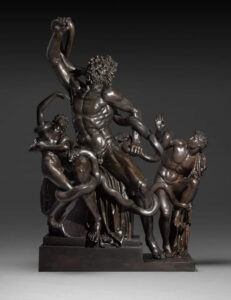
Laocoön and His Sons by Auguste-Jean-Marie Carbonneaux
As a prelude to their Old Masters evening sale, Sotheby’s London hosted a single-lot auction that shattered the record for the most expensive work of neoclassical sculpture ever sold.
Laocoön and His Sons is a bronze recreation of an ancient marble sculpture first excavated in Rome in 1506. The statue shows the Trojan priest Laocoön with his two sons being attacked by serpents. Though he does not appear in the Iliad or the Odyssey, Laocoön appears in ancient writings about the Trojan War, where one of the Greek gods (either Athena or Poseidon, depending on the text) sends serpents to strangle and kill him after he spoke out against bringing the Trojan Horse into the city. In book 36 of his Natural History, the Roman writer Pliny the Elder commented that a trio of sculptors from the Greek island of Rhodes created the statue. However, he did not mention whether it was a completely original work or a Roman copy of an earlier Greek bronze.
After the statue was excavated, Pope Julius II purchased it and had it installed at the Vatican, where it is still on display today. Laocoön and His Sons quickly became an object of adoration among Renaissance artists, exalted as the epitome of human anguish. Every part of the priest’s body is twisted and strained, while his face expresses pure suffering. The mythological subject has since become the focus of several works of art, including paintings by El Greco and Francesco Hayez.
The statue has left Italy only once, when Napoleon Bonaparte brought it to the Louvre following his Italian campaigns. During its time at the Louvre, plaster casts were made of the work, which were later used by the French neoclassical sculptor Auguste-Jean-Marie Carbonneaux to create the work offered at Sotheby’s on Wednesday. This was the first time in one hundred forty-four years that Carbonneaux’s Laocoön and His Sons had come to auction, with the last time being the monumental 1882 sale of the Hamilton family estate at Christie’s.
The newer bronze copy differs somewhat from the original marble sculpture. The most noticeable difference is that Carbonneaux has recreated several sections that were broken off the statue before excavation. There is also Laocoön’s outstretched right arm, which is consistent with the sculpture’s appearance until the 1980s. Following its excavation, the sculptor Jacopo Sansovino created a replacement for the missing right arm, which many assumed was outstretched in the typical heroic fashion. However, Michelangelo protested, saying that the arm was likely originally bent, with the hand reaching behind the subject’s shoulder. It was not until 1906 that the Czech archaeologist Ludwig Pollak discovered a marble fragment in the shape of a bent arm near where the original marble group had been unearthed. In the 1980s, during restorations, this fragment was identified as the missing arm and reattached, creating the sculpture group that visitors to the Vatican museums can see today.
Standing over ninety-two inches tall, Carbonneaux’s Laocoön and His Sons is one of the finest works of neoclassical sculpture to come to auction in recent years. Sotheby’s specialists, appropriately, estimated that the work would sell for at least £2 million. However, due to the work’s rarity, size, and condition, and because it is an impressive recreation of one of the most iconic classical sculptures in Western art, several interested parties fought over the Carbonneaux on Wednesday evening. After only a few minutes, the bid exceeded the £3 million high estimate and continued to climb until the hammer came down at an astounding £11.4 million (or £13.62 million / $18.1 million w/p).

Bronze Laocoön Smashes Auction Record
Laocoön and His Sons by Auguste-Jean-Marie Carbonneaux
As a prelude to their Old Masters evening sale, Sotheby’s London hosted a single-lot auction that shattered the record for the most expensive work of neoclassical sculpture ever sold.
Laocoön and His Sons is a bronze recreation of an ancient marble sculpture first excavated in Rome in 1506. The statue shows the Trojan priest Laocoön with his two sons being attacked by serpents. Though he does not appear in the Iliad or the Odyssey, Laocoön appears in ancient writings about the Trojan War, where one of the Greek gods (either Athena or Poseidon, depending on the text) sends serpents to strangle and kill him after he spoke out against bringing the Trojan Horse into the city. In book 36 of his Natural History, the Roman writer Pliny the Elder commented that a trio of sculptors from the Greek island of Rhodes created the statue. However, he did not mention whether it was a completely original work or a Roman copy of an earlier Greek bronze.
After the statue was excavated, Pope Julius II purchased it and had it installed at the Vatican, where it is still on display today. Laocoön and His Sons quickly became an object of adoration among Renaissance artists, exalted as the epitome of human anguish. Every part of the priest’s body is twisted and strained, while his face expresses pure suffering. The mythological subject has since become the focus of several works of art, including paintings by El Greco and Francesco Hayez.
The statue has left Italy only once, when Napoleon Bonaparte brought it to the Louvre following his Italian campaigns. During its time at the Louvre, plaster casts were made of the work, which were later used by the French neoclassical sculptor Auguste-Jean-Marie Carbonneaux to create the work offered at Sotheby’s on Wednesday. This was the first time in one hundred forty-four years that Carbonneaux’s Laocoön and His Sons had come to auction, with the last time being the monumental 1882 sale of the Hamilton family estate at Christie’s.
The newer bronze copy differs somewhat from the original marble sculpture. The most noticeable difference is that Carbonneaux has recreated several sections that were broken off the statue before excavation. There is also Laocoön’s outstretched right arm, which is consistent with the sculpture’s appearance until the 1980s. Following its excavation, the sculptor Jacopo Sansovino created a replacement for the missing right arm, which many assumed was outstretched in the typical heroic fashion. However, Michelangelo protested, saying that the arm was likely originally bent, with the hand reaching behind the subject’s shoulder. It was not until 1906 that the Czech archaeologist Ludwig Pollak discovered a marble fragment in the shape of a bent arm near where the original marble group had been unearthed. In the 1980s, during restorations, this fragment was identified as the missing arm and reattached, creating the sculpture group that visitors to the Vatican museums can see today.
Standing over ninety-two inches tall, Carbonneaux’s Laocoön and His Sons is one of the finest works of neoclassical sculpture to come to auction in recent years. Sotheby’s specialists, appropriately, estimated that the work would sell for at least £2 million. However, due to the work’s rarity, size, and condition, and because it is an impressive recreation of one of the most iconic classical sculptures in Western art, several interested parties fought over the Carbonneaux on Wednesday evening. After only a few minutes, the bid exceeded the £3 million high estimate and continued to climb until the hammer came down at an astounding £11.4 million (or £13.62 million / $18.1 million w/p).