
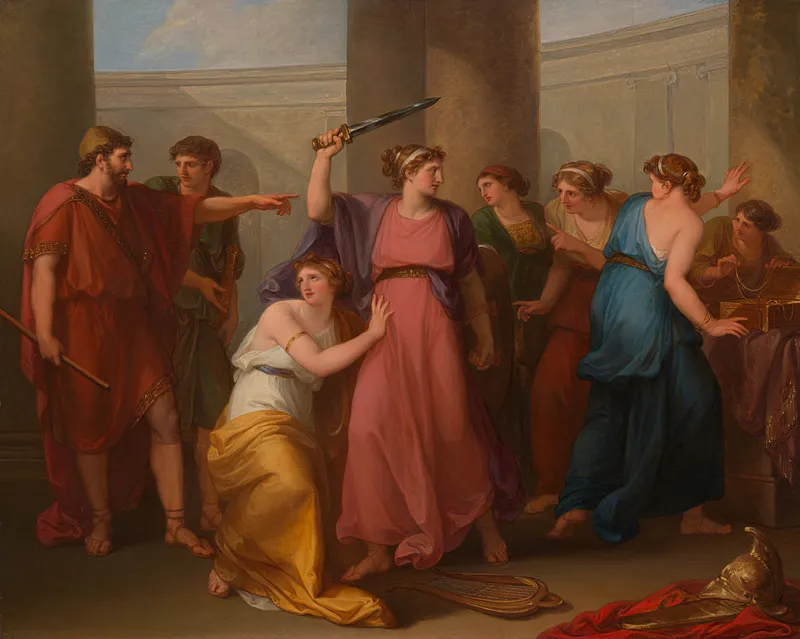
Achilles Discovered Among the Daughters of Lycomedes by Angelica Kauffman
London’s National Gallery has recently received an incredible new donation from Texas, including a mythological work by the eighteenth-century painter Angelica Kauffman.
Born in Switzerland, Kauffman made her career as a painter primarily in Rome and London. She was highly regarded in her lifetime, gaining fame not only as one of the few women working professionally as a painter, but as a master of historical scenes, portraits, and landscapes. In 1768, she became one of the founding members of the Royal Academy in London along with Benjamin West, Joshua Reynolds, Thomas Gainsborough, and others.
Her painting Achilles Discovered Among the Daughters of Lycomedes is one of several works donated to the National Gallery by Richard and Luba Barrett, an art-collecting couple based in Dallas who are considered connoisseurs of Swiss art. Among the other works in their donation are Four Large Trees by the nineteenth-century landscape painter Alexandre Calame and the 1885 portrait of Louis Montchal by Ferdinand Hodler. In recent years, the Barretts have become well-known for their generosity. In 2018, they donated over four hundred works from their collection to the University of Texas at Dallas. It was the largest donation in UTD’s history, and the largest gift of art ever given to the University of Texas system. The Barretts also promised to fund construction of a new museum to house their donation, which will be overseen by the university’s O’Donnell Institute of Art History. Their collection includes works by Swiss artists such as Caspar Wolf, Félix Vallotton, Cuno Amiet, and Giovanni Giacometti (the father of Alberto and Diego).
Kauffman’s Achilles dates to around 1787, several years after she left London to reestablish her studio in Rome. It is believed that Achilles is not a finished painting but a detailed study for a later work commissioned by the then-Empress of Russia, Catherine the Great. The empress had commissioned work from Kauffman in the early 1780s, with Achilles intended as a companion piece to Servius Tullius as a Child Asleep beneath the Miraculous Flame. Both the completed Achilles and Servius Tullius are currently held at the Scientific Research Museum at St. Petersburg’s Russian Academy of Arts.
The work depicts an important moment in the story of the Trojan War and in the life of Achilles. To prevent him from heeding Agamemnon’s call to war, the sea nymph Thetis sends her son Achilles to the island of Skyros disguised as a girl, where he would hide at the court of King Lycomedes. In search of the lost prince, Odysseus arrives on the island prepared to trick Achilles into revealing himself. He disguises himself as a merchant, laying out his wares for the ladies of the court to inspect. While the other women reach for jewelry, cloth, and other trinkets, the disguised Achilles reaches for the sword and other weapons. Finally, Odysseus fully exposes Achilles’s identity by having his men sound war horns in the distance to pretend they are under attack. Rather than show fear like the others, Achilles immediately brandishes the weapons to prepare for the impending danger. After revealing his identity, Achilles agrees to go off and fight at Troy. This episode in Achilles’ life has been a popular subject for artists, including Van Dyck, Poussin, and Artemisia Gentileschi. Kauffman herself had created a different take on the scene in 1769, which she exhibited at the Royal Academy.
Kauffman’s Achilles is the first oil painting by the artist since 1835 to enter a British national collection. Several dozen of her paintings are in museums and historic houses operated by the National Trust, but most are portraits rather than large-scale history paintings. Achilles Discovered Among the Daughters of Lycomedes is now the only example of Kauffman’s work at the National Gallery, and is currently on display there along with the two other paintings donated by the Barretts.