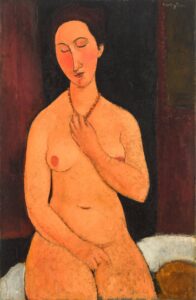
Nu assis au collier by Amedeo Modigliani
On Wednesday, June 24th, Sotheby’s hosted a prelude to their Modern & Contemporary evening sale featuring pieces from the collection of British businessman Joe Lewis. With his daughter Vivienne, Lewis assembled a collection estimated at a billion dollars, consisting mainly of nineteenth- and twentieth-century works by modern masters such as Caillebotte, Degas, Schiele, and Bacon.
There was no doubt that the evening’s star would be one of the two works by Amedeo Modigliani. Nu assis au collier was created around 1918 and passed through several private collections before Lewis purchased the work at Christie’s in May 1985. Sotheby’s specialists describe the work as “one of the most subtle and intimate” of the artist’s female nudes. Despite being an incredibly modern take on the subject, Modigliani also shows his admiration for the past masters. The pose is reminiscent of the Venus pudica, or the modest Venus, in which the subject is nude yet attempts to cover herself with her arms and hands, a motif originating in classical sculpture and later emulated by Botticelli, Rubens, and Manet. The woman also wears a coral necklace, similar to those worn in several works of Renaissance portraiture. The work offered at Sotheby’s is one of three paintings depicting the same subject in different poses; one is at the Guggenheim Museum in New York, and Oberlin College owns the other. Despite failing to reach its £45 million estimate, the Modigliani maintained its title as the sale’s star, achieving a final bid of £41.5 million (or £48.2 million / $54.6 million w/p). This places it in the top ten most expensive works by the artist ever sold at auction, and the most expensive Modigliani painting sold since his 1919 portrait Elvire en buste sold at Sotheby’s Paris last October for €26.98 million w/p.

Portrait of Gertrud Loew by Gustav Klimt
The second place lot, one of three with a minimum estimate exceeding £20 million, was Portrait of Gertrud Loew by Gustav Klimt. The Loew family was incredibly important to Klimt’s career and to the Vienna Secession in general as prominent collectors. Painted in 1902 when the subject was nineteen years old, specialists believe the portrait was commissioned by the sitter’s mother, Sophie, as a gift for her father, Dr. Anton Loew. The colors used seem rather monochromatic, reminiscent of James McNeill Whistler’s 1862 portrait popularly known as Symphony in White. However, in the 1890s and into the 1900s, Klimt often employed a reserved color palette, especially in his portraits. This can be seen in similar paintings of Serena Pulitzer Lederer and Hermine Gallia. Bidding lasted just over six minutes. The painting exceeded its £30 million high estimate, with Oliver Barker bringing the hammer down at £31 million (or £36.16 million / $40.9 million w/p).
And finally, for something slightly more recent, the third-place lot that evening was Sleeping by the Lion Carpet by Lucian Freud. The painting shows a corpulent nude woman reclining in a leather chair. Freud created several nude paintings of this particular subject, a woman named Sue Tilley, whom he used as a model from 1993 to 1996. For a portrait, the work is enormous, slightly larger than life-size, measuring nearly seven-and-a-half feet by four feet. Freud frequently returned to nude figure painting throughout his career, with many, including the specialists at Sotheby’s, describing the Tilley paintings as “the pinnacle of this endeavor, the zenith of his engagement with the trope.” The art critic Martin Gayford wrote of the Tilley portraits, “A body as extreme as this gives [Freud] painterly scope that other bodies might not offer. If a nude of ordinary proportions might be likened to a parish church, Sue is a whole baroque cathedral of flesh, real and fantastic at the same time (just as the rug in the background is simultaneously prosaic and exotic)”. The painting is both the Venus of Willendorf and Picasso’s La Rêve. There was considerable interest in the piece on Wednesday evening, with several interested parties bidding through the phone banks. The hammer eventually came down right on the £25 million low estimate (or £29.26 million / $33.1 million w/p), making it the fifth most expensive work by the artist ever to sell at auction. Another one of the Tilley paintings, Benefits Supervisor Sleeping, sits right above it in the number four position, having sold at Christie’s New York in May 2008 for $33.6 million w/p.
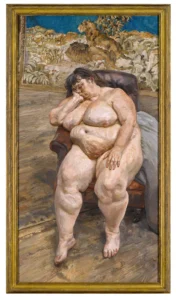
Sleeping by the Lion Carpet by Lucian Freud
In these blue-chip, single-collector sales, it’s very rare that any lot sells for anywhere close to double its high estimate. But in the Lewis collection, there was one work that proved so popular that it achieved over triple what Sotheby’s initially expected. La Belle promenade by the Belgian surrealist René Magritte features one of the artist’s most iconic motifs: the man in the bowler hat. Most famously seen in the 1964 painting Son of Man, the figure was also extensively used in a series in which his silhouette offers a window onto an image or scene against an unrelated background. In the work offered at Sotheby’s, the silhouette features a bright, cloudy sky, which stands in contrast to the deep, verdant background. Skies, stone walls, and bells are also elements that Magritte frequently included in his work. The combination of all these motifs makes it unsurprising that the painting did very well on Wednesday evening, surpassing the £4 million high estimate and hammering at £13.5 million (or £16 million / $18.15 million w/p).
Of the twenty-five lots that crossed the block on Wednesday, eight sold within their estimates, giving Sotheby’s specialists a 32% accuracy rate. An additional twelve lots (52%) sold above their estimates, while three (12%) sold below. Only a single lot, Edgar Degas’s 1880 painting La Loge, went unsold, giving the auction a 96% sell-through rate. The auction’s success led to an impressive total of £249.35 million (or £296.32 million / $335.34 million w/p), just shy of the £253.6 million pre-sale high estimate. This makes the Lewis collection one of the most expensive sales of the year, behind the Newhouse Collection and the 20th Century Evening Sale at Christie’s on May 18th. It is also the most expensive single-collector auction ever sold in Europe.

The Lewis Collection at Sotheby’s London
Nu assis au collier by Amedeo Modigliani
On Wednesday, June 24th, Sotheby’s hosted a prelude to their Modern & Contemporary evening sale featuring pieces from the collection of British businessman Joe Lewis. With his daughter Vivienne, Lewis assembled a collection estimated at a billion dollars, consisting mainly of nineteenth- and twentieth-century works by modern masters such as Caillebotte, Degas, Schiele, and Bacon.
There was no doubt that the evening’s star would be one of the two works by Amedeo Modigliani. Nu assis au collier was created around 1918 and passed through several private collections before Lewis purchased the work at Christie’s in May 1985. Sotheby’s specialists describe the work as “one of the most subtle and intimate” of the artist’s female nudes. Despite being an incredibly modern take on the subject, Modigliani also shows his admiration for the past masters. The pose is reminiscent of the Venus pudica, or the modest Venus, in which the subject is nude yet attempts to cover herself with her arms and hands, a motif originating in classical sculpture and later emulated by Botticelli, Rubens, and Manet. The woman also wears a coral necklace, similar to those worn in several works of Renaissance portraiture. The work offered at Sotheby’s is one of three paintings depicting the same subject in different poses; one is at the Guggenheim Museum in New York, and Oberlin College owns the other. Despite failing to reach its £45 million estimate, the Modigliani maintained its title as the sale’s star, achieving a final bid of £41.5 million (or £48.2 million / $54.6 million w/p). This places it in the top ten most expensive works by the artist ever sold at auction, and the most expensive Modigliani painting sold since his 1919 portrait Elvire en buste sold at Sotheby’s Paris last October for €26.98 million w/p.
Portrait of Gertrud Loew by Gustav Klimt
The second place lot, one of three with a minimum estimate exceeding £20 million, was Portrait of Gertrud Loew by Gustav Klimt. The Loew family was incredibly important to Klimt’s career and to the Vienna Secession in general as prominent collectors. Painted in 1902 when the subject was nineteen years old, specialists believe the portrait was commissioned by the sitter’s mother, Sophie, as a gift for her father, Dr. Anton Loew. The colors used seem rather monochromatic, reminiscent of James McNeill Whistler’s 1862 portrait popularly known as Symphony in White. However, in the 1890s and into the 1900s, Klimt often employed a reserved color palette, especially in his portraits. This can be seen in similar paintings of Serena Pulitzer Lederer and Hermine Gallia. Bidding lasted just over six minutes. The painting exceeded its £30 million high estimate, with Oliver Barker bringing the hammer down at £31 million (or £36.16 million / $40.9 million w/p).
And finally, for something slightly more recent, the third-place lot that evening was Sleeping by the Lion Carpet by Lucian Freud. The painting shows a corpulent nude woman reclining in a leather chair. Freud created several nude paintings of this particular subject, a woman named Sue Tilley, whom he used as a model from 1993 to 1996. For a portrait, the work is enormous, slightly larger than life-size, measuring nearly seven-and-a-half feet by four feet. Freud frequently returned to nude figure painting throughout his career, with many, including the specialists at Sotheby’s, describing the Tilley paintings as “the pinnacle of this endeavor, the zenith of his engagement with the trope.” The art critic Martin Gayford wrote of the Tilley portraits, “A body as extreme as this gives [Freud] painterly scope that other bodies might not offer. If a nude of ordinary proportions might be likened to a parish church, Sue is a whole baroque cathedral of flesh, real and fantastic at the same time (just as the rug in the background is simultaneously prosaic and exotic)”. The painting is both the Venus of Willendorf and Picasso’s La Rêve. There was considerable interest in the piece on Wednesday evening, with several interested parties bidding through the phone banks. The hammer eventually came down right on the £25 million low estimate (or £29.26 million / $33.1 million w/p), making it the fifth most expensive work by the artist ever to sell at auction. Another one of the Tilley paintings, Benefits Supervisor Sleeping, sits right above it in the number four position, having sold at Christie’s New York in May 2008 for $33.6 million w/p.
Sleeping by the Lion Carpet by Lucian Freud
In these blue-chip, single-collector sales, it’s very rare that any lot sells for anywhere close to double its high estimate. But in the Lewis collection, there was one work that proved so popular that it achieved over triple what Sotheby’s initially expected. La Belle promenade by the Belgian surrealist René Magritte features one of the artist’s most iconic motifs: the man in the bowler hat. Most famously seen in the 1964 painting Son of Man, the figure was also extensively used in a series in which his silhouette offers a window onto an image or scene against an unrelated background. In the work offered at Sotheby’s, the silhouette features a bright, cloudy sky, which stands in contrast to the deep, verdant background. Skies, stone walls, and bells are also elements that Magritte frequently included in his work. The combination of all these motifs makes it unsurprising that the painting did very well on Wednesday evening, surpassing the £4 million high estimate and hammering at £13.5 million (or £16 million / $18.15 million w/p).
Of the twenty-five lots that crossed the block on Wednesday, eight sold within their estimates, giving Sotheby’s specialists a 32% accuracy rate. An additional twelve lots (52%) sold above their estimates, while three (12%) sold below. Only a single lot, Edgar Degas’s 1880 painting La Loge, went unsold, giving the auction a 96% sell-through rate. The auction’s success led to an impressive total of £249.35 million (or £296.32 million / $335.34 million w/p), just shy of the £253.6 million pre-sale high estimate. This makes the Lewis collection one of the most expensive sales of the year, behind the Newhouse Collection and the 20th Century Evening Sale at Christie’s on May 18th. It is also the most expensive single-collector auction ever sold in Europe.