While the November evening sales in New York delivered plenty of excitement, including a remarkable $1 billion week for Sotheby’s, the day auctions told a more mixed story. Some sales performed exceptionally well, while others struggled to meet expectations. One thing was clear, however: demand for Impressionist and early Modernist paintings remains remarkably strong.
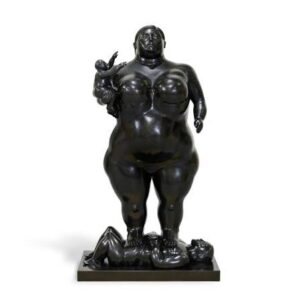
Mother and Child by Fernando Botero
The Baum Collection & Contemporary Day Sale at Sotheby’s
Sotheby’s faced a challenging afternoon on Tuesday with the Baum Collection day sale and their standard contemporary art auction. The Baum Collection had a wide variety of twentieth- and twenty-first-century works, including the abstract expressionism of Willem de Kooning, Andy Warhol’s Pop Art, and works by contemporary Japanese artists like Isamu Noguchi and Yoshitomo Nara. Unfortunately, twenty-one of the fifty-four lots, or 39%, sold below their estimates. An additional eight lots (15%) went unsold, including the 1973 Adolph Gottlieb painting Splatter, which was estimated to sell for at least $900K. The total hammer price fell slightly short of the $12.1 million total low pre-sale estimate.
Likewise, the contemporary day sale was rife with lots failing to meet their reserves. A small handful of these were given rather high estimates before the sale, including an untitled work by Christopher Wool (est. $900K to $1.2 million), Abstraction with Guitar by Roy Lichtenstein (est. $2.8 million to $3.5 million), and a 1968 color field painting by Mark Rothko (est. $3.5 million to $5 million). But there were some bright spots. Across all six of the day sales, one of the top lots was Fernando Botero’s 1979 bronze statue Mother and Child. The work ended up selling during the contemporary sale for $2.7 million (or $3.4 million w/p).
Overall, fifty-three of the two hundred forty-four lots, or 22% of the total, went unsold on Tuesday. While the Baum Collection fell ever so slightly short of its pre-sale estimate, the standard contemporary day sale missed the mark entirely, bringing in $65.13 million against a $75.7 million total estimate. Sotheby’s made up its shortcomings with the added buyer’s premium, bringing Tuesday’s total to $98.5 million against the $87.78 million that Sotheby’s anticipated.
Christie’s Impressionist & Modern Day Sales
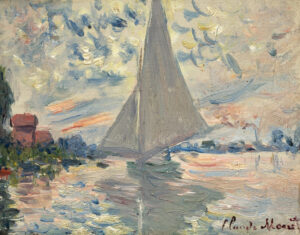
La Barque by Claude Monet
Wednesday at Christie’s, however, was more exciting, with some very successful back-to-back Impressionist & Modern sales. The works-on-paper sale in the morning did relatively well, featuring drawings and watercolors by a wide range of artists, including Vincent van Gogh and Remedios Varo. One hundred thirty-seven lots crossed the block that morning, with sixty-one of them, or 45% of the sale, surpassing their estimates. In fact, 10.9% of the lots sold for more than double their estimates. Perhaps the biggest surprise came from a gouache, watercolor, and chalk work by Eugène Boudin which sold for $14K (or $17.9K w/p) against a $3K high estimate. Overall, the works-on-paper achieved $10.9 million in total hammer against a $9 million total low estimate.
The standard Impressionist and Modern sale that followed did spectacularly. Fifty-nine of the one hundred ninety-one lots sold within their estimates, giving Christie’s a 31% accuracy rate. An additional seventy-two lots (38%) sold above estimate. Among the top lots was not only one of the biggest surprises of the sale but the entire year. Claude Monet’s incredibly small oil painting of a sailing boat on the water, dating to the early 1870s and measuring only 2 ¾ x 3 ½ inches, packed a powerful punch relative to its size. When I saw it hanging at the Christie’s galleries at Rockefeller Center, I almost laughed, since the stunning floral still life by Henri Fantin-Latour practically overshadowed it. It wasn’t until I read the information card that I even realized it was a Monet. Estimated to sell for no more than $500K, the painting proved incredibly popular with bidders that afternoon. Auctioneer David Kleiwig de Zwaan let the bids come in one after another, raising the price until he brought the hammer down at $5.6 million, or over eleven times the high estimate. Even without the extra attention from the Monet, the sale did very well overall, blowing away its $37.6 million minimum estimate and bringing in $51.5 million (or $65.7 million with fees).
Sotheby’s Modern Day Auction
Sotheby’s managed to pick itself back up slightly with its Modern Day Auction on Thursday, including works ranging from portraits by Sargent to abstract designs by Kandinsky. Another top lot of the day crossed the block at Sotheby’s, with Picasso’s 1964 painting Nu assis sur un tapis rayé selling for $2.7 million (or $3.4 million w/p) against a $2 million to $3 million estimate range. Sotheby’s finished strong, with 35% of lots selling within their estimates. This brought the total hammer to $45.96 million against a $40.4 million total low estimate.
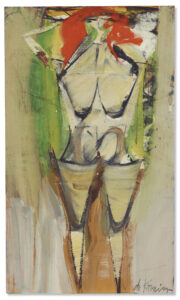
Figure in Landscape I by Willem de Kooning
Christie’s Post-War & Contemporary Day Sale
And finally, finishing out the week was the post-war and contemporary sale at Christie’s. Here we saw another one of the day sales’ top lots with Willem de Kooning’s 1951 painting Figure in Landscape I hammering exactly at its $3.5 million low estimate, coming out to $4.39 million with fees added. Of the three hundred forty available lots, one hundred seventeen sold within their estimates, giving Christie a 34% accuracy rate. However, in terms of the dollar amount, they just barely squeezed within the pre-sale total estimate, achieving $90 million in total hammer prices against an $89.24 million minimum. This was mainly due to several high-value works that went unsold. These included one of Josef Albers’s Homage to the Square paintings (est. $1 million to $1.5 million), Painting, 1956-1960 by Ad Reinhardt (est. $1.2 million to $1.8 million), and an example from Andy Warhol’s Flowers series (est. $2.5 million to $3.5 million).
Ultimately, while Sotheby’s enjoyed a remarkably successful week in its evening auctions, its day sales were considerably less consistent. Christie’s, on the other hand, demonstrated particular strength in the Impressionist and Modern categories, where strong bidding and several exceptional results helped carry the auction house through the week. In terms of total hammer price, Sotheby’s failed to meet its aggregate low estimate, bringing in $123.14 million across three sales against a minimum of $128.15 million. The added buyer’s premium certainly put them over this number, bringing their total to $157.15 million. Christie’s, on the other hand, did not need to rely on added fees, bringing in $152.47 million against a $135.88 million total minimum. The buyer’s premium provided a nice boost, bringing the three-sale total to $194.76 million.
The contrast offers an interesting glimpse into the current state of the art market. While some softness remains in the contemporary sector, demand for Impressionist and early Modernist works appears particularly resilient. If this week’s results are any indication, these established categories continue to attract both strong interest and serious competition among collectors.

A Mixed Week for Day Sales: Christie’s Impressionist & Modern Auctions Lead the Way
While the November evening sales in New York delivered plenty of excitement, including a remarkable $1 billion week for Sotheby’s, the day auctions told a more mixed story. Some sales performed exceptionally well, while others struggled to meet expectations. One thing was clear, however: demand for Impressionist and early Modernist paintings remains remarkably strong.
Mother and Child by Fernando Botero
The Baum Collection & Contemporary Day Sale at Sotheby’s
Sotheby’s faced a challenging afternoon on Tuesday with the Baum Collection day sale and their standard contemporary art auction. The Baum Collection had a wide variety of twentieth- and twenty-first-century works, including the abstract expressionism of Willem de Kooning, Andy Warhol’s Pop Art, and works by contemporary Japanese artists like Isamu Noguchi and Yoshitomo Nara. Unfortunately, twenty-one of the fifty-four lots, or 39%, sold below their estimates. An additional eight lots (15%) went unsold, including the 1973 Adolph Gottlieb painting Splatter, which was estimated to sell for at least $900K. The total hammer price fell slightly short of the $12.1 million total low pre-sale estimate.
Likewise, the contemporary day sale was rife with lots failing to meet their reserves. A small handful of these were given rather high estimates before the sale, including an untitled work by Christopher Wool (est. $900K to $1.2 million), Abstraction with Guitar by Roy Lichtenstein (est. $2.8 million to $3.5 million), and a 1968 color field painting by Mark Rothko (est. $3.5 million to $5 million). But there were some bright spots. Across all six of the day sales, one of the top lots was Fernando Botero’s 1979 bronze statue Mother and Child. The work ended up selling during the contemporary sale for $2.7 million (or $3.4 million w/p).
Overall, fifty-three of the two hundred forty-four lots, or 22% of the total, went unsold on Tuesday. While the Baum Collection fell ever so slightly short of its pre-sale estimate, the standard contemporary day sale missed the mark entirely, bringing in $65.13 million against a $75.7 million total estimate. Sotheby’s made up its shortcomings with the added buyer’s premium, bringing Tuesday’s total to $98.5 million against the $87.78 million that Sotheby’s anticipated.
Christie’s Impressionist & Modern Day Sales
La Barque by Claude Monet
Wednesday at Christie’s, however, was more exciting, with some very successful back-to-back Impressionist & Modern sales. The works-on-paper sale in the morning did relatively well, featuring drawings and watercolors by a wide range of artists, including Vincent van Gogh and Remedios Varo. One hundred thirty-seven lots crossed the block that morning, with sixty-one of them, or 45% of the sale, surpassing their estimates. In fact, 10.9% of the lots sold for more than double their estimates. Perhaps the biggest surprise came from a gouache, watercolor, and chalk work by Eugène Boudin which sold for $14K (or $17.9K w/p) against a $3K high estimate. Overall, the works-on-paper achieved $10.9 million in total hammer against a $9 million total low estimate.
The standard Impressionist and Modern sale that followed did spectacularly. Fifty-nine of the one hundred ninety-one lots sold within their estimates, giving Christie’s a 31% accuracy rate. An additional seventy-two lots (38%) sold above estimate. Among the top lots was not only one of the biggest surprises of the sale but the entire year. Claude Monet’s incredibly small oil painting of a sailing boat on the water, dating to the early 1870s and measuring only 2 ¾ x 3 ½ inches, packed a powerful punch relative to its size. When I saw it hanging at the Christie’s galleries at Rockefeller Center, I almost laughed, since the stunning floral still life by Henri Fantin-Latour practically overshadowed it. It wasn’t until I read the information card that I even realized it was a Monet. Estimated to sell for no more than $500K, the painting proved incredibly popular with bidders that afternoon. Auctioneer David Kleiwig de Zwaan let the bids come in one after another, raising the price until he brought the hammer down at $5.6 million, or over eleven times the high estimate. Even without the extra attention from the Monet, the sale did very well overall, blowing away its $37.6 million minimum estimate and bringing in $51.5 million (or $65.7 million with fees).
Sotheby’s Modern Day Auction
Sotheby’s managed to pick itself back up slightly with its Modern Day Auction on Thursday, including works ranging from portraits by Sargent to abstract designs by Kandinsky. Another top lot of the day crossed the block at Sotheby’s, with Picasso’s 1964 painting Nu assis sur un tapis rayé selling for $2.7 million (or $3.4 million w/p) against a $2 million to $3 million estimate range. Sotheby’s finished strong, with 35% of lots selling within their estimates. This brought the total hammer to $45.96 million against a $40.4 million total low estimate.
Figure in Landscape I by Willem de Kooning
Christie’s Post-War & Contemporary Day Sale
And finally, finishing out the week was the post-war and contemporary sale at Christie’s. Here we saw another one of the day sales’ top lots with Willem de Kooning’s 1951 painting Figure in Landscape I hammering exactly at its $3.5 million low estimate, coming out to $4.39 million with fees added. Of the three hundred forty available lots, one hundred seventeen sold within their estimates, giving Christie a 34% accuracy rate. However, in terms of the dollar amount, they just barely squeezed within the pre-sale total estimate, achieving $90 million in total hammer prices against an $89.24 million minimum. This was mainly due to several high-value works that went unsold. These included one of Josef Albers’s Homage to the Square paintings (est. $1 million to $1.5 million), Painting, 1956-1960 by Ad Reinhardt (est. $1.2 million to $1.8 million), and an example from Andy Warhol’s Flowers series (est. $2.5 million to $3.5 million).
Ultimately, while Sotheby’s enjoyed a remarkably successful week in its evening auctions, its day sales were considerably less consistent. Christie’s, on the other hand, demonstrated particular strength in the Impressionist and Modern categories, where strong bidding and several exceptional results helped carry the auction house through the week. In terms of total hammer price, Sotheby’s failed to meet its aggregate low estimate, bringing in $123.14 million across three sales against a minimum of $128.15 million. The added buyer’s premium certainly put them over this number, bringing their total to $157.15 million. Christie’s, on the other hand, did not need to rely on added fees, bringing in $152.47 million against a $135.88 million total minimum. The buyer’s premium provided a nice boost, bringing the three-sale total to $194.76 million.
The contrast offers an interesting glimpse into the current state of the art market. While some softness remains in the contemporary sector, demand for Impressionist and early Modernist works appears particularly resilient. If this week’s results are any indication, these established categories continue to attract both strong interest and serious competition among collectors.