Over the past week, the New York auction houses hosted a series of massive sales mainly of modern and contemporary art. In the process, several auction records were set, while several last-minute withdrawals brought some scandalous details to light.
The Baum Collection & Contemporary Evening Sale at Sotheby’s
The end-of-year sales started at Sotheby’s with the Baum Collection. Theodore Baum was a cable-television executive who, along with his wife Ruth, became known for their collection of modern and contemporary art, antique furniture, rare books, and other items. The evening’s highlights included Joan Mitchell’s 1960 painting Green Book of Barbara Guest, which hammered at the higher end of its $12 million to $18 million estimate range at $16.2 million (or $19.3 million w/p). An untitled 1967 work by Mark Rothko, a vibrant arrangement of scarlet and orange, also made an appearance, selling for slightly above its $15 million high estimate at $15.5 million (or $17.7 million w/p). Finally, the auction included one of Ed Ruscha’s text paintings from the early 1960s. Dimple is one of only seven examples from this series that includes a C-clamp on one of the letters. Unfortunately, this one fell slightly short of its $10 million low estimate, with a hammer coming down at $9.5 million (or $11.6 million w/p). It also served as a good introduction for Sotheby’s contemporary art evening auction, which featured works by Roy Lichtenstein, Willem de Kooning, and Andy Warhol. Across the back-to-back sales, Sotheby’s saw thirty-four of the seventy-four lots sell within their estimates, giving the specialists a 45.9% accuracy rate. Overall, Sotheby’s brought in $310.7 million in total hammer prices on just Monday night alone, with $90.88 million, nearly a third of the evening’s total, coming from the Baum Collection. This number rises to $378.7 million with buyer’s premium added.

Betonte Ecken by Wassily Kandinsky
Christie’s 20th Century Evening Sale
Christie’s then got their turn the following night with their 20th Century Evening Sale, which featured some of the most expensive works sold at auction this year. Wassily Kandinsky’s Betonte Ecken is considered one of the masterpieces of the artist’s Bauhaus period of the early 1920s. It is one of the most important milestones in Kandinsky’s journey toward developing a style that “synthesizes all of the arts into a singular spiritual experience.” It served as a major inspiration for the post-war abstract expressionists several decades after its creation, and became well regarded as one of the artist’s fifty works in Solomon Guggenheim’s collection. Kandinsky‘s auction record was set at Sotheby’s London in March 2023, with Murnau mit Kirche II selling for £33 million, or about $39.6 million at the time. Betonte Ecken completely blew this record out of the water, selling for $74 million (or $85.78 million w/p). Next up was the Klimt. It seems Gustav Klimt’s paintings are appearing more frequently at auction and achieving astounding prices. And this year was no different. Litzlbergkeller is one of the artist’s famous paintings created during his time spent on the shores of Lake Attersee, a popular vacation destination for well-off residents of Vienna. The titular building was a popular inn among visitors to the area, depicted on the canvas surrounded by the vibrant greenery rendered with distinctively small brushstrokes that make the entire landscape come alive in a way that Klimt’s Attersee paintings have become known for. Estimated to sell for at least $60 million, Litzlbergkeller hammered at $71 million (or $82.3 million w/p).
Several other prominent works crossed the block Tuesday evening, including paintings by Picasso and sculptures by Alberto Giacometti. There were even a couple of scattered surprises, including René Magritte’s 1947 painting Shéhérazade, which sold for $1.35 million against a $600K high estimate. There was also Diego Rivera’s Vendedora de flores, de Tehuantepec, which achieved a hammer price of $8.1 million against a $3.5 million high estimate. The seventy-three available lots brought in $521.1 million, or $653.2 million with fees added. It may have been a little too close for comfort given the total was only slightly above the $510.4 million low estimate. This can mainly be attributed to twenty-five of the seventy-three lots, or 34% of the sale, selling below their estimates, while an additional six lots failed to sell at all. Several withdrawals may have also inhibited the auction’s success. These include the small Frida Kahlo work Congreso de los pueblos por la paz, which was removed from the sale because concerns arose that the painting was not permitted to leave Mexico. Regardless, Tuesday’s evening sale is eclipsed only by Christie’s sale of the Newhouse Collection this past May as the year’s most expensive sale. But for the most expensive evening of the week, we return to Sotheby’s on Wednesday.
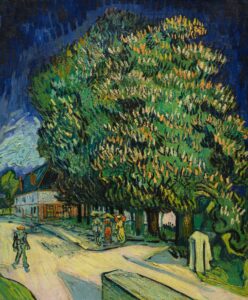
Châtaigniers en fleurs by Vincent van Gogh
The Blaquier-Arrieta Collection & Modern Evening Sale at Sotheby’s
Sotheby’s started off its evening sales on Wednesday with the collection of the Blaquier family. Argentine sugar executive Carlos Pedro Blaquier and his wife Nelly Arrieta de Blaquier amassed one of the most impressive collections of Impressionist and Modern art in the world, featuring works by Gauguin, Toulouse-Lautrec, Pissarro, and other masters. The expected star of the Sotheby’s sale was Vincent van Gogh’s Châtaigniers en fleurs. Created in 1890 within days of arriving in Auvers-sur-Oise, the painting, showing a collection of chestnut trees, has been in the Blaquier collection since 1975. Given the work’s quality and rarity, Sotheby’s gave the work an astounding estimate of $180 million. The Van Gogh failed to attract enough bids to reach that final price. However, with the hammer coming down at $165 million (or $190.4 million w/p), Châtaigniers en fleurs is now the most expensive Van Gogh ever sold at auction, and by far the most expensive work by any artist sold at auction this year.
There was a bit of controversy surrounding the Van Gogh since there were claims that the painting was stolen during the Holocaust. According to the descendants of the painting’s previous owners, the work was sold under duress in 1936, after originally being part of the collection of German Jewish publisher Samuel Fischer. Some commentators have noted that the department at Sotheby’s responsible for flagging potential restitution issues has recently been weakened by the departure of longtime specialist Lucien Simmons. Despite the Blaquier and Fischer families reaching an agreement just before the sale, these issues may have scared off some potential buyers.
The Blaquier collection also included one of Paul Cézanne’s Arlequin paintings. Executed between 1888 and 1890, the artist created a series of four paintings focusing on the Harlequin as a commedia dell’arte stock character. Some posit that this series by Cézanne had an immense influence on later modernist painters who used such performers in their work, including Picasso and Miró. Like the Van Gogh, the Cézanne also received a jaw-dropping estimate of $120 million. If the painting achieved this price, it would have been tied for the artist’s auction record set in 2023 by the painting La Montagne Sainte-Victoire, part of the monumental Paul Allen Collection sold at Christie’s New York. Unfortunately, also like the Van Gogh, the Cézanne fell a little short, selling for $99 million (or $111 million w/p) and becoming the second most expensive work by the artist ever sold. The following Modern Evening sale featured some equally impressive works by Edward Hopper, René Magritte, and Claude Monet. While 58% of the Blaquier collection sold below the works’ estimates, the second sale buoyed the evening’s overall results. Across the two auctions, Sotheby’s achieved an incredible $662.6 million in sales, or $777.8 million with fees.
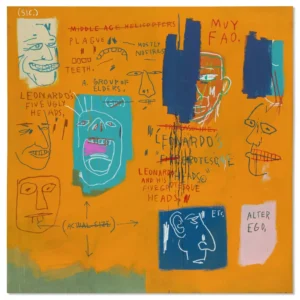
Untitled (Leonardo and His Five Grotesque Heads) by Jean-Michel Basquiat
Christie’s 21st Century Evening Sale
Rounding out this gargantuan week for the auction houses was the Thursday night 21st Century sale at Christie’s. Gerhard Richter’s Abstraktes Bild (est. $7 million to $10 million) and Andy Warhol’s Turkey Noodle edition of his Campbell’s Soup Cans series (est. $6 million to $8 million) sold handily within their estimates, hammering at $7.6 million and $7.3 million, respectively (or $9.4 million and $9 million w/p). The one work Christie’s advertised as this sale’s main attraction was Jean-Michel Basquiat’s 1983 work Untitled (Leonardo and His Five Grotesque Heads), which was on display at the base of the auction house’s main staircase in the days leading up to the sale. Inspired by a 1493 drawing by Leonardo da Vinci, the Basquiat painting last sold at Sotheby’s London in October 2005 for £736K w/p. The twenty years in a private collection did wonders for the work’s value, since Christie’s gave it a pre-sale estimate range of $30 million to $50 million. Perhaps the house specialists were a little overenthusiastic or the energy in the room Thursday evening was lackluster, since the Basquiat failed to reach the low estimate. The evening’s auctioneer Yü-Ge Wang sold the lot for $28 million (or $32.9 million w/p). The Basquiat was one of nineteen lots that sold below their estimates, accounting for 34% of the total sale. Additionally, five lots went unsold. Despite the other successes at Christie’s on Thursday, the total dollar amount unfortunately fell short, amounting to $117.7 million (or $155.9 million w/p) against a total low estimate of $126.7 million.
The November 2026 sales were actually somewhat consistent with the same auctions last year. Despite Christie’s reputation as the larger, more profitable auction house, Sotheby’s again outperformed its main competitor. Just like last year, Sotheby’s secured two impressive private collections featuring record-breaking paintings. Last year, it was the Klimt from the Lauder Collection; this year, it was the Van Gogh from the Blaquier Collection. Christie’s was unable to secure a prominent private collection this year, unlike last year’s success with the auction of the Robert and Patricia Ross Weis collection. They ended up underperforming, doing $772.5 million in sales versus $813.4 million from last year. Sotheby’s, on the other hand, improved on last year‘s performance despite the Blaquier Collection faring slightly worse than initially expected. It was difficult to match Sotheby’s incredible November 2025 sales: both the Lauder and Pritzker collections, the successful Modern and Contemporary evening sales, plus a sprinkling of surrealism with the Exquisite Corpus sales collectively brought in just over $1 billion. However, in 2026, Sotheby’s recorded $1.16 billion in total sales across four separate auctions.

Evenings at Christie’s & Sotheby’s: The November Blockbuster Sales
Over the past week, the New York auction houses hosted a series of massive sales mainly of modern and contemporary art. In the process, several auction records were set, while several last-minute withdrawals brought some scandalous details to light.
The Baum Collection & Contemporary Evening Sale at Sotheby’s
The end-of-year sales started at Sotheby’s with the Baum Collection. Theodore Baum was a cable-television executive who, along with his wife Ruth, became known for their collection of modern and contemporary art, antique furniture, rare books, and other items. The evening’s highlights included Joan Mitchell’s 1960 painting Green Book of Barbara Guest, which hammered at the higher end of its $12 million to $18 million estimate range at $16.2 million (or $19.3 million w/p). An untitled 1967 work by Mark Rothko, a vibrant arrangement of scarlet and orange, also made an appearance, selling for slightly above its $15 million high estimate at $15.5 million (or $17.7 million w/p). Finally, the auction included one of Ed Ruscha’s text paintings from the early 1960s. Dimple is one of only seven examples from this series that includes a C-clamp on one of the letters. Unfortunately, this one fell slightly short of its $10 million low estimate, with a hammer coming down at $9.5 million (or $11.6 million w/p). It also served as a good introduction for Sotheby’s contemporary art evening auction, which featured works by Roy Lichtenstein, Willem de Kooning, and Andy Warhol. Across the back-to-back sales, Sotheby’s saw thirty-four of the seventy-four lots sell within their estimates, giving the specialists a 45.9% accuracy rate. Overall, Sotheby’s brought in $310.7 million in total hammer prices on just Monday night alone, with $90.88 million, nearly a third of the evening’s total, coming from the Baum Collection. This number rises to $378.7 million with buyer’s premium added.
Betonte Ecken by Wassily Kandinsky
Christie’s 20th Century Evening Sale
Christie’s then got their turn the following night with their 20th Century Evening Sale, which featured some of the most expensive works sold at auction this year. Wassily Kandinsky’s Betonte Ecken is considered one of the masterpieces of the artist’s Bauhaus period of the early 1920s. It is one of the most important milestones in Kandinsky’s journey toward developing a style that “synthesizes all of the arts into a singular spiritual experience.” It served as a major inspiration for the post-war abstract expressionists several decades after its creation, and became well regarded as one of the artist’s fifty works in Solomon Guggenheim’s collection. Kandinsky‘s auction record was set at Sotheby’s London in March 2023, with Murnau mit Kirche II selling for £33 million, or about $39.6 million at the time. Betonte Ecken completely blew this record out of the water, selling for $74 million (or $85.78 million w/p). Next up was the Klimt. It seems Gustav Klimt’s paintings are appearing more frequently at auction and achieving astounding prices. And this year was no different. Litzlbergkeller is one of the artist’s famous paintings created during his time spent on the shores of Lake Attersee, a popular vacation destination for well-off residents of Vienna. The titular building was a popular inn among visitors to the area, depicted on the canvas surrounded by the vibrant greenery rendered with distinctively small brushstrokes that make the entire landscape come alive in a way that Klimt’s Attersee paintings have become known for. Estimated to sell for at least $60 million, Litzlbergkeller hammered at $71 million (or $82.3 million w/p).
Several other prominent works crossed the block Tuesday evening, including paintings by Picasso and sculptures by Alberto Giacometti. There were even a couple of scattered surprises, including René Magritte’s 1947 painting Shéhérazade, which sold for $1.35 million against a $600K high estimate. There was also Diego Rivera’s Vendedora de flores, de Tehuantepec, which achieved a hammer price of $8.1 million against a $3.5 million high estimate. The seventy-three available lots brought in $521.1 million, or $653.2 million with fees added. It may have been a little too close for comfort given the total was only slightly above the $510.4 million low estimate. This can mainly be attributed to twenty-five of the seventy-three lots, or 34% of the sale, selling below their estimates, while an additional six lots failed to sell at all. Several withdrawals may have also inhibited the auction’s success. These include the small Frida Kahlo work Congreso de los pueblos por la paz, which was removed from the sale because concerns arose that the painting was not permitted to leave Mexico. Regardless, Tuesday’s evening sale is eclipsed only by Christie’s sale of the Newhouse Collection this past May as the year’s most expensive sale. But for the most expensive evening of the week, we return to Sotheby’s on Wednesday.
Châtaigniers en fleurs by Vincent van Gogh
The Blaquier-Arrieta Collection & Modern Evening Sale at Sotheby’s
Sotheby’s started off its evening sales on Wednesday with the collection of the Blaquier family. Argentine sugar executive Carlos Pedro Blaquier and his wife Nelly Arrieta de Blaquier amassed one of the most impressive collections of Impressionist and Modern art in the world, featuring works by Gauguin, Toulouse-Lautrec, Pissarro, and other masters. The expected star of the Sotheby’s sale was Vincent van Gogh’s Châtaigniers en fleurs. Created in 1890 within days of arriving in Auvers-sur-Oise, the painting, showing a collection of chestnut trees, has been in the Blaquier collection since 1975. Given the work’s quality and rarity, Sotheby’s gave the work an astounding estimate of $180 million. The Van Gogh failed to attract enough bids to reach that final price. However, with the hammer coming down at $165 million (or $190.4 million w/p), Châtaigniers en fleurs is now the most expensive Van Gogh ever sold at auction, and by far the most expensive work by any artist sold at auction this year.
There was a bit of controversy surrounding the Van Gogh since there were claims that the painting was stolen during the Holocaust. According to the descendants of the painting’s previous owners, the work was sold under duress in 1936, after originally being part of the collection of German Jewish publisher Samuel Fischer. Some commentators have noted that the department at Sotheby’s responsible for flagging potential restitution issues has recently been weakened by the departure of longtime specialist Lucien Simmons. Despite the Blaquier and Fischer families reaching an agreement just before the sale, these issues may have scared off some potential buyers.
The Blaquier collection also included one of Paul Cézanne’s Arlequin paintings. Executed between 1888 and 1890, the artist created a series of four paintings focusing on the Harlequin as a commedia dell’arte stock character. Some posit that this series by Cézanne had an immense influence on later modernist painters who used such performers in their work, including Picasso and Miró. Like the Van Gogh, the Cézanne also received a jaw-dropping estimate of $120 million. If the painting achieved this price, it would have been tied for the artist’s auction record set in 2023 by the painting La Montagne Sainte-Victoire, part of the monumental Paul Allen Collection sold at Christie’s New York. Unfortunately, also like the Van Gogh, the Cézanne fell a little short, selling for $99 million (or $111 million w/p) and becoming the second most expensive work by the artist ever sold. The following Modern Evening sale featured some equally impressive works by Edward Hopper, René Magritte, and Claude Monet. While 58% of the Blaquier collection sold below the works’ estimates, the second sale buoyed the evening’s overall results. Across the two auctions, Sotheby’s achieved an incredible $662.6 million in sales, or $777.8 million with fees.
Untitled (Leonardo and His Five Grotesque Heads) by Jean-Michel Basquiat
Christie’s 21st Century Evening Sale
Rounding out this gargantuan week for the auction houses was the Thursday night 21st Century sale at Christie’s. Gerhard Richter’s Abstraktes Bild (est. $7 million to $10 million) and Andy Warhol’s Turkey Noodle edition of his Campbell’s Soup Cans series (est. $6 million to $8 million) sold handily within their estimates, hammering at $7.6 million and $7.3 million, respectively (or $9.4 million and $9 million w/p). The one work Christie’s advertised as this sale’s main attraction was Jean-Michel Basquiat’s 1983 work Untitled (Leonardo and His Five Grotesque Heads), which was on display at the base of the auction house’s main staircase in the days leading up to the sale. Inspired by a 1493 drawing by Leonardo da Vinci, the Basquiat painting last sold at Sotheby’s London in October 2005 for £736K w/p. The twenty years in a private collection did wonders for the work’s value, since Christie’s gave it a pre-sale estimate range of $30 million to $50 million. Perhaps the house specialists were a little overenthusiastic or the energy in the room Thursday evening was lackluster, since the Basquiat failed to reach the low estimate. The evening’s auctioneer Yü-Ge Wang sold the lot for $28 million (or $32.9 million w/p). The Basquiat was one of nineteen lots that sold below their estimates, accounting for 34% of the total sale. Additionally, five lots went unsold. Despite the other successes at Christie’s on Thursday, the total dollar amount unfortunately fell short, amounting to $117.7 million (or $155.9 million w/p) against a total low estimate of $126.7 million.
The November 2026 sales were actually somewhat consistent with the same auctions last year. Despite Christie’s reputation as the larger, more profitable auction house, Sotheby’s again outperformed its main competitor. Just like last year, Sotheby’s secured two impressive private collections featuring record-breaking paintings. Last year, it was the Klimt from the Lauder Collection; this year, it was the Van Gogh from the Blaquier Collection. Christie’s was unable to secure a prominent private collection this year, unlike last year’s success with the auction of the Robert and Patricia Ross Weis collection. They ended up underperforming, doing $772.5 million in sales versus $813.4 million from last year. Sotheby’s, on the other hand, improved on last year‘s performance despite the Blaquier Collection faring slightly worse than initially expected. It was difficult to match Sotheby’s incredible November 2025 sales: both the Lauder and Pritzker collections, the successful Modern and Contemporary evening sales, plus a sprinkling of surrealism with the Exquisite Corpus sales collectively brought in just over $1 billion. However, in 2026, Sotheby’s recorded $1.16 billion in total sales across four separate auctions.