
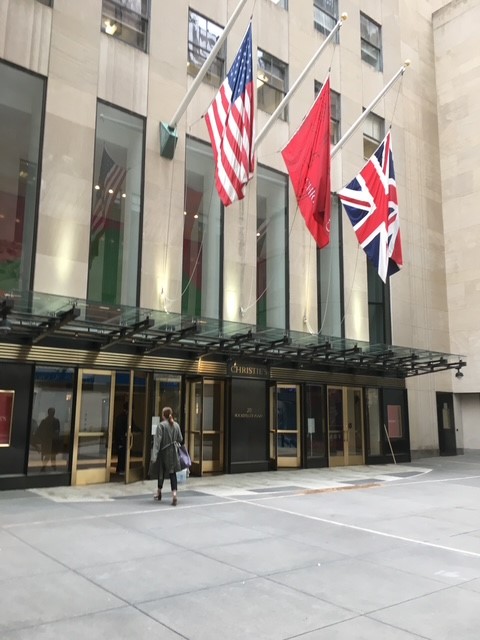
Christie’s New York
Recently, we received an email from Doyle’s, one of the more reliable midsize auction houses in New York. They let us know that, starting on December 1st, they would be changing their buyer’s premiums, creating a new tier that puts a 29% fee on the first $100K, moving to 28% between $100K and $2 million. This is not the first time this year that we have received such an email. Such notifications are a stark reminder that the secondary art market is not immune from rising costs. Lately, it is becoming more and more expensive to buy and sell at auction.
Auction house premiums have been rising over the past few years, especially since the pandemic. At one point, Christie’s increased its fees at a rate of once a year. In 2026 alone, nearly all major auction houses have altered their buyers’ premium structure. Most recently, both Christie’s and Bonhams did so in September. The latter introduced a new tier that applies a 30% premium rate to the first $35K in hammer price at its New York location, or £25K at its two London locations. After that, 28% is applied to bids between $35K and $750K (or £25K and £500K). Sotheby’s, meanwhile, changed theirs back in February, with all lots sold for up to $2 million being subject to a 28% fee. Bonhams CEO Seth Johnson quickly pointed out that their recent changes mark the first time in three years the auction house has raised its premiums. He also commented that the move was made “to properly reflect the value that Bonhams as a global auction house provides.”
Sotheby’s actually grabbed a good deal of attention in 2024 with their experimental two-tier system. Starting in May of that year, they implemented a new fee structure in which all sales up to $6 million were subject to a flat 20% buyer’s premium, with 10% on everything over that amount. The switch to the two-tier structure was said to simplify things and bring in new business. A Sotheby’s statement called the three-tier system, now commonplace at most major auction houses, “intimidatingly complex”, while Sotheby’s CEO Charles Stewart described the move as “a step toward maturity for the art world”. Unfortunately, they ended up rolling this back later in the year. While it would have been nice to see what this sort of structure would look like long-term, it was scrapped after seven months because it didn’t produce the desired results… or, in other words, it wasn’t profitable enough.
Rising premiums have an interesting effect on how people buy at auction. Not only do buyers have to pay more, but it also lowers their bidding ceiling. All buyers have a maximum amount they’re willing to bid. That ceiling remains the same, but with buyers’ premiums increasing year after year, their willingness to bid just one more time grows weaker. Placing a final bid of $5,000 a few years ago used to cost $6,250. But now it costs $6,400. Plus there’s tax on top of that. And that’s even before adding packing and shipping costs, if you aren’t local.
Now, of course, running an auction house is certainly expensive. You have the costs of owning and maintaining physical showrooms and office buildings. Then there’s paying for the services of whole departments full of specialists, researchers, photographers, graphic designers, marketers, and many others. With all the overhead and other day-to-day operating costs, profits can only come from so few places. But auction houses do not have a monopoly on buying and selling art. Because they are larger organizations, they can facilitate these transactions more quickly. But of course, that’s something you must be willing to pay for.