
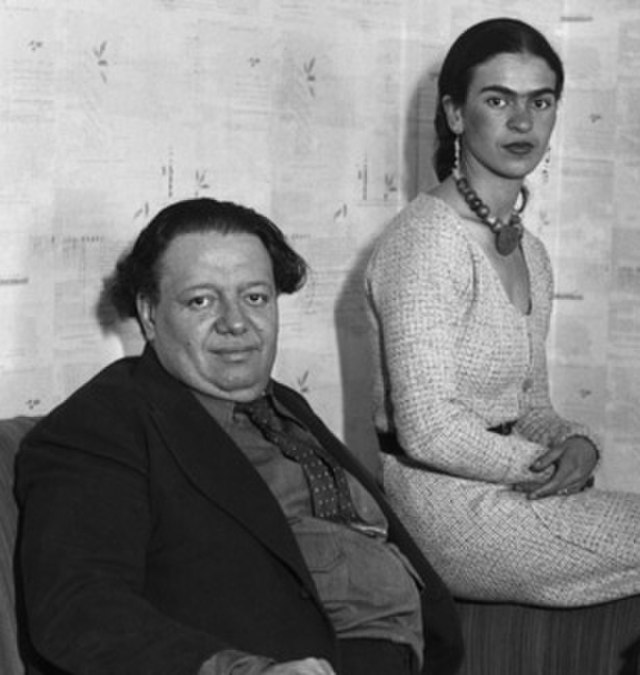
Diego Rivera & Frida Kahlo
The Museum of Modern Art recently opened a small exhibit featuring the works of Frida Kahlo and Diego Rivera in collaboration with the Metropolitan Opera’s new production focusing on the two artists.
El último sueño de Frida y Diego (Frida and Diego’s Last Dream) is a new opera that will premiere at the Lincoln Center institution on May 14, 2026. Composer Gabriela Lena Frank and librettist Nilo Cruz have created something that seems befitting of the magical realism and surrealism of Kahlo’s work. In what the Metropolitan Opera calls “a reversal of the Orpheus and Euridice myth”, the production focuses on Frida Kahlo’s spirit taking advantage of Día de Muertos to visit Diego Rivera. Media exploring their relationship has always been popular. The two embodied striking dichotomies. In both appearance and temperament, they were profoundly different. Kahlo’s mother, Matilde Calderón, famously referred to them as “the elephant and the dove.” Their artistic styles diverged as well, with Rivera creating monumental public murals, while Kahlo focused on deeply intimate self-portraits. Yet both achieved the same goal, redefining the culture of post-revolutionary Mexico. Both also had a deep passion for traditional Mexican folk art and were champions of leftist politics.
The opera’s one-night reunion is said to be an artistic fulfilment of Rivera’s final wish. Before he died in 1957, he requested that his cremated remains be placed beside those of Frida Kahlo. Hers are located in an urn at the Casa Azul, the Kahlo family home, which is now a museum dedicated to the artist. However, Rivera remarried following Kahlo’s death in 1954. His fourth and final wife, Emma Hurtado, defied his wishes, allegedly for religious reasons. Instead, he was given a large, public funeral and buried at the Panteón de Dolores in Mexico City.
El último sueño de Frida y Diego originally premiered at the San Diego Opera in 2022. Productions were also staged in Los Angeles and San Francisco. A production in Chicago is planned for later this year. However, Frank began the project in 2007, when the Arizona Opera’s artistic director approached her with the idea of creating a work about Frida Kahlo. She soon found Cruz as a collaborator. Cruz, however, commented that he was “not interested in writing a biopic”, especially since “Frida’s work is so autobiographical to begin with.” The need for an alternative storytelling vehicle is what prompted the Day of the Dead elements. While Cruz took great inspiration from Kahlo’s 1949 painting The Love Embrace of the Universe, the Earth (Mexico), Myself, Diego, and Señor Xólotl, the MoMA exhibit focuses on the opera’s production design.
Since the museum show is not an attempt by curators to make an art-historical argument, none of the works on display were accompanied by articles or explanations. MoMA creators instead presented the works by the two artists and allowed visitors to draw their own conclusions. Several important Kahlo paintings are on display, including Self-Portrait with Cropped Hair and Self-Portrait on the Borderline between Mexico and the United States. Several large works by Rivera were also on display, including Líder Agrario Zapata and Flower Festival: Feast of Santa Anita. Several dozen paintings, drawings, lithographs, and other works by both artists give visitors a crash course in the styles, subjects, and themes that Kahlo and Rivera respectively preferred.
Most striking, however, was not necessarily an artwork in the exhibition, but something decorative. On one side of the single large room where the exhibition is taking place is a sort of sculpture resembling a gnarled, leafless tree, the bark tinted red. The trunk grows through a blue four-poster bed, something that Kahlo included in some of her work, most famously The Dream (The Bed), which set an auction record for a Latin American artist and a female artist when it was sold at Sotheby’s last November for $54.7 million w/p. Both the tree and the bed are important parts of the opera’s design, among the few large set pieces on stage. In an interview with MoMA, production designer Jon Bausor explained how it fits in with the themes of the larger story: “For me, the idea of cracks and fissures, tears and wounds was important, and the sense of what is revealed beneath the skin or surface. I’ve translated these themes into a materialism. There’s a tree of life and death; its arterial red branches are like a human heart or lung held up and underpinned by wooden scaffolding.” The iconography of hearts, arteries, and bloodlines was a common feature in Kahlo’s work, most famously in her 1939 painting The Two Fridas. This symbolism was also featured in one of the works on display at MoMA, My Grandparents, My Parents, and I.
But the image of the tree may remind audiences of the first painting exhibition-goers see when they enter the space: Kahlo’s painting Árbol de esperanza, mantente firme, the title of which translates to Tree of Hope, Remain Strong. She created this work in 1946 following a trip to New York, where she underwent surgery for her chronic spinal pain. Though no tree is visible in the painting, the title, printed on a flag Kahlo holds, is more metaphorical. It could refer to Kahlo’s spine, or even her spirit. The fact that her life and work can inspire others to create great works of art just goes to show that while Frida Kahlo’s body often failed her, her spirit has remained strong even decades after her death.