
Few artists captured the drama and elegance of 19th-century sailing quite like James Edward Buttersworth, one of the most celebrated marine painters working in America during the second half of the century. Born in England in 1817, Buttersworth was the son and student of noted British marine painter Thomas Buttersworth, from whom he inherited both a deep understanding of naval architecture and a remarkable ability to convey movement on the water.
By the time Buttersworth began his career, England’s great age of naval warfare had largely passed. Marine painters increasingly turned their attention from battles to commercial shipping and competitive yachting, subjects that would define Buttersworth’s work for the rest of his life. Seeking broader opportunities, he emigrated to the United States in 1847. Shortly after arriving, he was introduced to publisher Nathaniel Currier, who commissioned him to create works for the firm Currier & Ives—an association that helped establish his reputation among American collectors.
Settling in West Hoboken, New Jersey, with a studio in Brooklyn, Buttersworth quickly became one of the leading interpreters of America’s growing sailing culture. The mid-19th century saw the rise of organized yacht racing and the formation of elite clubs such as the New York Yacht Club. These regattas provided dramatic subject matter: sleek racing yachts cutting through choppy waters, dramatic skies overhead, and spectators watching from accompanying vessels.
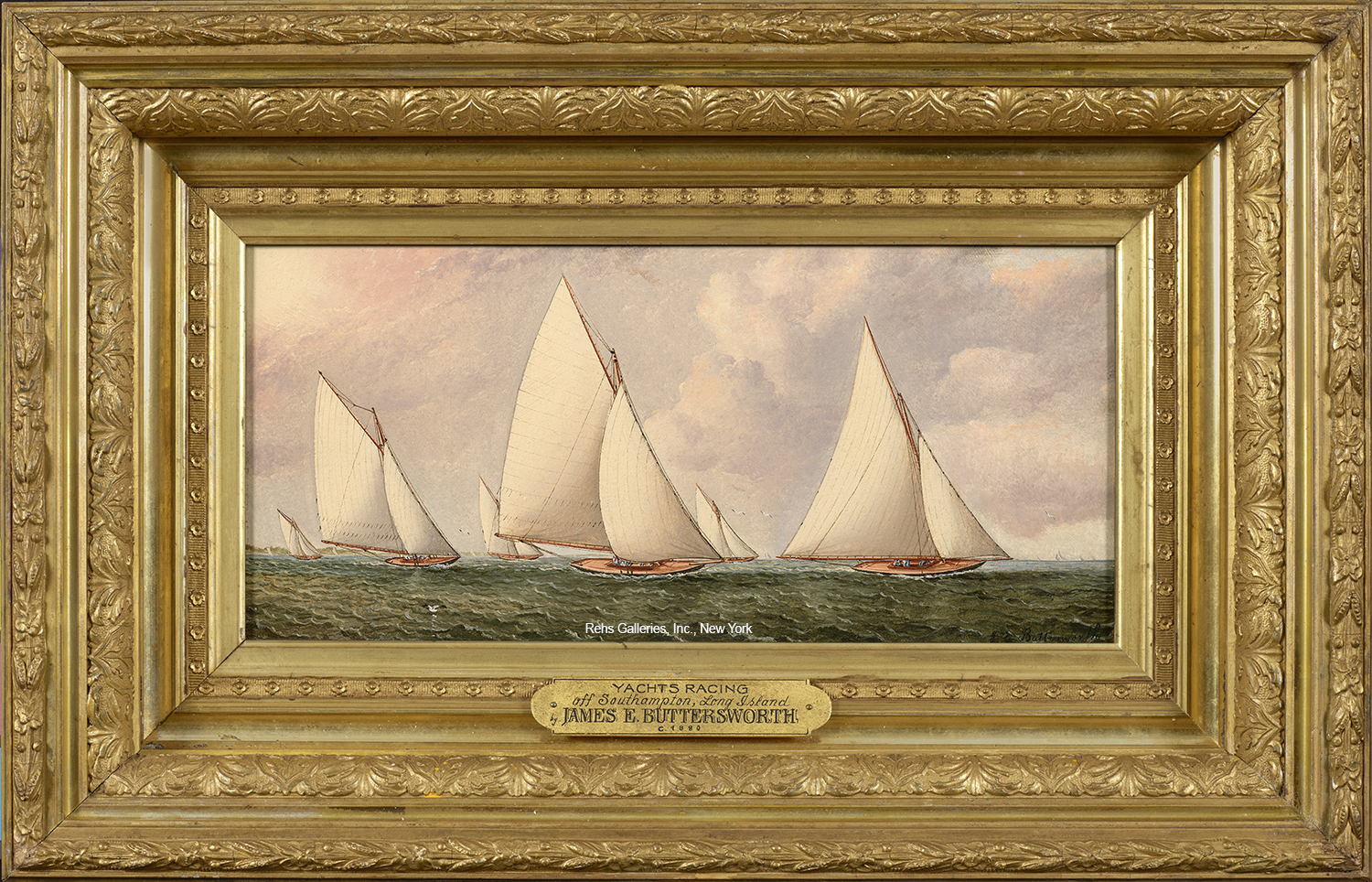
Yachts Racing off Southampton, Long Island
Long Island’s coastline, particularly the waters off Southampton, became one of Buttersworth’s favorite settings. In works such as Yachts Racing off Southampton, Long Island, he captures the excitement of competitive sailing with extraordinary technical accuracy. His paintings are prized for their precise rendering of rigging, hull design, and sail configuration, reflecting a painter who clearly understood the mechanics of the vessels he depicted. At the same time, his compositions convey speed and atmosphere — the billowing sails, shifting light, and rolling Atlantic waters all contributing to the sense of a race unfolding before the viewer.
The featured work, Yachts Racing off Southampton, Long Island, painted in oil on panel and measuring 7 × 15 inches (15 × 23 inches framed), exemplifies Buttersworth’s ability to combine intimacy of scale with expansive maritime drama. The elongated format mirrors the sea’s horizontal sweep and allows the racing vessels to stretch across the composition, their sails filled with wind as they compete along the Long Island shoreline. The painting is signed and inscribed on the reverse, and notably comes from the John Stobart Collection, linking it to another renowned painter of maritime history.
Today, Buttersworth is recognized as one of the most important marine painters working in America during the 19th century. His works are held in numerous institutional collections, including the U.S. Naval Academy Museum, the Newark Museum, the Museum of the City of New York, the Virginia Museum of Fine Arts, and the Peabody Essex Museum in Salem. Through paintings like Yachts Racing off Southampton, he preserved the energy and elegance of an era when sail still ruled the sea—and when the waters of Long Island served as a stage for some of the most exciting races of the age.