
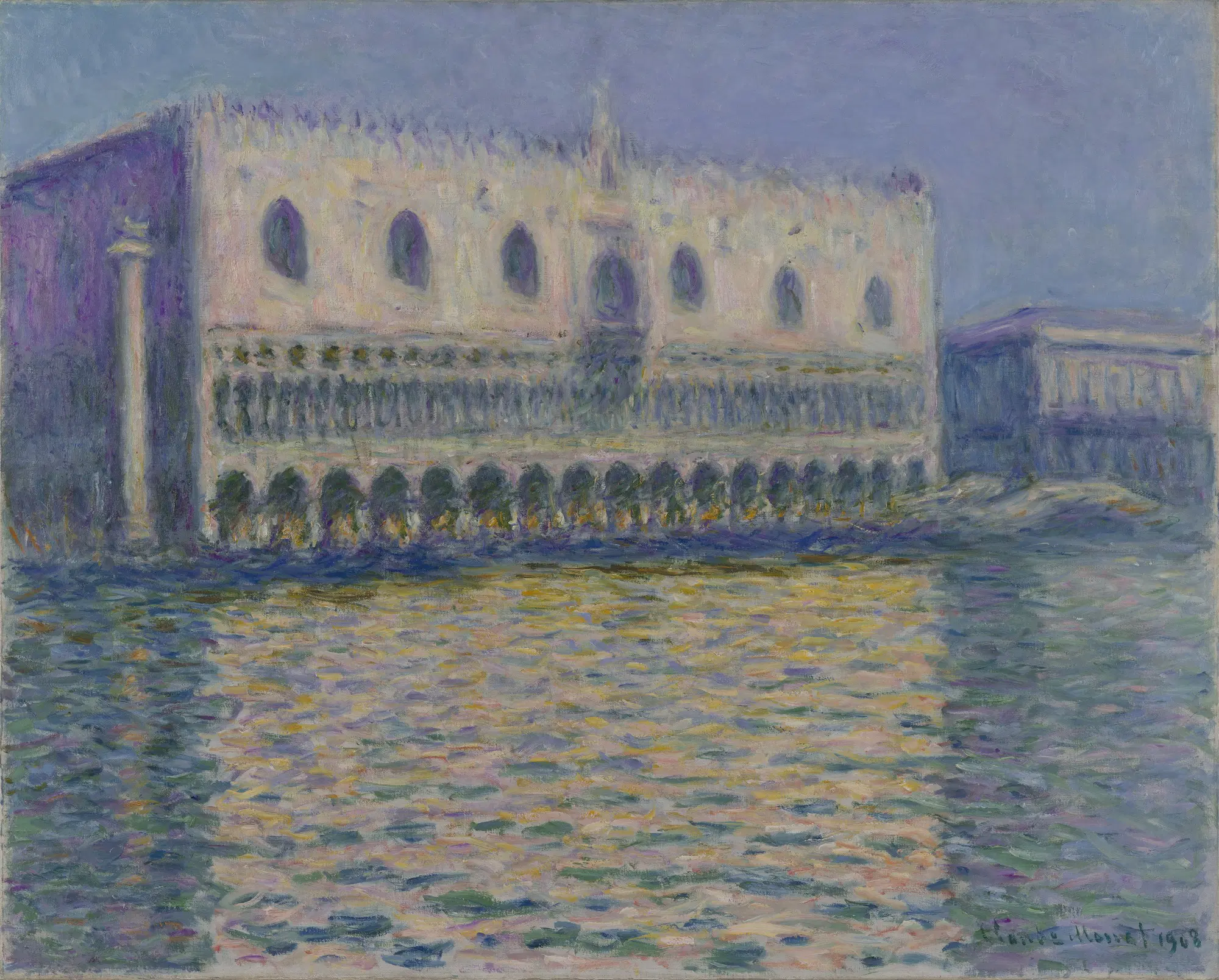
Palazzo Ducale by Claude Monet
On Saturday, October 11th, the Brooklyn Museum opened its Monet & Venice exhibition to the public, marking the largest museum show to focus on the artist in nearly twenty-five years.
In 1908, Claude Monet was living and working in the small town of Giverny, about 40 miles northwest of Paris. There, he owned a house surrounded by the lush gardens that inspired his famous water lily paintings. By this time, Monet had been exploring garden scenes for over a decade but found himself in a creative slump. That changed when British collector Mary Syth Hunter invited him to Venice. During his two-month stay, Monet created thirty-seven paintings, twenty-nine of which were later exhibited at Galerie Bernheim in 1912.
The majority of the current exhibition centers on the Brooklyn Museum curators’ efforts to contextualize Monet’s Venetian paintings. Visitors begin their experience in a darkened room, where projected videos of Venice envelop the walls, accompanied by the sounds of seabirds and the gentle lapping of lagoon water against the jetties.
From there, guests move into a smaller gallery that transports them from present-day Venice to the city as it was in 1908. Display cases feature letters, postcards, and photographs that Claude and Alice Monet sent back to France—reminders that, though time passes, the essence of being a tourist remains unchanged. The exhibition also includes period travel guides the Monets likely consulted, as well as several paintings, such as An Interior in Venice by American artist John Singer Sargent, offering further glimpses into Venetian life a century ago.
Both then and now, Venice has captivated travelers as a beautiful, slightly decaying city that seems lifted from a fairytale. In these opening galleries, visitors witness the depth of that fascination. Alongside two of Monet’s views of the Palazzo Ducale hang a pair of monumental Venetian cityscapes by the eighteenth-century master Canaletto, one depicting the very same building. Nearby, etchings and engravings by Michele Marieschi showcase other iconic Venetian landmarks.
These works by Canaletto and Marieschi are more than picturesque views, they reflect the flourishing art market driven by young aristocrats undertaking the Grand Tour, a cultural rite of passage through Europe that often culminated in Italy. Later in the exhibition, the curators extend this historical arc with nineteenth-century interpretations of Venice by Thomas Moran, James McNeill Whistler, and Pierre-Auguste Renoir.
This thoughtful contextualization underscores Venice’s enduring allure, both as a destination and as an artistic muse, across the centuries leading up to Monet’s transformative 1908 visit.
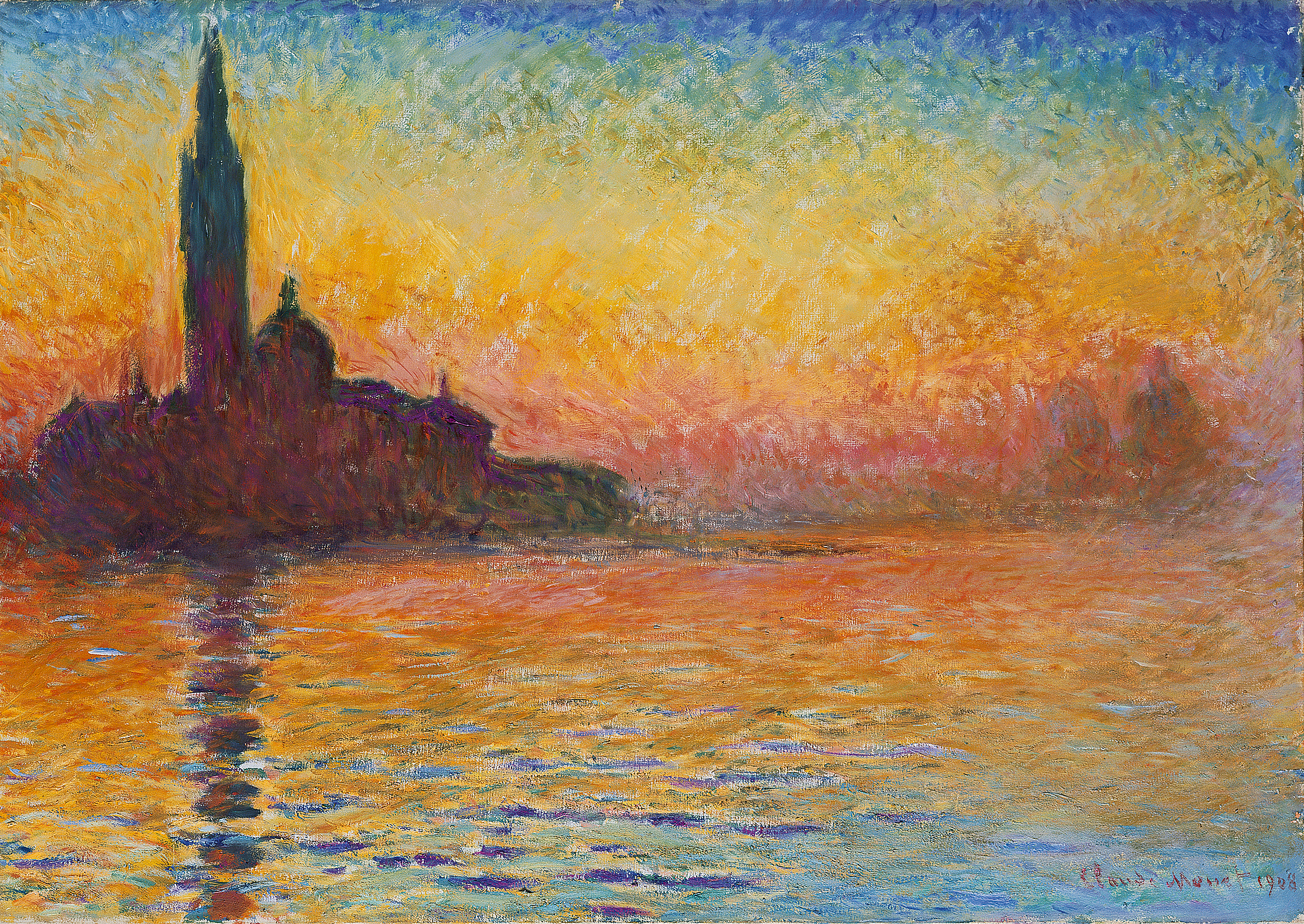
San Giorgio Maggiore at Dusk by Claude Monet
The curators then turn their attention to Monet’s own artistic evolution, offering deeper context through two key lenses.
First, they explore the artist’s lifelong relationship with water. Raised in the port city of Le Havre, Monet was naturally drawn to waterways—a motif that would define much of his career. The English Channel, the River Seine, and his beloved pond in Giverny all served as enduring sources of inspiration. This fascination was hardly unique among the Impressionists and their predecessors; artists such as Eugène Boudin, one of Monet’s earliest mentors, also made water a central subject in their work. Yet Monet pushed this exploration further than anyone before him. His obsession with capturing the shifting interplay between light and reflection led him to abandon traditional landscape conventions, creating compositions like his Water Lilies that omit the horizon line entirely, immersing viewers in pure atmosphere and surface.
The second focus of the exhibition examines Monet’s pioneering use of series. By this point in his career, he had completed several ambitious cycles, painting the same subject repeatedly under different weather and lighting conditions. While his Water Lilies remain the most celebrated, other notable series include his Haystacks, Rouen Cathedral, and Houses of Parliament. One of the London paintings from this last group is featured in the Monet and Venice exhibition, on loan from the Brooklyn Museum’s own collection.
Though this serial approach was groundbreaking, it eventually left Monet restless after decades of painting familiar motifs. His 1908 trip to Venice, however, reignited his creative spark. In many ways, it recalled his younger days, when he would outfit a small boat as a floating studio and paint scenes along the Seine in places like Argenteuil and Vétheuil. In Venice, surrounded by canals, gondolas, and centuries-old architecture, Monet rediscovered the joy of painting. As he later wrote to his dealer, the experience made him “see my canvases with a better eye.”
The curators at the Brooklyn Museum have done a remarkable job of providing such thorough context precisely because it reframes Monet—not as an isolated genius, but as an artist shaped by multiple artistic lineages and influences. This approach underscores how his Venetian paintings emerged not in a vacuum, but as the culmination of decades of experimentation and dialogue with the art of his predecessors and contemporaries.
After all this rich contextualization, the exhibition reaches its crescendo. The centerpiece is a grand oval room draped in deep blue velvet, where ten of Monet’s Venetian paintings are displayed together. While individual Monet works appear throughout the earlier galleries alongside those of other artists, this room is devoted entirely to the Impressionist master himself.
The paintings are grouped in trios, each depicting the same view—whether the Church of Santa Maria della Salute, the island of San Giorgio Maggiore, or the Palazzo Ducale, captured under varying conditions of light and atmosphere. Seen together, the subtle shifts in tone and color reveal Monet’s obsessive sensitivity to change and his ability to render the intangible passage of time. His loose, fluid brushstrokes lend the works an almost dreamlike quality—what the curators aptly describe as “ethereal.”
By omitting human figures, Monet directs attention entirely to the architecture and to Venice itself. The result is a vision of tranquility that echoes the city’s centuries-old nickname, La Serenissima—“the most serene.” His time in Venice not only revitalized his artistic spirit but also sustained his creativity for the final eighteen years of his life.
Monet & Venice is on view at the Brooklyn Museum through February 1, 2026.