
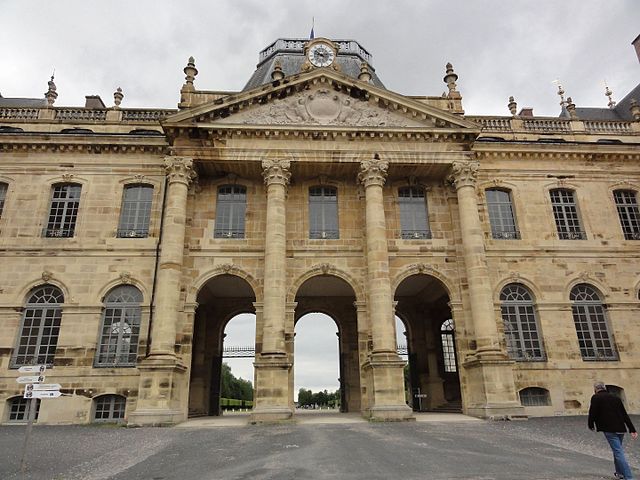
The Château de Lunéville, maintained by the Fondation du Patrimoine
France is considering the establishment of a new cultural organization, modeled after the National Trust in the United Kingdom.
The National Trust is technically a private entity but receives substantial support from the British government. The monarch is the organization’s patron, overseeing the preservation and conservation of historically and culturally significant land, structures, and other forms of tangible heritage. It is also well-funded, receiving over £720 million from 2023 to 2024 through donations, government grants, and millions of membership subscriptions. France is not lacking in cultural organizations, both private and governmental. But for a country that is as proud and protective of its national heritage as France, it may be surprising to some that they’re taking cues from the Brits.
The idea of forming a French equivalent of the National Trust was reportedly suggested by France’s Minister of Culture, Rachida Dati. It may not be very coincidental that such a suggestion would come after Emmanuel Macron’s state visit to the United Kingdom. During the president’s trip, British and French officials signed several cultural cooperation agreements. Not only will the countries’ respective cultural ministries work more closely despite Brexit, but the Centre des Monuments Nationaux has signed a declaration of intent to collaborate more closely with the National Trust, the National Trust for Scotland, and English Heritage. This would mainly be for “charitable and conservation principles” to promote best practice in several key areas such as “environmental and tourism sustainability practices in the interests of protecting the heritage, increasing its enjoyment and addressing the effects of the climate and biodiversity crises”.
Some are, however, rather confused about why Rachida Dati believes a French National Trust is necessary, since, from the perspective of many, France already has an organization like that. In 1996, Jacques Chirac’s government helped establish the Fondation du Patrimoine, an independent nonprofit organization that utilizes both public and private funds to protect French heritage. Although not as large and well-funded as its British counterpart, it nonetheless has a budget of over €100 million per year. However, it acts more as a custodian of historic sites rather than the outright owner of the properties like the National Trust in the United Kingdom. Furthermore, it has just under a hundred employees to oversee at least five hundred structures and other sites. They therefore rely heavily on volunteers. When speaking with the French newspaper Le Monde, the Fondation du Patrimoine’s president, Guillaume Poitrinal, responded to Dati’s proposal by saying, “The ‘French National Trust’ already exists, it’s us! The simplest way is to help us develop”.
The Fondation du Patrimoine mainly relies on volunteer work. Alexandre Giuglaris, the organization’s director, remarked that, previously, the volunteers were mostly retirees. “Today, they are much more qualified, skilled in specific aspects of protection.” However, this is not enough. Some have noted that France’s republican history may have influenced the way its people perceive their heritage sites. In Britain, common people are often eager to pitch in and help maintain a castle or an old country estate. Although they may not have noble blood or an aristocratic upbringing, they feel a stronger attachment to that world, as the monarchy remains a powerful institution in the country. France, on the other hand, made their feelings on monarchy well known when they cut off the head of Louis XVI. Julien Lacaze, director of the French organization Sites & Monuments, noted, “The state dreams of the English model where villagers act as guides and are proud of it. That’s not compatible in France.” This difference presents a challenge in maintaining French historic sites, which are significant generators of revenue through tourism. Perhaps a complete copy-and-paste method from the British model is not the most feasible approach. Instead, it may be better to ensure that existing cultural preservation groups have the necessary funding to hire more full-time employees to perform their duties more thoroughly and efficiently.