
On Saturday, July 5th, the Whitney Museum of American Art in New York unveiled its latest exhibition, Untitled (America). The show presents an opportunity for the museum to showcase many of its collection highlights, with a subtle goal of defining American art.
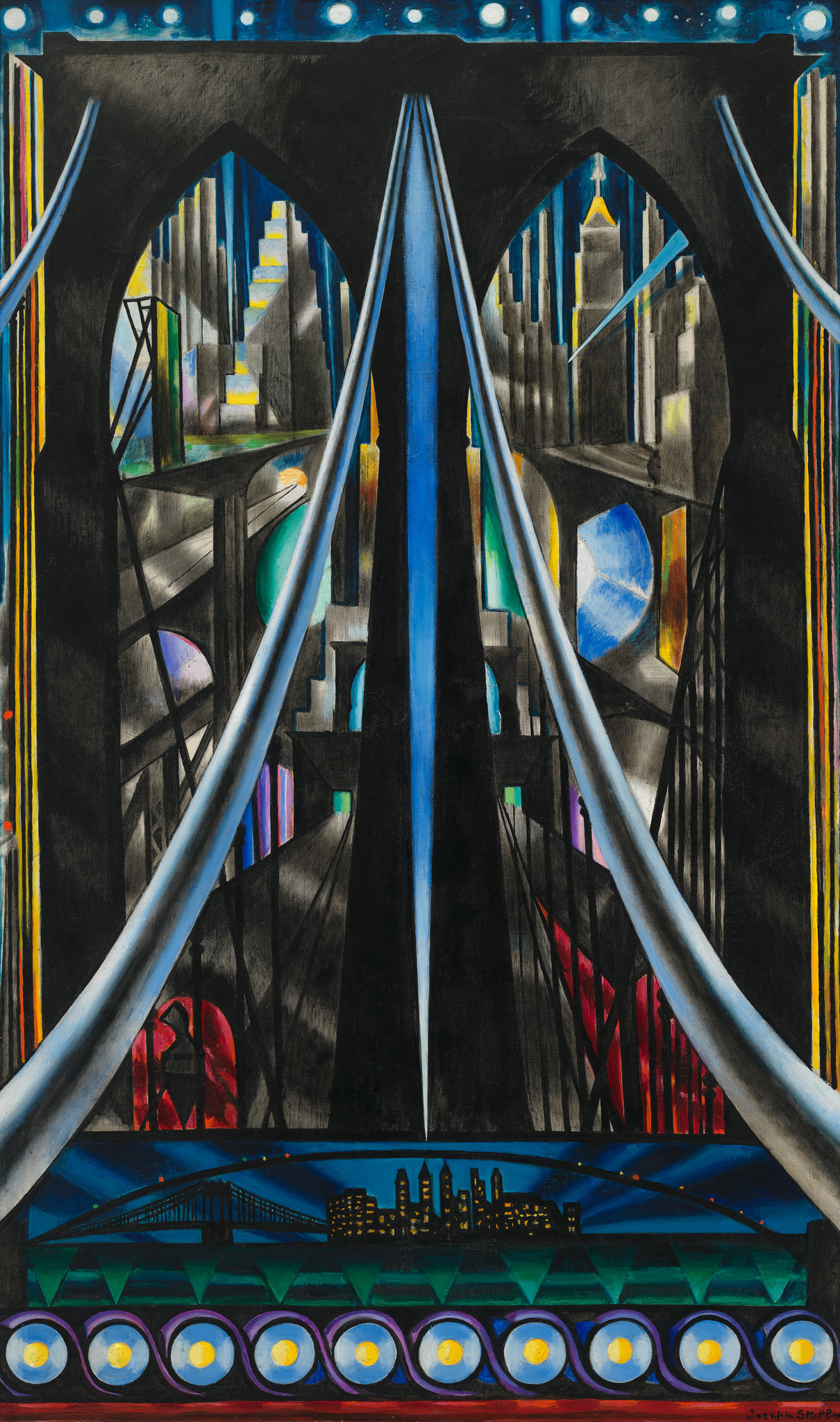
Brooklyn Bridge by Joseph Stella
Upon exiting the elevator onto the seventh floor, viewers are greeted by several iconic museum highlights, including Summer Days by Georgia O’Keeffe and Three Flags by Jasper Johns. They serve as a little appetizer for what’s to come. The Johns, of course, is an iconic rendering of an equally iconic American symbol, standing in for the exhibition’s subject. The O’Keeffe, however, represents one of the main topics the Whitney curators try to address: America as a physical place. Throughout her work, O’Keeffe made great use of the flora, fauna, and landscapes of the American Southwest. The United States and the continent of North America itself are so diverse in terms of climate and the ways humans choose to live alongside one another. City life formed a key part of the exhibition. Several paintings by Edward Hopper, such as Early Sunday Morning, as well as Brooklyn Bridge by Joseph Stella and Pittsburgh by Elsie Driggs, offer glimpses into quintessentially American urban life, from the smoke of industry to the bright lights of skyscrapers to dozens of businesses and storefronts lined up one by one down broad avenues. However, it is challenging to separate the physicality of the American experience from another key theme highlighted by the Whitney, namely Black American experience.
The culture and identity that developed among Black Americans is unique to this continent, incredibly distinct from the constellation of European national and ethnic traditions transplanted to the United States. Having suffered the loss of the indigenous African cultures of their forebears, Black Americans, both before and after emancipation, sought to create something of their own. They drew from bits and scraps of West African, Indigenous, and white British and Irish cultures and folkways, creating something truly and authentically American. For example, Archibald Motley’s Gettin’ Religion depicts a nighttime street on the South Side of Chicago, where people are dancing and celebrating to the sound of jazz played by a handful of instrumentalists. European instruments interpret echoes of African musical traditions filtered through spirituals and work songs. Jacob Lawrence’s War series was also present in the galleries, depicting the experiences of Black veterans during the Second World War in a way that evokes the aesthetics of African folk art. Of course, Jean-Michel Basquiat makes an appearance with his Hollywood Africans, a commentary on the limited and demeaning cultural depictions of Black Americans. And Barkley Hendricks’s life-size, full-length portrait Steve not only showcases contemporary Black fashion of the 1970s but also serves as a sort of predecessor to Black American realist painting now being pioneered by the portraitist Amy Sherald.

White Crush by Buck, exhibited at Rehs Contemporary’s Art of Subversion
Of course, it wouldn’t truly be an exhibition on American art without including twentieth-century consumerism and the subsequent genre of pop art. While Andy Warhol’s Campbell’s Soup Can series is probably the artist’s most iconic work, his Green Coca-Cola Bottles presented in the Whitney galleries is perhaps more representative of the consumer culture the exhibition curators sought to convey. Still Life with Crystal Bowl by Roy Lichtenstein and Large Trademark with Eight Spotlights by Ed Ruscha also serve as stand-ins for twentieth-century American mass culture transformed into an accepted form of high art. The distinction between fine art and decorative art often hinges on function. I mentioned this over a year ago when a museum in France proposed changing its name to better reflect that it also showcases decorative art, folk art, and archaeological artifacts. However, an object having a functional purpose does not necessarily deprive it of its aesthetic qualities that would make it the recipient of admiration in a gallery setting. We saw this firsthand during our own Art of Subversion exhibition last year, part of which included functional glass sculpture. Many of the pieces have a practical use, yet their aesthetic qualities are so evident that the craftsmanship and artistry can often overtake the practicality. That is the essence of pop art, and it has since become a cornerstone of modern American art.
The Whitney Museum is dedicated to American art and serves as a platform for contemporary artists. But aside from the nationality of one artist or another, what makes some art distinctly American? The title of Untitled (America) is borrowed from an installation work by Felix Gonzalez-Torres. Many visitors to the Whitney have probably seen and taken little to no notice of it. The work consists of twelve strings, each with forty-two lightbulbs. Part of the piece’s uniqueness lies in the fact that the artist left no instructions for curators, allowing it to be displayed in any manner that the exhibitors see fit. With even the slightest change, anyone who handles it creates a new version of the artwork. On my previous visits, Untitled (America) was hanging in the main museum stairwell. But for this exhibition, part of it was displayed by a window facing the Hudson River. A significant portion of the string was coiled up on the floor, light bulbs aglow like a luminescent bird’s nest. One of the installation’s meanings, which also lends itself to the entire exhibition, is that defining what is and is not American is so nebulous. There are as many interpretations of what is American as there are ways to hang a string of lights. Or, as the artist put it, America is “an unattainable dream”. And just from the museum highlights alone, the Whitney is able to create a cross-section of American art, focusing on a handful of key themes. But of course, the topics covered by Whitney curators barely scratch the surface of what it means to be American, whether it’s a person or a work of art.