
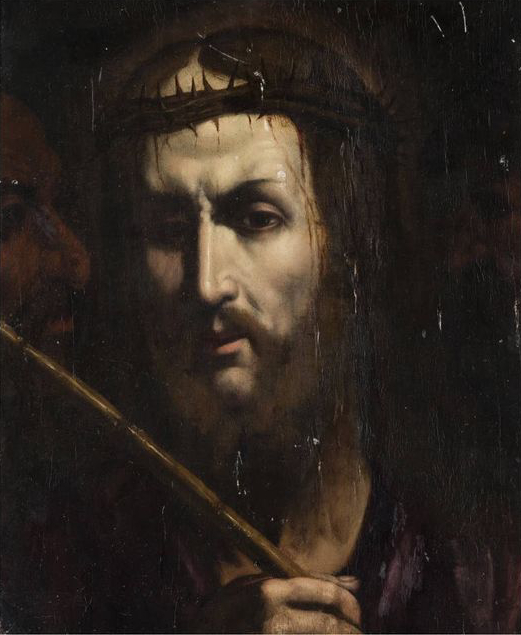
Ecce Homo, falsely attributed to Caravaggio
According to experts at Spain’s Prado Museum, an art dealer intentionally misattributed an allegedly rediscovered masterpiece by Caravaggio to scam a group of buyers.
In 2023, the Spanish art dealer Herennia Trillo sold a painting she claimed was a lost Caravaggio for €275K (or $297K). The Central Operational Unit’s Historic Heritage Section, under the purview of Spain’s Civil Guard, is now investigating Trillo, believing that she may have conspired to falsely attribute the work to Caravaggio and inflate the price. She is accused of enlisting several accomplices. They include Sara Muñoz, who allegedly pretended to be a Caravaggio expert employed by Florence’s Uffizi Gallery, and David Badía, a gallery owner in Madrid who is suspected of issuing false invoices to help hide the money Trillo received. Investigators also allege that Trillo pressured a group of buyers into acquiring the painting by falsely telling them that there were several other interested parties. She also said the painting had been part of an aristocratic Italian family collection. Only five Caravaggio paintings are known to exist in Spanish private collections and museums. The pressure to own the sixth may have been substantial even without Trillo’s prodding. After the buyers transferred the money, they insisted on hiring an independent specialist to examine the work. According to the Spanish publication El Confidencial, Trillo began backpedaling, saying that the Caravaggio attribution was not entirely conclusive. The buyers soon reported Trillo for potential fraud. With all this information having come to light, though, Trillo may also face charges of being involved in a criminal conspiracy.
In 2024, Spanish authorities confiscated the painting and turned it over to the Prado Museum for examination. When investigators raided Trillo’s home and located the work, she was in the process of fleeing with the painting to Switzerland. Investigators found that the painting last came up at auction in 2022, where it sold for just under €17K. The person who bought it was José Luis León Rodríguez, Sara Muñoz’s romantic partner who acted as the link between Muñoz and Trillo. At a court in Madrid, specialists from the Prado Museum testified that the painting was created sometime in the early seventeenth century and that the artist worked in the Italian Baroque tradition. However, the true artist’s identity is unknown, and, according to the experts, the painting is “not particularly refined workmanship”. University of Naples art historian Giuseppe Porzio also supports this conclusion, saying that the artist was more likely a follower or student of Caravaggio’s contemporary Annibale Carracci. Trillo has denied that she committed any wrongdoing.
This is not the first time in the past few years that Prado experts have been instrumental in deciding the authenticity of an alleged Caravaggio. Last year, the Spanish Cultural Ministry placed an export ban on an Ecce Homo painting suspected to be a lost work by the Italian Baroque master. It had been listed on an auction house website for €1,500 and attributed to the Spanish painter José de Ribera. Specialists from the Prado Museum, as well as art historians from Spain and Italy, confirmed this work’s authenticity as a Caravaggio, tracing it to the collection of Spain’s former prime minister Evaristo Pérez de Castro, whose descendants were the ones who consigned the work to the Ansorena auction house. Once they were informed of the painting’s true authorship, the Pérez de Castro family sold the work to an anonymous buyer, bringing it to the Colnaghi Gallery for authentication and restoration. They later loaned Ecce Homo to the Prado, where it has been on display since May 27, 2024.
Had the false Caravaggio been authentic, it may have been worth many millions. However, Prado specialists say that, at most, it is worth about €22K.