
Iris by Claude Monet
On Thursday, October 22nd, Sotheby’s Paris hosted a sale of spectacular nineteenth- and twentieth-century paintings and sculptures from the Schlumberger family collection.
The Schlumbergers amassed their fortune through mining and petroleum technologies. While brothers Marcel and Conrad Schlumberger may have started the family business, Marcel’s wife, Jeanne, was mainly responsible for the family’s art collection. Through her relationship with art dealer Katia Granoff, Jeanne Schlumberger and her family became among the most prominent collectors of Impressionist, Post-Impressionist, and other modernist works of art. The family became particularly well known for its collection of Claude Monet’s late-career works, created between 1914 and his death in 1926. For decades after the artist’s death, the Schlumberger family collection was the only place other than the Musée de l’Orangerie and the Galerie Katia Granoff where one could view large numbers of later Monet paintings. Furthermore, Jeanne Schlumberger very rarely loaned the family paintings for exhibitions, if at all. This means the collection’s contents have not been seen publicly for decades, and many works are in near-perfect condition given the minimal handling and transport they have experienced.
The expected star of the evening was one such late-period Monet. The artist created Iris in the last years of his life, around 1924 or 1925. Before selling it to the Schlumbergers, Katia Granoff acquired the painting directly from Michel Monet, the artist’s son. Despite the water lily being practically synonymous with Monet and his paintings, the Impressionist master was equally fond of irises. His stepson Jean-Pierre Hoschedé wrote that the flower beds in Monet’s garden at Giverny were all lined with irises. What makes the work offered at Sotheby’s so different from some other works featuring this flower is that Monet completely abandoned any sense of perspective or depth. There is no background or foreground, no horizon line, just the flowers. The viewer does not know where the sky ends and its reflection in the pond begins.
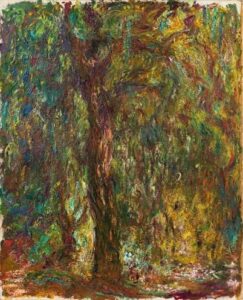
Saule pleureur, or L’Arbre de feu by Claude Monet
By the end of his life, Monet had became obsessed with reducing his work to the purest essence of light and color, leading him to forgo traditional landscape conventions and omit the horizon line entirely, immersing viewers in pure atmosphere. The French critic Claude Roger Marx commented in 1909 that Monet wanted to “abolish the terrestrial setting that once closed off the horizon”. Iris is one of the largest of Monet’s late-career works still in private hands, and is arguably the best. Sotheby’s specialists expected Iris to sell for at least €22 million. While this would be a record-setting achievement for most artists at auction, Monet’s paintings have continued to achieve higher and higher prices. Six of the top ten most expensive Monet paintings sold at auction have crossed the block in the last five years. While Iris did not make the top ten on Thursday, it set a record of another kind. Bidding went on for a staggering forty-two minutes, with the hammer finally coming down at €43 million (or €50 million / $56.1 million w/p). This made Iris the most expensive work of art ever sold in France.
Four of the evening’s twenty-three lots were paintings by Claude Monet. One came from his series of paintings of the willow tree on his property. Monet created around twenty paintings of his willow tree between 1918 and 1919. In many of his water lily paintings, the tree is relegated to the background, or appears only in the pond’s reflection. The work offered at Sotheby’s, Saule pleureur, is one of the few times the artist used the willow as a painting’s sole subject. The warm autumnal shades of brown, red, and yellow that accent the work, particularly on its right side, give the painting its alternate title, L’Arbre de feu, or Tree of Fire. The willow occupies the entire canvas, which Sotheby’s specialists call “compactly scaled”. The painting shows how later generations of artists, particularly the Abstract Expressionists, drew on Monet’s later-life paintings despite their critical failings in the early twentieth century. However, Saule pleureur proved slightly less popular with buyers than anticipated on Thursday evening, achieving €7.9 million (or €9.68 million / $10.85 million w/p), slightly under its €9 million low estimate.
Finally, one of the evening’s few surprises took third place. Pierre Bonnard created the painting La cueillette des prunes around 1899. According to the artist’s catalogue raisonné compiled by Jean and Henry Dauberville, the painting is likely the central panel of a planned triptych. The two other panels likely meant to accompany this work are Enfants jouant avec une chèvre and La Cueillette des pommes, both kept at the Pola Museum of Art in Kanagawa Prefecture, Japan. The painting fits Bonnard’s tendency to feature gardens in his work. Sotheby’s specialists comment that the artist used gardens not only as a subject but as “a realm of memory as much as a pictorial laboratory in which light and colour undergo constant transformations.” Sotheby’s expected the work to sell for no more than €800K. However, strong interest in the painting prolonged bidding for over six minutes, pushing the price to more than double the high estimate. Eventually, auctioneer Aurélie Vandevoorde closed the lot at €1.95 million (or €2.48 million / $2.77 million w/p).

La cueillette des prunes by Pierre Bonnard
Usually, in single-collector blockbuster sales, very few lots achieve more than double their high estimates. However, with the Schlumberger collection, a small handful did just this. Apart from the Bonnard, the auction also included four works by the Post-Impressionist painter Pierre Laprade. All four were expected to sell for no more than €1,500 each. All of them sold for nearly triple that amount or more, with the biggest surprise being the final lot, a simple floral still life, which sold for €18K (or €23K / $25.8K w/p), or twelve times its high estimate.
Overall, the sale was a smashing success. Of the twenty-three available lots, seven sold within their estimates, giving Sotheby’s Paris a 30% accuracy rate. Only three lots (13%) sold below estimate, while an impressive thirteen lots (57%) sold above. Against a total pre-sale estimate range of €37.85 million and €51.9 million, the Schlumberger collection brought in €62.5 million. Of course, 68.8% of this came from Monet’s Iris. However, even if the painting had sold for just its €30 million high estimate, the sale would still have been a great success.

The Schlumberger Collection at Sotheby’s Paris
Iris by Claude Monet
On Thursday, October 22nd, Sotheby’s Paris hosted a sale of spectacular nineteenth- and twentieth-century paintings and sculptures from the Schlumberger family collection.
The Schlumbergers amassed their fortune through mining and petroleum technologies. While brothers Marcel and Conrad Schlumberger may have started the family business, Marcel’s wife, Jeanne, was mainly responsible for the family’s art collection. Through her relationship with art dealer Katia Granoff, Jeanne Schlumberger and her family became among the most prominent collectors of Impressionist, Post-Impressionist, and other modernist works of art. The family became particularly well known for its collection of Claude Monet’s late-career works, created between 1914 and his death in 1926. For decades after the artist’s death, the Schlumberger family collection was the only place other than the Musée de l’Orangerie and the Galerie Katia Granoff where one could view large numbers of later Monet paintings. Furthermore, Jeanne Schlumberger very rarely loaned the family paintings for exhibitions, if at all. This means the collection’s contents have not been seen publicly for decades, and many works are in near-perfect condition given the minimal handling and transport they have experienced.
The expected star of the evening was one such late-period Monet. The artist created Iris in the last years of his life, around 1924 or 1925. Before selling it to the Schlumbergers, Katia Granoff acquired the painting directly from Michel Monet, the artist’s son. Despite the water lily being practically synonymous with Monet and his paintings, the Impressionist master was equally fond of irises. His stepson Jean-Pierre Hoschedé wrote that the flower beds in Monet’s garden at Giverny were all lined with irises. What makes the work offered at Sotheby’s so different from some other works featuring this flower is that Monet completely abandoned any sense of perspective or depth. There is no background or foreground, no horizon line, just the flowers. The viewer does not know where the sky ends and its reflection in the pond begins.
Saule pleureur, or L’Arbre de feu by Claude Monet
By the end of his life, Monet had became obsessed with reducing his work to the purest essence of light and color, leading him to forgo traditional landscape conventions and omit the horizon line entirely, immersing viewers in pure atmosphere. The French critic Claude Roger Marx commented in 1909 that Monet wanted to “abolish the terrestrial setting that once closed off the horizon”. Iris is one of the largest of Monet’s late-career works still in private hands, and is arguably the best. Sotheby’s specialists expected Iris to sell for at least €22 million. While this would be a record-setting achievement for most artists at auction, Monet’s paintings have continued to achieve higher and higher prices. Six of the top ten most expensive Monet paintings sold at auction have crossed the block in the last five years. While Iris did not make the top ten on Thursday, it set a record of another kind. Bidding went on for a staggering forty-two minutes, with the hammer finally coming down at €43 million (or €50 million / $56.1 million w/p). This made Iris the most expensive work of art ever sold in France.
Four of the evening’s twenty-three lots were paintings by Claude Monet. One came from his series of paintings of the willow tree on his property. Monet created around twenty paintings of his willow tree between 1918 and 1919. In many of his water lily paintings, the tree is relegated to the background, or appears only in the pond’s reflection. The work offered at Sotheby’s, Saule pleureur, is one of the few times the artist used the willow as a painting’s sole subject. The warm autumnal shades of brown, red, and yellow that accent the work, particularly on its right side, give the painting its alternate title, L’Arbre de feu, or Tree of Fire. The willow occupies the entire canvas, which Sotheby’s specialists call “compactly scaled”. The painting shows how later generations of artists, particularly the Abstract Expressionists, drew on Monet’s later-life paintings despite their critical failings in the early twentieth century. However, Saule pleureur proved slightly less popular with buyers than anticipated on Thursday evening, achieving €7.9 million (or €9.68 million / $10.85 million w/p), slightly under its €9 million low estimate.
Finally, one of the evening’s few surprises took third place. Pierre Bonnard created the painting La cueillette des prunes around 1899. According to the artist’s catalogue raisonné compiled by Jean and Henry Dauberville, the painting is likely the central panel of a planned triptych. The two other panels likely meant to accompany this work are Enfants jouant avec une chèvre and La Cueillette des pommes, both kept at the Pola Museum of Art in Kanagawa Prefecture, Japan. The painting fits Bonnard’s tendency to feature gardens in his work. Sotheby’s specialists comment that the artist used gardens not only as a subject but as “a realm of memory as much as a pictorial laboratory in which light and colour undergo constant transformations.” Sotheby’s expected the work to sell for no more than €800K. However, strong interest in the painting prolonged bidding for over six minutes, pushing the price to more than double the high estimate. Eventually, auctioneer Aurélie Vandevoorde closed the lot at €1.95 million (or €2.48 million / $2.77 million w/p).
La cueillette des prunes by Pierre Bonnard
Usually, in single-collector blockbuster sales, very few lots achieve more than double their high estimates. However, with the Schlumberger collection, a small handful did just this. Apart from the Bonnard, the auction also included four works by the Post-Impressionist painter Pierre Laprade. All four were expected to sell for no more than €1,500 each. All of them sold for nearly triple that amount or more, with the biggest surprise being the final lot, a simple floral still life, which sold for €18K (or €23K / $25.8K w/p), or twelve times its high estimate.
Overall, the sale was a smashing success. Of the twenty-three available lots, seven sold within their estimates, giving Sotheby’s Paris a 30% accuracy rate. Only three lots (13%) sold below estimate, while an impressive thirteen lots (57%) sold above. Against a total pre-sale estimate range of €37.85 million and €51.9 million, the Schlumberger collection brought in €62.5 million. Of course, 68.8% of this came from Monet’s Iris. However, even if the painting had sold for just its €30 million high estimate, the sale would still have been a great success.