
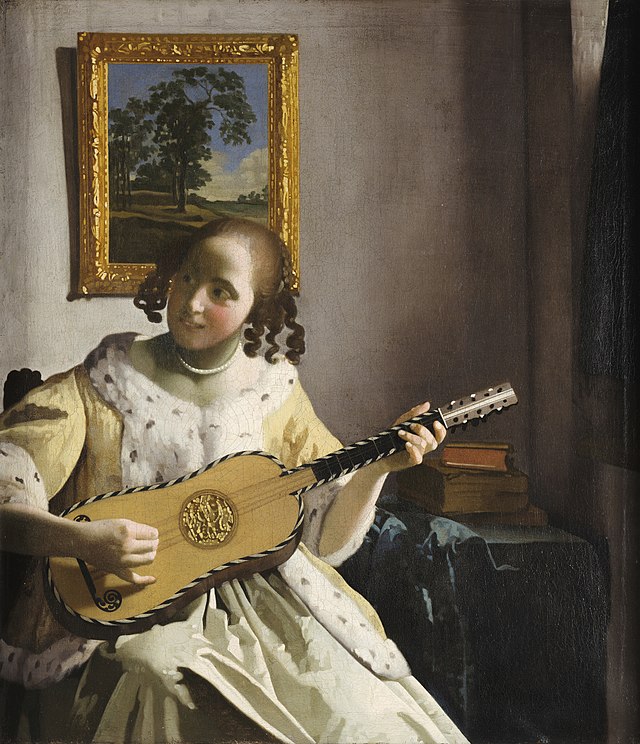
The Guitar Player by Johannes Vermeer (Kenwood Version)
A new exhibition in London seeks to reopen the debate regarding two nearly identical paintings, one by Johannes Vermeer and the other allegedly a copy. But some claim that the alleged copy is, in fact, an original Vermeer.
London’s Kenwood House is a museum and former stately home that now serves as an exhibition space. Previously, they hosted a show centering on the paintings of John Singer Sargent and his portraits of American Dollar Princesses. And now, from September 1st to January 11th, it will host Double Vision, a new exhibition focusing on Vermeer’s 1672 painting The Guitar Player and its mysterious twin. It is the first time that the two paintings are being displayed side-by-side. The supposed original is part of Kenwood House’s collection, while the Philadelphia Museum of Art owns the copy. The debate surrounding the Philadelphia version’s authorship was reignited in 2023 when Rijksmuseum specialist Arie Wallert claimed that the Philadelphia painting is likely an original work by the artist. His evidence includes a specific pigment used in the painting, lead-tin yellow, which would have fallen out of use among Western European artists at the beginning of the eighteenth century. The main reason many consider the Kenwood painting to be the original is its relatively good condition upon its rediscovery in 1927.
There are two primary differences between the paintings: first, the Kenwood version is signed, while the Philadelphia version is not. Second is the subject’s hair, with the Kenwood painting having it styled into ringlets, while the Philadelphia version has her hair worn up in a sort of crown braid. Specialists from the Philadelphia Museum of Art, Washington DC’s National Gallery of Art, and Kenwood House have not released a final report yet, but they have some preliminary findings. The Kenwood version, for example, was prepared using a light greyish brown made from a combination of white lead, chalk, and earth-tone pigments. The Philadelphia version, meanwhile, uses a darker brown, mainly made from burnt umber. The Philadelphia painting also uses indigo, which was much cheaper than Vermeer’s preferred blue pigment, ultramarine. Former Rijksmuseum fine arts director Gregor Weber has also weighed in, examining the hairstyle of the paintings’ respective subjects. While some speculate that both paintings are by Vermeer, Weber insists that the hairstyle of the Philadelphia version indicates that it is a copy, albeit a very early copy. The hair has been changed to modernize the painting’s appearance, since the Philadelphia version shows the woman “a style starting around 1680 as can be seen in several portraits of fashionable women by Jan Verkolje in Delft, Nicolaes Maes in Amsterdam and others.”
Wendy Monkhouse, the senior curator at Kenwood House, describes the new exhibition as “a rather beautiful confusion” for visitors. The show not only presents the expert analysis of the two paintings but also encourages each visitor to draw their own conclusions. The public’s involvement in not just art’s appreciation but its study and scholarship is the central idea behind the exhibition’s layout. The final report on the expert analysis is due to be released in the next few months, adding to the anticipation and excitement.