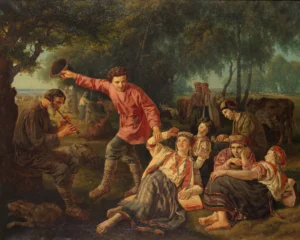
A Summer Pastoral, attributed to Vladimir Sherwood
The fine art market took a bit of a break in August, with many of the main auction houses using that time to focus on sales of luxury goods such as cars, sports memorabilia, watches, jewelry, and other items. However, the market for paintings has started back up again with Bonhams British & European Art sale at their Knightsbridge location in London. One hundred twenty-three lots were available on Wednesday, September 17th, and did rather well. The works ranged from watercolors of birds by Archibald Thorburn, scenes of Venetian canals by Antoine Bouvard, and British landscapes by Percy and Leader. However, there were several surprises on Wednesday that ended up becoming the sale’s top lots. First was an oil painting attributed to the nineteenth-century Russian master Vladimir Sherwood (sometimes spelt Shervud).

Garrison Church, Potsdam by Lotte Laserstein
Though primarily known as a Russian revival architect who designed the State Historical Museum on Red Square in Moscow, Sherwood was also an accomplished painter. The painting offered at Bonhams, A Summer Pastoral, cannot be positively attributed to the artist with complete assurance. Still, his name can be seen as if it is carved into the stump of a tree on the left-hand side, accompanied by the date 1868 as well as the name of Moscow, all in Latin letters rather than Cyrillic. As the grandson of English immigrants to the Russian Empire, he likely would have been educated in both English and Russian. The painting shows a group of young people in traditional Eastern European peasant dress. An older man on the left-hand side sits on the aforementioned stump playing a vertical flute, with a young man inviting one of the girls to dance to the music being played. There are other figures in the background, both human and bovine. Many cows populate the painting, indicating that the group of figures is part of a Russian cattle farming community. With the rise of modern nationalism in the nineteenth century, local peasant customs became a source in forming broader national traditions like clothing, food, dance, and other forms of cultural expression. The Sherwood was only estimated to sell for no more than £2K, and it isn’t difficult to see why. Even without zooming in on the images Bonhams provided, you can see extensive craquelure and pigment separation throughout. The painting requires extensive restoration before any buyer can resell it. However, A Summer Pastoral attracted far more attention than anyone would have anticipated. Bids came pouring in, elevating the hammer price past the high estimate, past £10K, past £20K, finally landing at £42K / $57.3K (or £53.7K / $73.3K w/p). This put the hammer price at twenty-one times over the high estimate, making it the most expensive work by the artist ever sold at auction on record, beating out an oil painting attributed to the artist that sold at Dorotheum in 2019 for €37.8K w/p against an €8K high estimate.
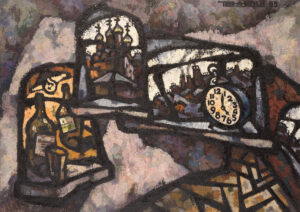
Four Windows and an Alarm Clock by Oscar Rabin
Next up were two works that each sold for the same amount. Garrison Church, Potsdam is an ink drawing by the German artist Lotte Laserstein, who mainly gained prominence during the inter-war period in Germany. While the drawing is undated, it likely dates to Laserstein’s time in Germany before she escaped to Sweden in 1937 due to increasing Nazi oppression. Furthermore, the church itself was demolished by East German authorities in 1968. It would not be until 2017 that work would begin to rebuild the church. Construction is scheduled to be completed by 2027. Like the Sherwood, the Laserstein drawing was not expected to make much, with Bonham’s specialist assigning it an £800 to £1.2K estimate range. In terms of exceeding expectations, the Laserstein actually outperformed the Sherwood, eventually selling for £28K / $38.2K (or £35.8K / $48.9K w/p), or 23.3 times the high estimate. A different lot, a painting by Oscar Rabin, achieved the same hammer price. However, this was less surprising than the Laserstein since it fell within its pre-sale estimate range. Four Windows and an Alarm Clock has been in the same private collection since leaving the artist’s studio in 1965. Rabin, being one of the preeminent artists of the Soviet nonconformist movement, focused mainly on Soviet material life. Bonhams specialists predicted it would sell for between £28K and £30K. The Rabin ended up squarely on the low estimate.
The Sherwood and the Laserstein were by far the biggest surprises of the sale, but they were not the only ones. Nine lots sold for more than double their estimates, including A Caravan in the Desert by Robert George Talbot Kelly (est. £700 to £1K; £3.4K hammer) and Westminster Abbey by George Hyde-Pownall (est. £2K to £3K; £9.5K hammer). Overall, the sale didn’t do too badly, with thirty-six of the one hundred twenty-three lots selling within their estimates, giving Bonhams a 29% accuracy rate. Fourteen lots (11%) sold below, while thirty-four lots (28%) sold above. This leaves thirty-nine lots unsold, giving Bonhams a 68% sell-through rate. Adding everything up, the lots that sold brought in £412.7K / $563K against a total low estimate of £330K. Even if the Sherwood and the Laserstein only reached their high estimates, the sale would have still reached that number.

Bonhams British & European Art
A Summer Pastoral, attributed to Vladimir Sherwood
The fine art market took a bit of a break in August, with many of the main auction houses using that time to focus on sales of luxury goods such as cars, sports memorabilia, watches, jewelry, and other items. However, the market for paintings has started back up again with Bonhams British & European Art sale at their Knightsbridge location in London. One hundred twenty-three lots were available on Wednesday, September 17th, and did rather well. The works ranged from watercolors of birds by Archibald Thorburn, scenes of Venetian canals by Antoine Bouvard, and British landscapes by Percy and Leader. However, there were several surprises on Wednesday that ended up becoming the sale’s top lots. First was an oil painting attributed to the nineteenth-century Russian master Vladimir Sherwood (sometimes spelt Shervud).
Garrison Church, Potsdam by Lotte Laserstein
Though primarily known as a Russian revival architect who designed the State Historical Museum on Red Square in Moscow, Sherwood was also an accomplished painter. The painting offered at Bonhams, A Summer Pastoral, cannot be positively attributed to the artist with complete assurance. Still, his name can be seen as if it is carved into the stump of a tree on the left-hand side, accompanied by the date 1868 as well as the name of Moscow, all in Latin letters rather than Cyrillic. As the grandson of English immigrants to the Russian Empire, he likely would have been educated in both English and Russian. The painting shows a group of young people in traditional Eastern European peasant dress. An older man on the left-hand side sits on the aforementioned stump playing a vertical flute, with a young man inviting one of the girls to dance to the music being played. There are other figures in the background, both human and bovine. Many cows populate the painting, indicating that the group of figures is part of a Russian cattle farming community. With the rise of modern nationalism in the nineteenth century, local peasant customs became a source in forming broader national traditions like clothing, food, dance, and other forms of cultural expression. The Sherwood was only estimated to sell for no more than £2K, and it isn’t difficult to see why. Even without zooming in on the images Bonhams provided, you can see extensive craquelure and pigment separation throughout. The painting requires extensive restoration before any buyer can resell it. However, A Summer Pastoral attracted far more attention than anyone would have anticipated. Bids came pouring in, elevating the hammer price past the high estimate, past £10K, past £20K, finally landing at £42K / $57.3K (or £53.7K / $73.3K w/p). This put the hammer price at twenty-one times over the high estimate, making it the most expensive work by the artist ever sold at auction on record, beating out an oil painting attributed to the artist that sold at Dorotheum in 2019 for €37.8K w/p against an €8K high estimate.
Four Windows and an Alarm Clock by Oscar Rabin
Next up were two works that each sold for the same amount. Garrison Church, Potsdam is an ink drawing by the German artist Lotte Laserstein, who mainly gained prominence during the inter-war period in Germany. While the drawing is undated, it likely dates to Laserstein’s time in Germany before she escaped to Sweden in 1937 due to increasing Nazi oppression. Furthermore, the church itself was demolished by East German authorities in 1968. It would not be until 2017 that work would begin to rebuild the church. Construction is scheduled to be completed by 2027. Like the Sherwood, the Laserstein drawing was not expected to make much, with Bonham’s specialist assigning it an £800 to £1.2K estimate range. In terms of exceeding expectations, the Laserstein actually outperformed the Sherwood, eventually selling for £28K / $38.2K (or £35.8K / $48.9K w/p), or 23.3 times the high estimate. A different lot, a painting by Oscar Rabin, achieved the same hammer price. However, this was less surprising than the Laserstein since it fell within its pre-sale estimate range. Four Windows and an Alarm Clock has been in the same private collection since leaving the artist’s studio in 1965. Rabin, being one of the preeminent artists of the Soviet nonconformist movement, focused mainly on Soviet material life. Bonhams specialists predicted it would sell for between £28K and £30K. The Rabin ended up squarely on the low estimate.
The Sherwood and the Laserstein were by far the biggest surprises of the sale, but they were not the only ones. Nine lots sold for more than double their estimates, including A Caravan in the Desert by Robert George Talbot Kelly (est. £700 to £1K; £3.4K hammer) and Westminster Abbey by George Hyde-Pownall (est. £2K to £3K; £9.5K hammer). Overall, the sale didn’t do too badly, with thirty-six of the one hundred twenty-three lots selling within their estimates, giving Bonhams a 29% accuracy rate. Fourteen lots (11%) sold below, while thirty-four lots (28%) sold above. This leaves thirty-nine lots unsold, giving Bonhams a 68% sell-through rate. Adding everything up, the lots that sold brought in £412.7K / $563K against a total low estimate of £330K. Even if the Sherwood and the Laserstein only reached their high estimates, the sale would have still reached that number.