
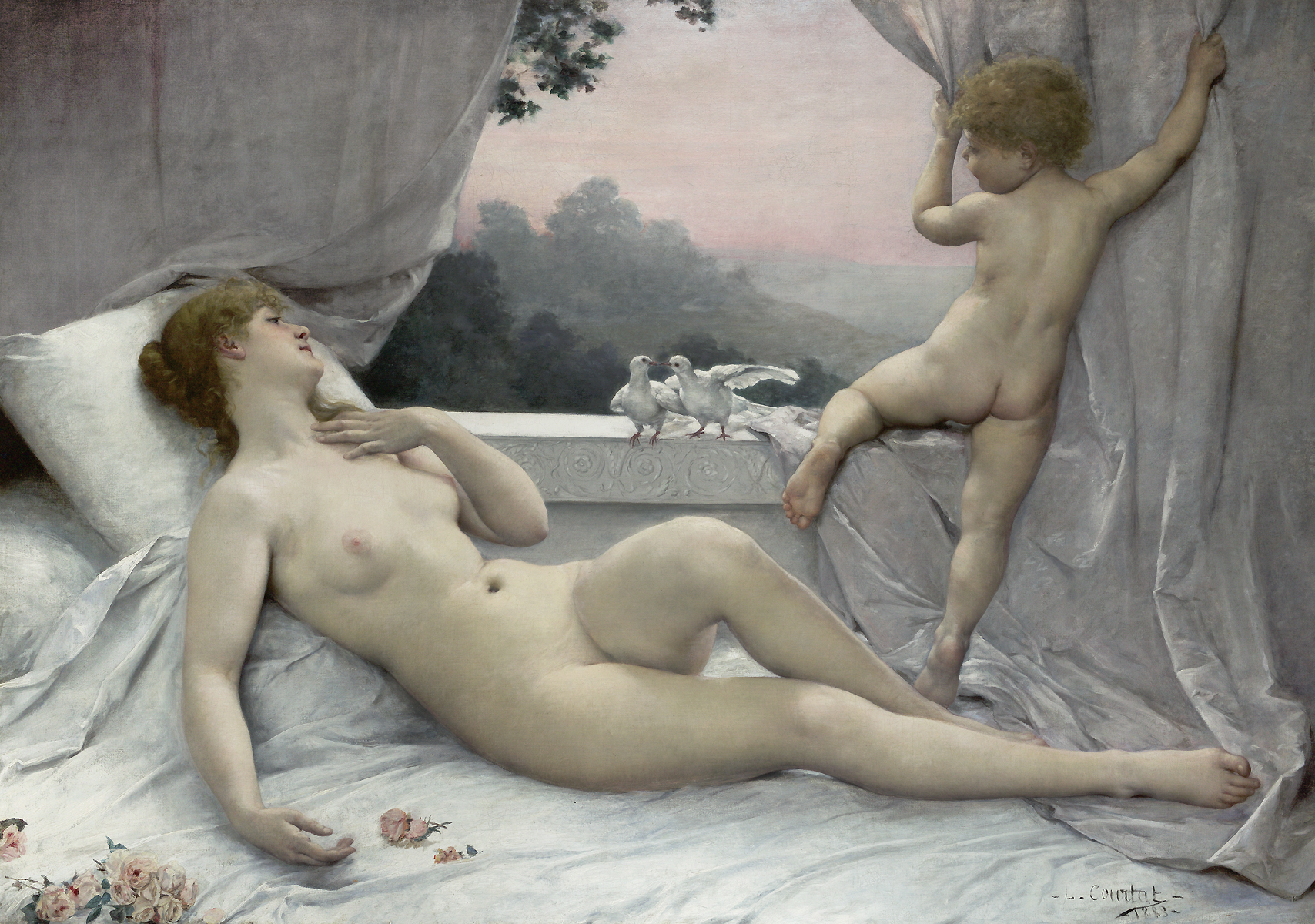
Le Réveil de Vénus by Louis Courtat
Louis Courtat’s painting Le Réveil de Vénus (The Awakening of Venus) is a nineteenth-century rendition of a classical subject, incorporating stylistic motifs from eighteenth-century Rococo and Neoclassical painting. Much of Courtat’s work is a continuation of the artistic lineage established by his academic predecessors, such as Alexandre Cabanel. He was also a great admirer of Jean-Auguste-Dominique Ingres, the leading neoclassical master of the early nineteenth century. Courtat became known for his mythological subjects and female nudes, often combining the two genres, as seen in Le Réveil de Vénus. His first recognition at the Salon, a decade before creating Le Réveil de Vénus, was a painting of the popular mythological subject Leda and the Swan. The subject of the sleeping Venus had been used in Western painting prior to Courtat’s rendition, with other artists, such as Charles-Joseph Natoire, Jean-Honoré Fragonard, Simon Vouet, and François Boucher, known for their own respective versions.
Here, Courtat depicts the goddess Venus, representing love itself, reclining on a bed as she awakens from a peaceful slumber. The scene is tranquil, with a nude cherub gently drawing back a curtain to reveal a serene landscape in the background. It is misty outside, but the outlines of trees and hills are detectable. A thin band of rosy light appears, indicating the coming of morning. Meanwhile, a pair of doves is perched on the window’s ledge, indicating not only peace and renewal but love and partnership. The presence of the doves, symbolizing fidelity, counters any potential erotic overtones, ensuring that the nude Venus is purely an allegorical or symbolic figure. The doves, therefore, serve a similar purpose as the small dog in Titian’s Venus of Urbino, symbolizing fidelity rather than any carnal desires. Courtat seamlessly combines the imagery of nascent love and new beginnings with his mastery of figure painting in the academic style. While some of his contemporaries experimented with more realistic nudes using modern subjects, Courtat’s work continued a tradition of elegance and precision that still captivates viewers today.