
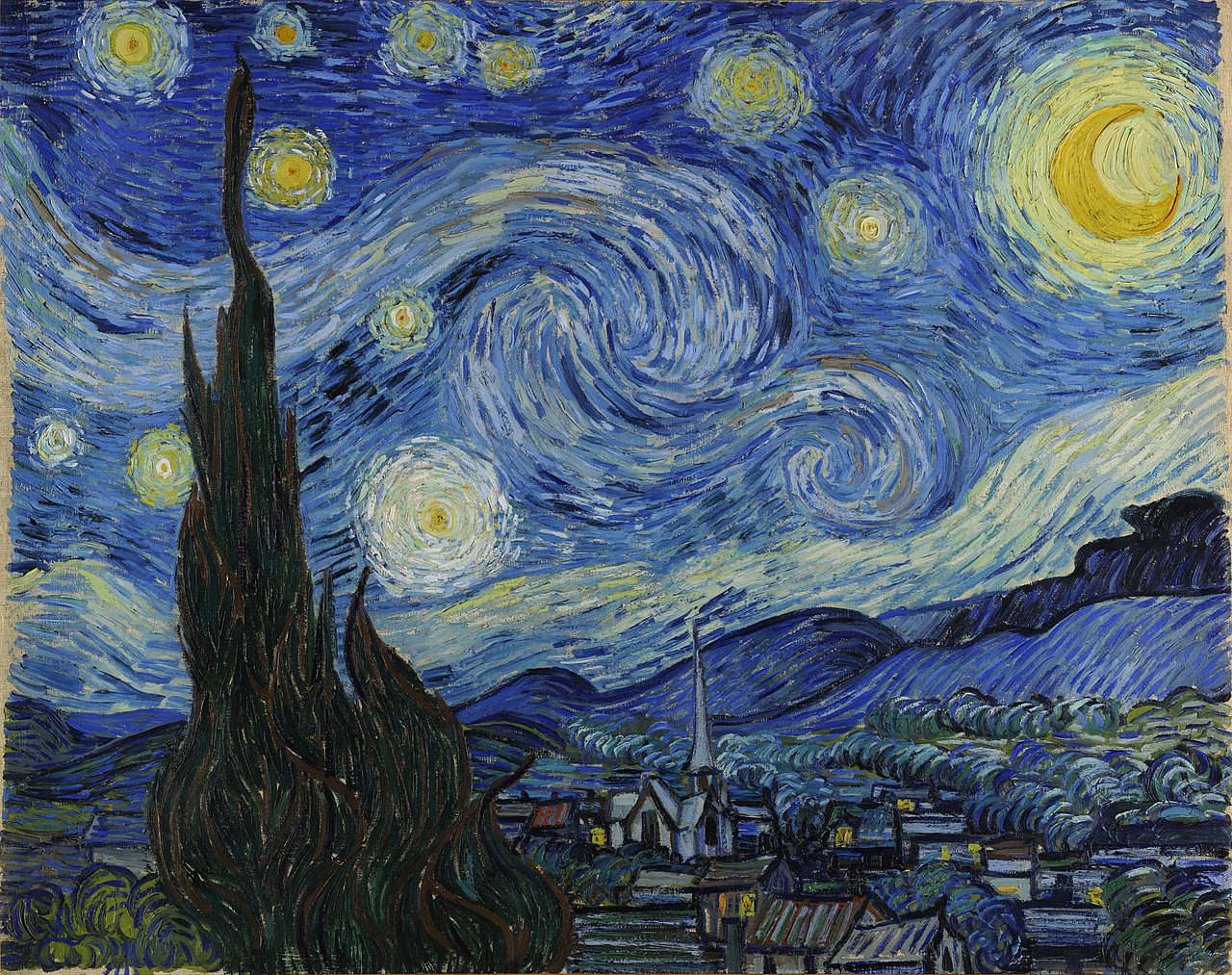
Starry Night by Vincent van Gogh
A research team claims to have pinpointed the exact day Vincent van Gogh conceived his Starry Night.
Art historians generally agree that Van Gogh painted Starry Night sometime in June 1889. This is shortly after the artist checked himself into a mental asylum in Saint-Rémy-de-Provence. However, the placement of the stars and the shape of the moon in the painting have long troubled those who try to date the painting more precisely. At no point in June 1889 did the night sky look like what Van Gogh depicts. But now, a research team based in South Korea, a collaboration between the telescope manufacturer SLAAB and Kyung Hee University’s School of Space Research, believes it has narrowed down a specific date.
Three components have allowed the research team to date Starry Night with some accuracy. First, the moon appears as a waning crescent. Secondly, observers note that Van Gogh also included the planet Venus in the night sky, depicting it like a bright white star right next to the cypress tree in the foreground. Third, the Hyades, a V-shaped star cluster in the constellation Taurus. At no point in June 1889 did all three of these components appear in the sky in a configuration resembling the one in the painting.
Before the issue of determining the date of Starry Night can be addressed, there is the important question of whether or not the painting is meant to depict the actual night sky. Some scholars suggest that the work is more or less a fantasy imbued with symbolism or religious meaning. The researchers call this “the imaginative reading”. However, they claim that Van Gogh meant to depict the real sky, an interpretation their report calls “the observational reading”. They remark that, previously, those who reject the observational reading have done so due to “the failure to integrate the painter’s actual field of view, the shape of the central asterism, and the letters and weather records into a single set of physical constraints.” They therefore posit that if the composition of the work can be matched to the sky of a specific day, the burden of proof would be shifted onto the imaginative reading’s advocates.
Before blindly applying their calculations to Starry Night, the team tested their analysis on several other paintings with more documentation to verify their dates of creation. They did this with the 1850 painting Starry Night by Jean-François Millet, as well as two other nighttime paintings by Van Gogh: Starry Night Over the Rhône and Café Terrace at Night. In all three, the team could specify the day, or range of days, the paintings likely represent. Before applying this analysis to Starry Night, the researchers first eliminated a range of dates because the moon appears higher in the sky than Venus. The only possible dates when that occurred in Van Gogh’s field of vision were June 23rd and between July 22nd and 23rd. However, only on July 22nd is the Hyades cluster also visible.


José Luis Aragón, a physics professor at the National Autonomous University of Mexico, commented that the new report is “a careful and genuinely interdisciplinary study” that poses “an intriguing hypothesis rather than a settled answer”.