
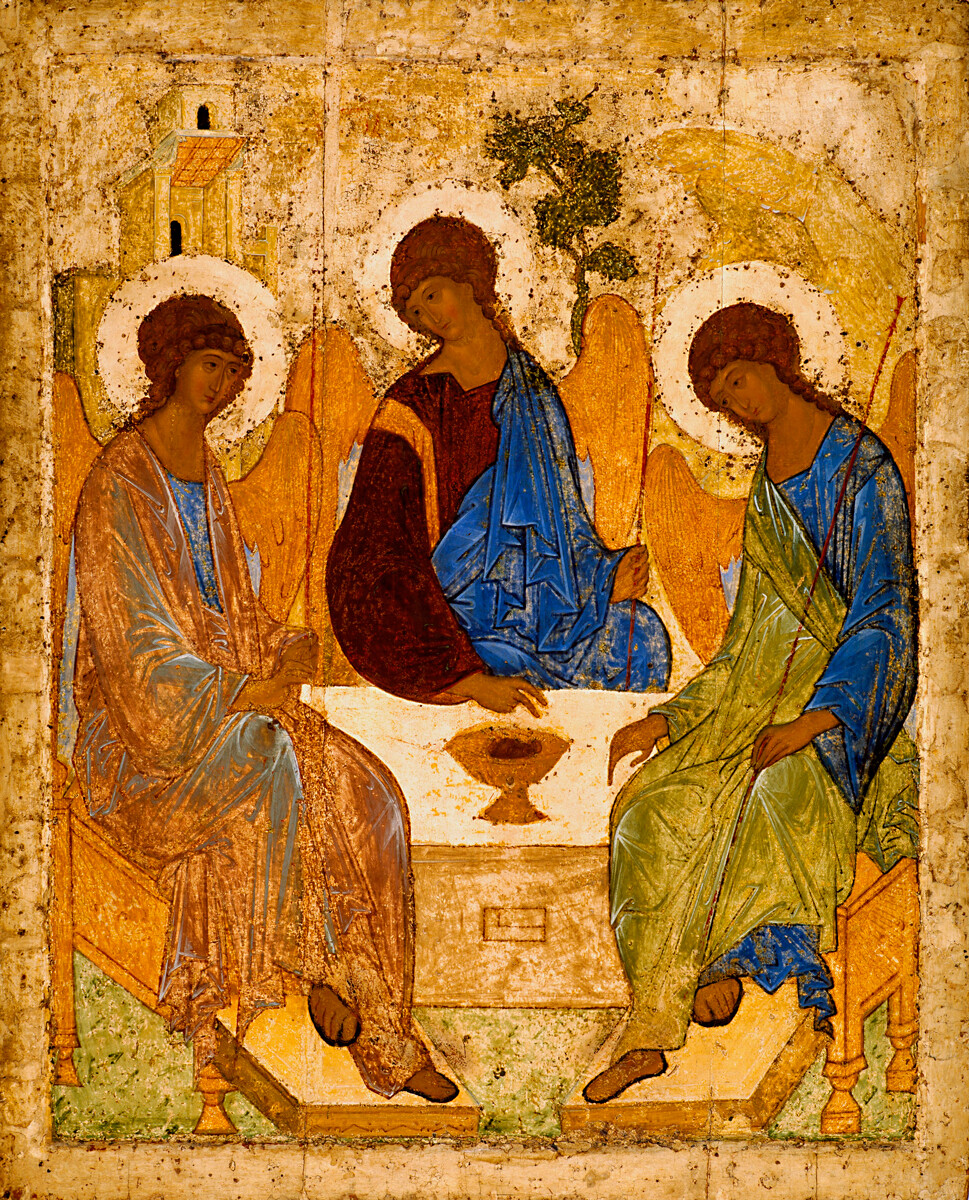
Trinity by Andrei Rublev
Andrei Rublev’s Trinity icon, one of the most important works of Russian art, has been severely damaged after climate control systems failed at the church where it is kept.
The Trinity icon was created sometime in the early fifteenth century by the famed Russian painter Andrei Rublev. He is credited with creating many icons and frescoes found at several Russian Orthodox churches. However, because these paintings were often collaborative, the Trinity is the only surviving work by the artist made solely by his hand. Rublev is often named as one of the greatest artists in Russian history. He brought harmony of color and form to the previously stiff, Byzantine-inspired painting traditions of medieval Russia, becoming the model for religious art that followed.
The Trinity icon was originally intended as The Hospitality of Abraham. This refers to chapter 18 of Genesis, where Abraham offers the protection of his tent to a trio of angels disguised as travelers. However, Rublev removed Abraham and Sarah from the scene, leaving only the angels and transforming them into a representation of the Christian Trinity. The icon was originally kept at the Trinity Lavra of St. Sergius, a church just outside Moscow considered the spiritual epicenter of the Russian Orthodox Church. It is home to several hundred monks and serves as the official residence of the patriarch of Moscow, who serves as head of the church. The Trinity Lavra’s founder, Saint Sergius of Radonezh, is considered one of Russia’s patron saints. The painting was transferred to the State Tretyakov Gallery in 1929, but was returned to the church in 2022 at the direction of Vladimir Putin’s government. Some art historians and conservators cautioned against this move at the time, warning that the monastery lacks adequate facilities to maintain the ideal environment for the icon’s well-being and for future maintenance and conservation. Moving the icon, however, was likely more political than devotional.
Throughout his leadership of Russia, both as president and prime minister, Putin has enjoyed a close relationship with the Orthodox Church. Writing for the think tank Theos, Ben Ryan said Putin and the church have an “unusual symbiotic relationship” in which the government permits the church to exercise considerable power. Meanwhile, the church, in return, has provided “the intellectual and cultural backing for Putin’s Statist vision of Russia”. Returning the most famous work of Russian religious art to its place of origin was likely a move by the Russian government to lend prestige to the church while currying additional favor with its leadership. Patriarch Kirill, the current head of the church and close Putin ally, has even tried to associate the Trinity icon with Russia’s ongoing war in Ukraine, saying that the struggles the country faced at the time of its creation can be likened to its contemporary hegemonic endeavors. He stated that it “connects us to the time when our Russia, in great danger from foreign and domestic enemies, was concentrating on becoming a great power”.
As the aforementioned conservators predicted, the capsule in which the Trinity icon has been kept was insufficient to maintain the proper environmental conditions. Tretyakov director Elena Pronicheva said the wood panels on which the icon was painted should be kept at 19ºC (about 66ºF) with humidity at 50% to 55%. The icon is made of egg tempera on three wood panels glued together. However, the humidity inside the church’s case was found to be around 80%. This has caused significant warping in the panels and deterioration of the glue. Russian art historian Oleg Voskoboinikov posted a photo on Facebook on September 13th showing a “scar” in the wood panel that now bisects the face of one of the angels. The icon was removed to the Tretyakov’s restoration labs on September 14th, with a copy placed on display at the church the following day.
This news may sour Putin’s image as an ally of the church, since earlier this year the Kremlin moved two other important paintings from museums to churches. According to a statement from the patriarchate, the government moved The Virgin of Vladimir and Our Lady of the Don from the Tretyakov to the Cathedral of Christ the Savior in Moscow. Plans also include moving the latter to the Donskoy Monastery later. Both paintings are notably older than Rublev’s Trinity, with The Virgin of Vladimir being made in Constantinople in the twelfth century and Our Lady of the Don made in the late fourteenth century. Putin’s government has agreed to lease the icons to the Church for a period of forty-nine years. Tretyakov specialists are allowed unfettered access to the paintings during their stay in church custody, but no one knows for sure what problems may arise.