
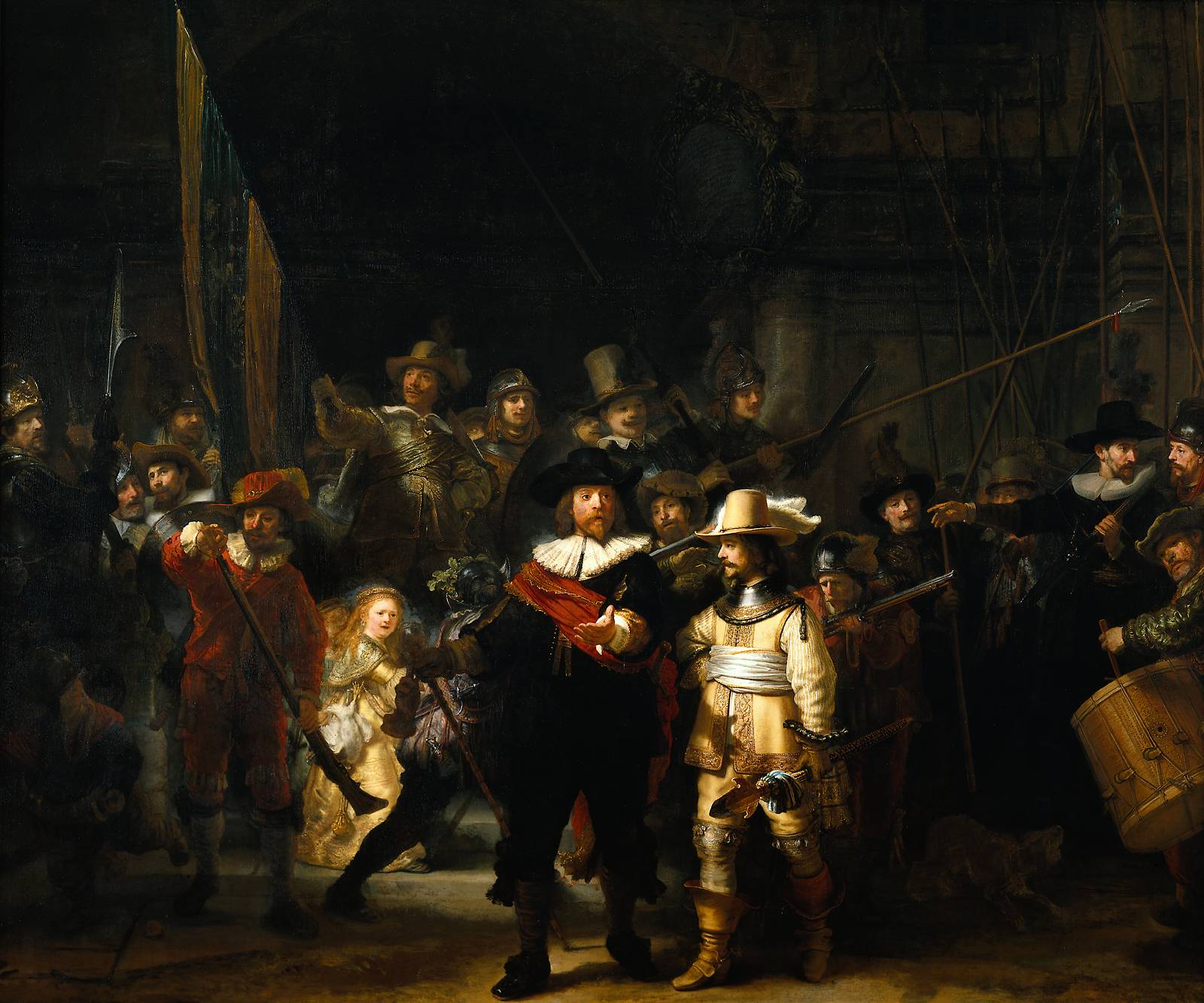
The Night Watch by Rembrandt van Rijn
An Amsterdam museum will soon be looking at one of Rembrandt’s most famous paintings incredibly closely.
The Micropia is a science museum in Amsterdam dedicated to educating people about microbes and microorganisms, the only one of its kind in the world. It is an affiliate of the Artis, the city of Amsterdam’s main zoo. Starting in November, Micropia specialists will collaborate with the Rijksmuseum to stage an installation titled The Night Watch Lives. Microbiologists and other experts will collect samples from Rembrandt’s Night Watch and see if any cultures develop, indicating microbial activity from the past and the present.
The eventual installation at the Micropia will feature a life-size reproduction of the painting with added graphics explaining the work’s microbial components. Eline van Bloois, a Micropia microbiologist, stated that the goal of the installation is to “make the microbiome of The Night Watch visible”. She continued that despite well-funded, prestigious museums’ attempts to completely conserve their collections, The Night Watch Lives plans to show that “even a masterpiece preserved as carefully as The Night Watch is constantly in contact with a living environment.” This collaboration is part of the Rijksmuseum’s ongoing Operation Night Watch project, which seeks to completely restore and perform research on Rembrandt’s painting all while the work is continuously on display behind a glass wall. Operation Night Watch has been underway since 2019 and aims to make art history, research, and restoration more accessible to the public. The current stage of the restoration involves Rijksmuseum conservators removing the varnish applied to the painting’s surface in the 1970s. Micropia specialists therefore plan to take samples over six months to compare the varnished and unvarnished areas of the canvas.
Of course, specialists working on The Night Watch Lives have admitted that the ultimate find would be microorganisms dating back to Rembrandt himself, even DNA from the artist or his contemporaries. Dr. Katrien Keune, the Rijksmuseum’s head of science, has also said this research could uncover not only information about the painting, but also about museum visitors. “Whenever we walk around, we lose our bio-material. When you speak, you have your saliva reaching out. […] can we find how visitors are represented on The Night Watch?”
The Night Watch Lives will be unveiled at the Micropia on November 11, 2026.