
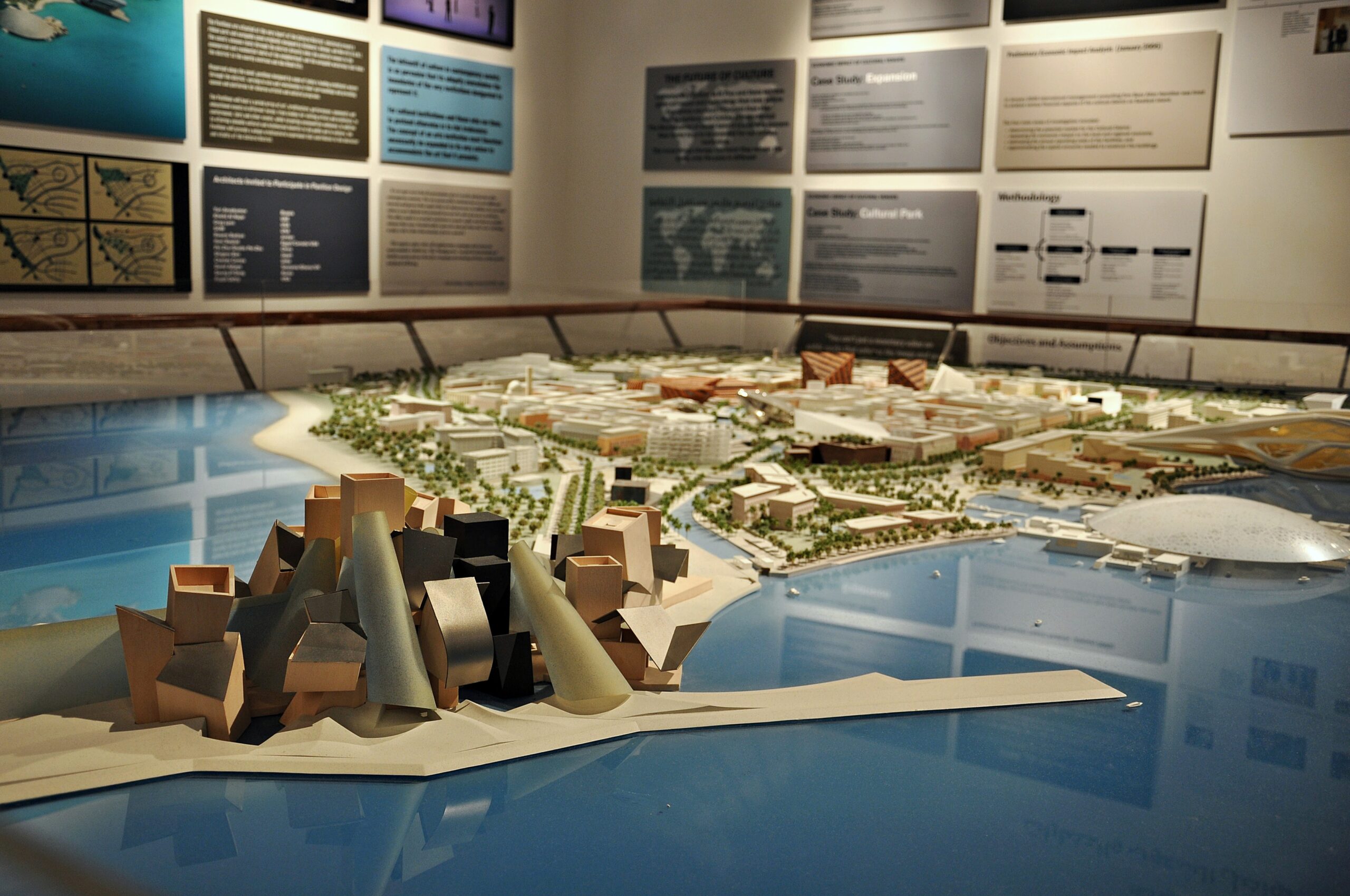
A model of the planned Guggenheim Abu Dhabi (image courtesy of Alberto Govi)
After 20 years of anticipation, the Guggenheim Abu Dhabi has announced via press release that it will open its doors on December 11, 2026. First announced in July 2006, it will become the fourth institution in the Guggenheim’s international network, joining the museums in New York City, Venice, and Bilbao. Like the Guggenheim Bilbao, the Abu Dhabi building was designed by late Canadian-American architect Frank Gehry and marks another step in the foundation’s global expansion following earlier unrealized or failed projects in Finland, Brazil, Mexico, Germany, and the United States.
The site is projected to be the largest Guggenheim outpost at 320,000 square feet, with 130,000 square feet dedicated to exhibition space. Abu Dhabi’s Department of Culture and Tourism has assumed the cost of constructing and operating the museum. An exact construction budget hasn’t been made public, but it’s believed to exceed $1 billion. The department will also oversee all major hiring decisions, and any art acquired by the museum will be owned by the government.
The collection will focus on contemporary art from the 1960s onward, with particular emphasis on North African, West Asian, and South Asian artists, though art of all cultures will be presented. These will be works that have long been underrepresented in Western museum collections. Pieces will be displayed thematically rather than chronologically, highlighting connections across artistic movements. The museum will also have to navigate the tension between the United Arab Emirates’ conservative Islamic culture and the often confrontational themes found in contemporary art. This has manifested in the museum’s exclusion of nudity and most religious imagery.
The museum will be located on Saadiyat Island, already home to the Louvre Abu Dhabi, the Zayed National Museum, a performing arts center, the Abu Dhabi Museum of Natural History, and New York University’s Abu Dhabi campus. Development on the island of hotels, museums, and NYU’s campus was plagued by allegations of worker mistreatment. The Guggenheim’s arrival on Saadiyat Island will cement its status as the cultural heart of not just Abu Dhabi but the wider UAE. This development is seen as key to drawing international recognition and tourism as part of the UAE’s broader arts initiative.
By Madeleine Kent