

Portrait of a man, bust-length, in black with a white ruff attributed to El Greco
On Tuesday, June 2nd, Christie’s New York hosted their Old Masters & 19th Century Paintings auction. The expected star of the sale was a bust-length portrait attributed to El Greco. While the painting cannot be definitively attributed to the Greek-born Spanish painter, the composition contains some of his hallmarks. Christie’s specialists note that one eye is rendered in sharper definition than the other, indicating an “asymmetric finish that recurs across El Greco‘s portraits of the late 1570s to 1580s.” The painting first appears on the record in 1970, when the London art restorer John Brealey sent a photograph of the work to the director of the Prado Museum, Xavier de Salas. The work had not been restored, and a chain around the subject’s neck, added at a later date, was visible. Based solely on the photograph, de Salas and another El Greco expert were unable to fully attribute the painting to the artist. However, other specialists have examined the painting in person and reached more positive conclusions. The work was given an estimate range of $500K to $700K. The work ended up selling for its low estimate, or approximately $635K w/p.
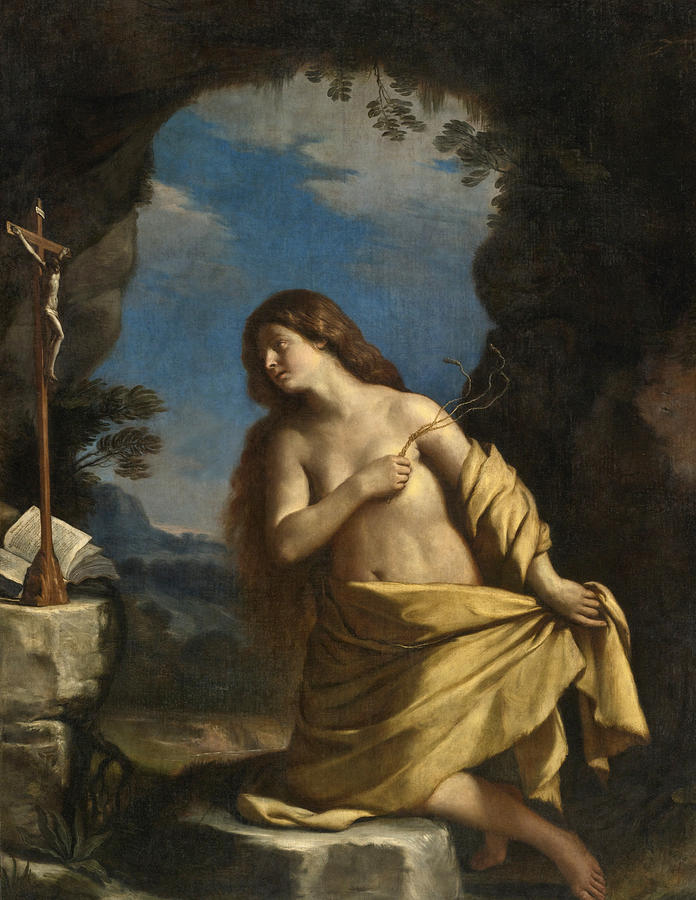
The Penitent Magdalene by Guercino
Next up was a religious work by the Baroque painter Guercino. The Penitent Magdalene depicts Mary Magdalene in a sort of cave, popularly thought to be a grotto at Sainte-Baume in southern France, where she spent the last thirty years of her life. She kneels before a crucifix while holding a knotted cord typically used for self-flagellation. The painting was originally commissioned sometime between 1648 and 1651 by the papal ambassador to Bologna, Cardinal Fabrizio Savelli. By the nineteenth century, it had reached England, where it circulated among several private collections before coming into the possession of Macclesfield Borough Council in the county of Cheshire. The council put it up for auction at Sotheby’s London, where it was purchased by the individual who consigned it to Christie’s this time. The work is part of a series of five religious paintings Cardinal Savelli commissioned from Guercino during his time in Bologna. Estimated to sell for no more than $180K, Guercino’s Penitent Magdalene exceeded its estimate, selling for $300K (or $381K w/p).
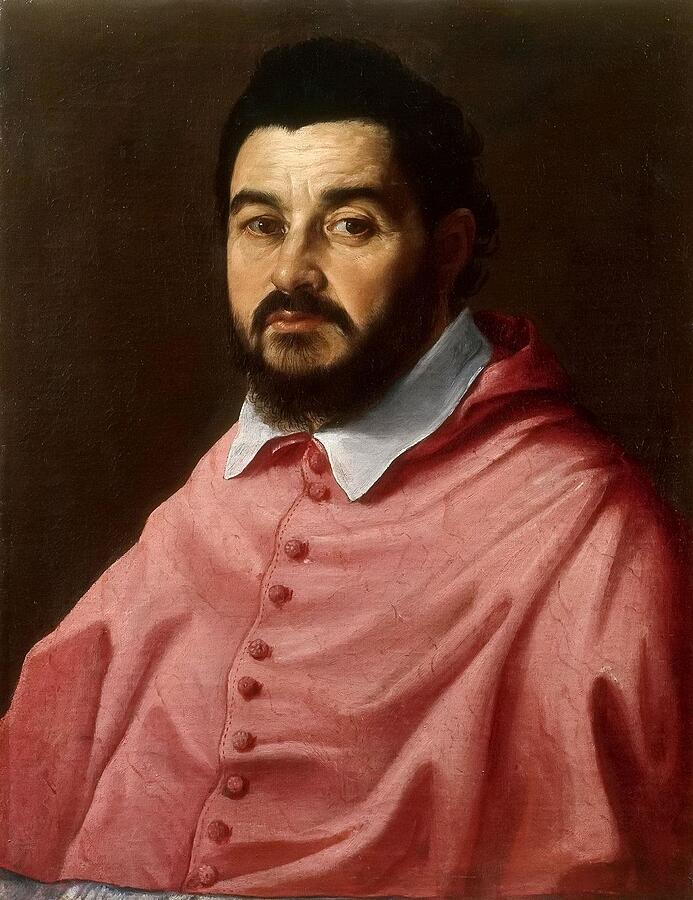
Portrait of Cardinal Giacomo Sannesio by Guido Reni
From one Bolognese Baroque master to another, the third-place spot went to Guido Reni’s portrait of Cardinal Giacomo Sannesio. Reni is primarily known for his religious and mythological paintings, making his portraiture rather rare. The 1609 painting offered at Christie’s is, according to specialists, the only verified portrait created by the artist during his time living and working in Rome between 1601 and 1614. The painting has mainly remained in private collections, appearing at auction only once, at Sotheby’s Old Master Paintings auction in December 2004. It was not fully attributed to Reni at the time, with the artist listed only as “Italian School”. It was given a high estimate of £8K, with the final price realized coming out to £26.4K w/p. Following the 2004 auction, German art historian Erich Schleier found a copy of the painting in the town hall of the cardinal’s hometown of Belforte del Chienti, which identified the subject as Sannesio. With the authorship confirmed, this time around the portrait secured an estimate range of $100K to $150K.
Sharing the third-place spot with the Reni was a more modern work by an artist whose paintings we’ve dealt with before. The American Clipper Ship ‘Rainbow’ – Sunset by the British maritime painter Montague Dawson is an example of the artist’s proclivity for recreating historic sailing ships in their prime. The titular vessel, the Rainbow, was built in 1845 for shipping cargo to and from China. She had a short but esteemed career, setting speed records by making the trip from Guangzhou to New York in seventy-seven days. On her fifth voyage in 1848, she left New York heading to Valparaíso, Chile. However, she disappeared at sea, the assumption being that she sank somewhere around Cape Horn. It is not known when Dawson created this painting, but it eventually found its way to the collection of New York governor Thomas Dewey. The Dawson ended up being one of Tuesday’s surprises, shattering its $80K high estimate and selling for the same price as the Reni portrait at $280K (or $355.6K w/p).

The American Clipper Ship ‘Rainbow’ – Sunset by Montague Dawson
Of course, the auction was not without its fair share of surprises. Ten of the one hundred twenty-eight available lots sold for at least double their high pre-sale estimates. Some of the more notable surprises included a floral still-life by the nineteenth-century French painter Jean Benner (est. $10K to $15K; hammer $65K), Elijah and the Angel by the seventeenth-century Neapolitan painter Francesco Glielmo (est. $15K to $20K; hammer $90K), and a moonlit Dutch landscape by Aert van der Neer (est. $15K to $20K; hammer $95K). Thankfully, these successes compensated for some of the high-value lots that went unsold. Another Guercino painting, The Blessed Andrea Dotti of Sansepolcro, Reading a Book, initially received a pre-sale estimate of $70K to $100K, yet ultimately failed to garner enough attention during the auction. Similarly, a trompe l’oeil work by Franciscus Gysbrechts, valued at between $100K and $150K, was also bought in.
Of the one hundred twenty-eight available lots, twenty-six sold within their estimates, giving Christie’s specialists a 20% accuracy rate. An additional forty lots (31%) sold above estimate, while thirty-eight (30%) sold below. This left twenty-four lots unsold, giving the auction a 81% sell-through rate. Against a pre-sale total low estimate of $4.58 million, the entire sale brought in $5.48 million, or $6.96 million w/p.