
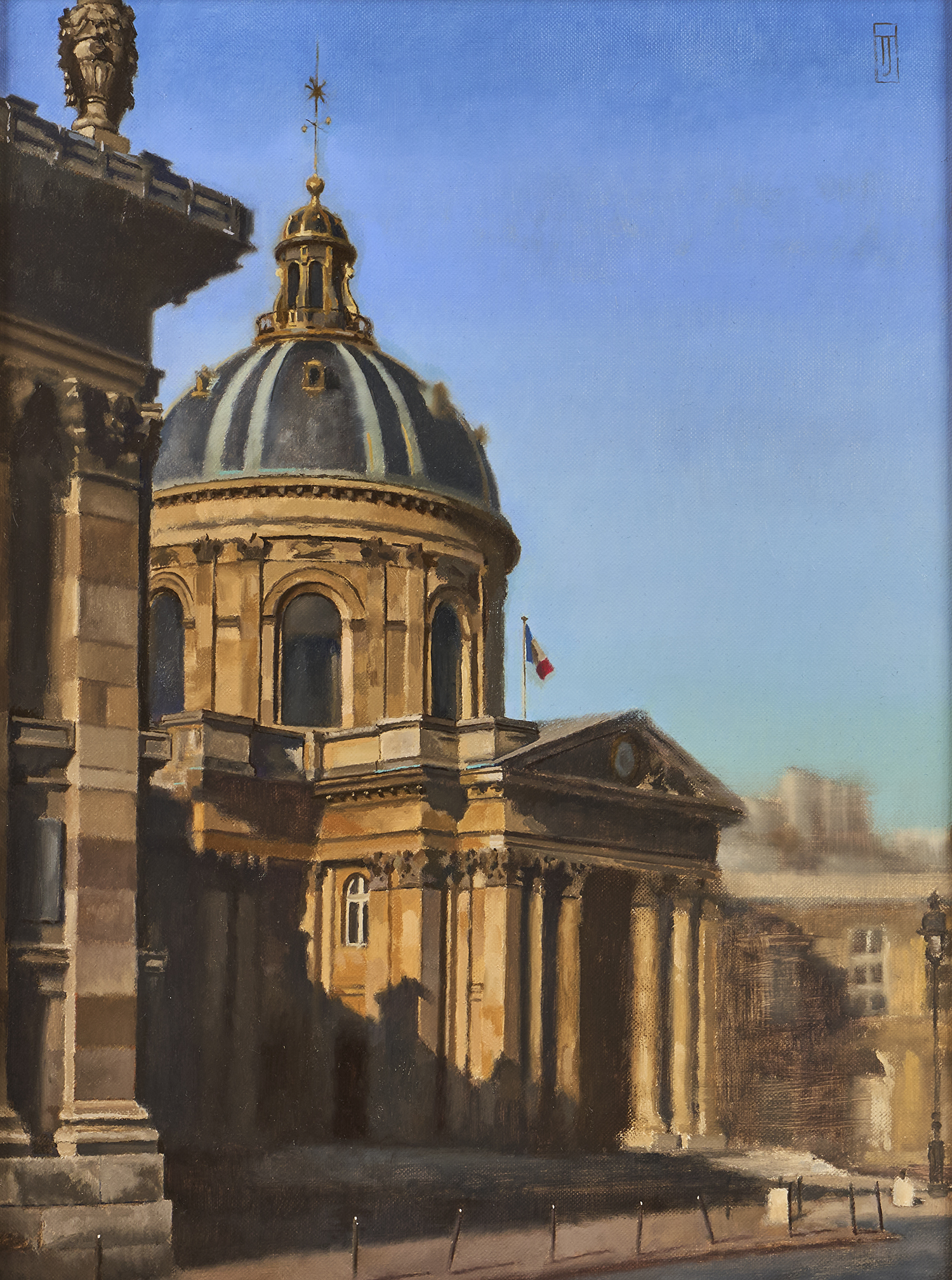
The Allure of Parisian Architecture by Timothy Jahn Oil on linen 16 x 12 inches
Timothy Jahn’s The Allure of Parisian Architecture marks a dramatic departure from the artist’s previous work. While Jahn has proven himself a most capable master of figure painting, still life, and, more recently, interior scenes, The Allure of Parisian Architecture is one of his few cityscapes. Upon receiving the painting, I was hit with a wave of memories from my first and only time in Paris. I had just left the Louvre one day in July, wandering around one of the several large courtyards formed by the palatial buildings. I exited through a large archway, which led to the Quai François Mitterrand and the River Seine when I saw a large dome building across the river. A French tricolor was perched atop the columned entrance while parts of the dome gleamed as if it were decorated with gold. I would later discover that it was indeed gold.
I snapped a photo, not knowing what I was looking at. I later realized this was the Institut de France, the country’s national academy. It contains the Académie des Beaux-Arts, which sponsored and judged the annual Salon for centuries. But perhaps more importantly, it oversees the Académie Française, the academic body that establishes and maintains the rules governing the French language. The French are incredibly proud of their language, so much so that unless you speak French at a native level, they will not use it to speak to you. They will just sigh and switch to English. So while the Eiffel Tower or I.M. Pei’s Louvre Pyramid may be more recognizable as some of the most iconic structures in the city, the gilded dome of the Institut de France may be more representative of the feel of Paris, its ethos, its attitudes. It is one of only three buildings in Paris that features 24-karat gold on its exterior, demonstrating its importance and place of pride among the French nation.
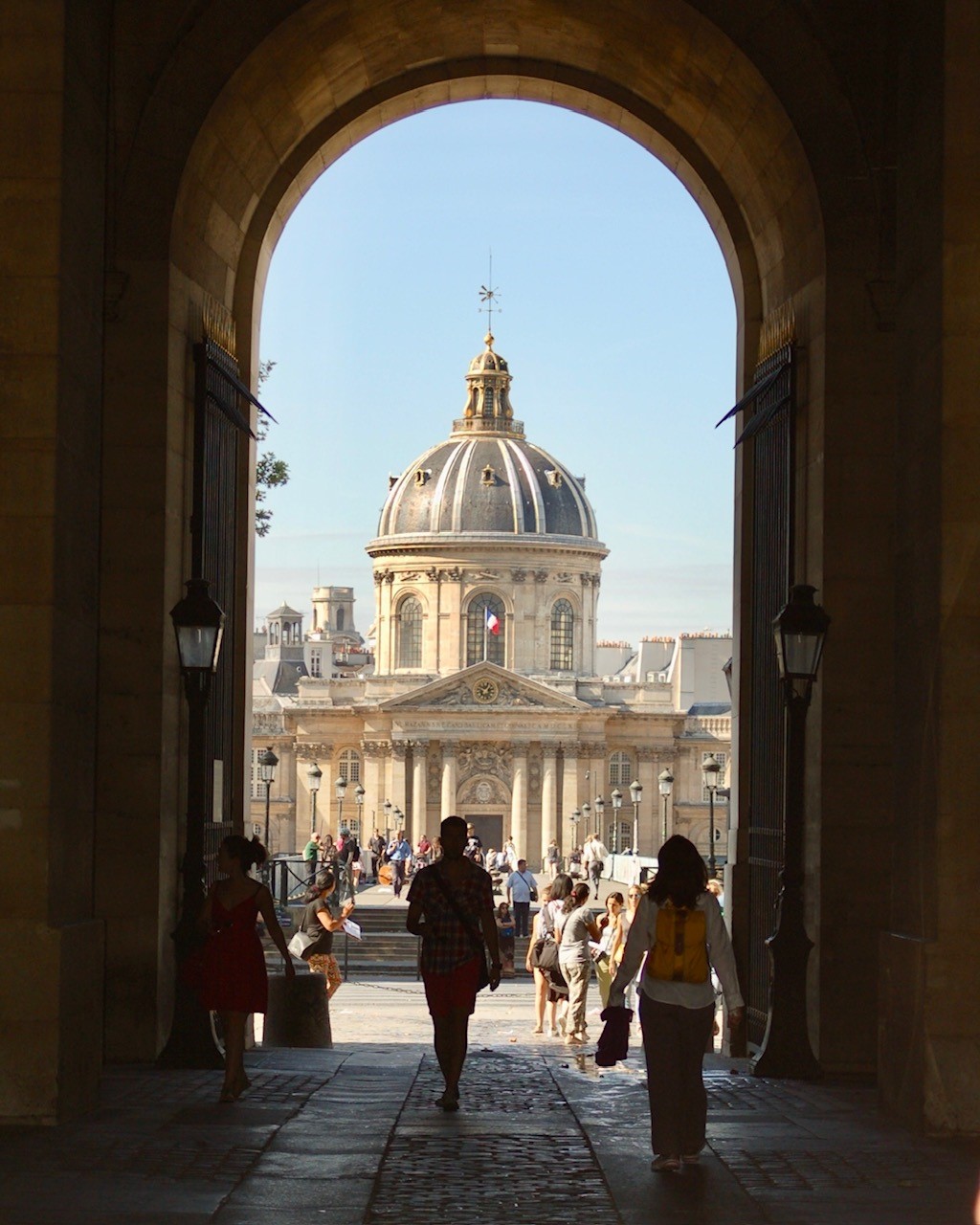
The Institut de France as seen from the Louvre
In Jahn’s painting, the building stands dignified as the sun rises behind the viewer, casting a golden glow upon its façade. Jahn displays an incredible command over color in this work, with the stone emerging from shadow and the dome’s gilded accents shining in the morning light. But Jahn also employs slightly looser brushwork here, omitting the finer details of the structures in the background in favor of a somewhat more impressionistic technique. It’s not something he does often, but it allows the audience to focus their attention on the intended subject. It distinguishes the work, transforming it from a purely accurate rendering of a building, no different from a photograph, into an artist’s approach to a beautiful subject.