
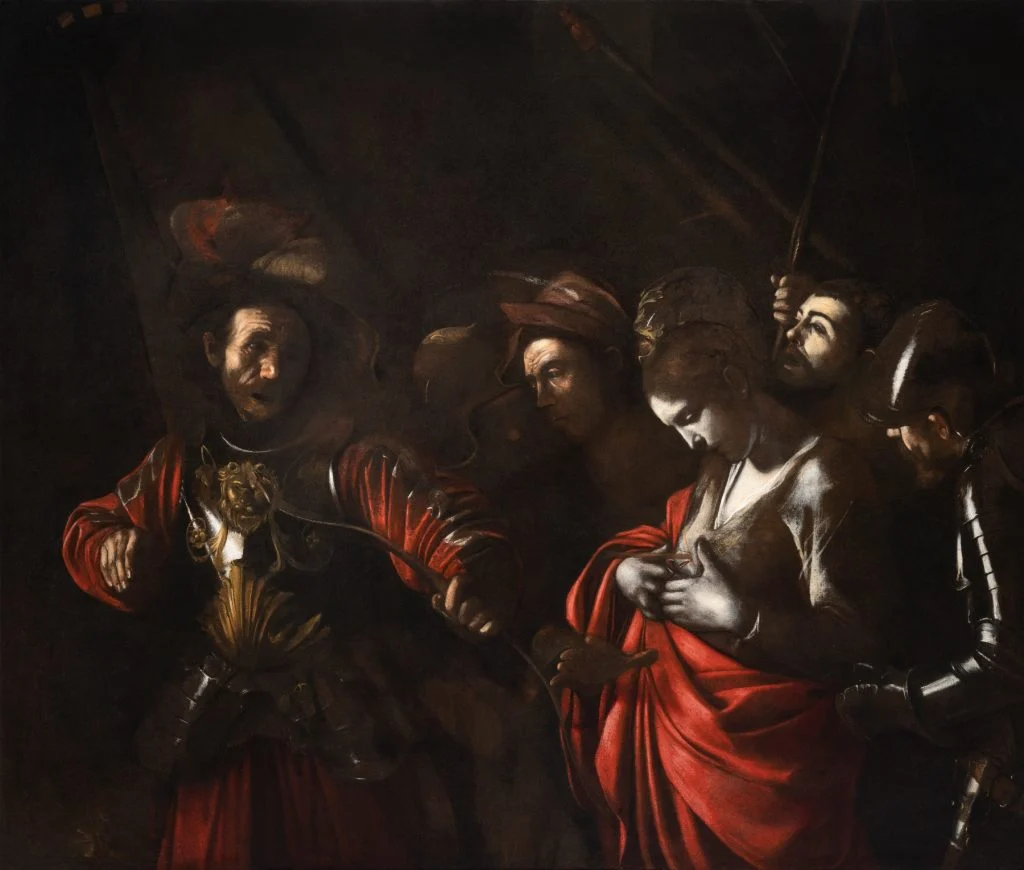
The Martyrdom of St. Ursula by Michelangelo da Caravaggio
As part of the highly anticipated Caravaggio 2025 exhibition, the Palazzo Barberini has revealed hidden segments of a painting now unveiled through meticulous restoration.
Caravaggio’s Martyrdom of St. Ursula is the last painting the artist created before his death in June 1610. The work shows the death of a fourth-century woman who, according to the Catholic Church, led a pilgrimage of 11,000 virgins from Britain to Rome. On the way back, while passing through the Roman settlement at Colonia Agrippina (now Cologne, Germany), the Huns besieged the area and killed the pilgrims. According to some versions of the story, the Hunnic commander promised to spare Ursula if she married him. Having gone on the initial pilgrimage to postpone her marriage to a pagan prince, Ursula refused. The commander then shot her point blank with an arrow. The story is not the most popular artistic subject, but it has been depicted by other artists, namely Hans Memling and Peter Paul Rubens. Biblical scenes and the lives of the saints were popular subjects for Caravaggio since much of his work was part of the Catholic Church’s counterreformation. The Martyrdom of St. Ursula has been in poor condition for quite some time, mostly because there was uncertainty as to whether it was an original Caravaggio painting. This was until scholars uncovered archival evidence in 1980 confirming that Caravaggio did create a Saint Ursula painting in the last year of his life. Previous conservation efforts have not been particularly thorough, partly due to the work’s fragile condition. However, with this more comprehensive restoration, the painting has new life breathed into it. Not only are some of the colors much brighter but there are segments of the painting that were previously obscured but are now visible.
A previous bout of restorations between 2003 and 2004 revealed the outstretched arm separating the titular saint from the Hun. This time around, however, another component has been revealed. In the space between the commander and the saint, there used to be part of a helmet seemingly floating in the darkness. The cleaning job revealed more of the helmet and some of its wearer. A nose and other parts of a face have been uncovered, adding another figure to the scene. Exhibition curator Maria Cristina Terzaghi remarked that even though the painting’s condition has improved, it has still been irreparably damaged and is still very delicate. We may not be able to see it completely restored, but this is the best it’s going to get for now.
Caravaggio 2025 has proven to be a massive success, with more than 60,000 tickets sold prior to its opening on March 7th. The Palazzo Barberini coordinated many museum loans to make the show possible, securing paintings from institutions such as Madrid’s Thyssen-Bornemisza Museum, New York’s Metropolitan Museum, and the Detroit Institute of Arts. Several paintings in the exhibition once adorned the palace walls as part of the Barberini family collection. One of the most interesting additions to the show was the portrait of a young Pope Urban VIII while still a priest. The show is scheduled to run through July 6th.