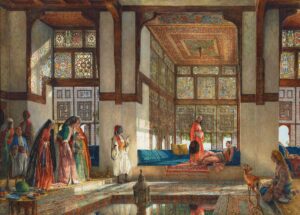
A Reception in the Harem by John Frederick Lewis
On Wednesday, March 26th, Bonhams’ sale room at New Bond Street, London, hosted their 19th-Century and British Impressionist art sale, featuring works by Heywood Hardy, Rudolf Ernst, Sir Alfred Munnings, and Dame Laura Knight. However, the works of the orientalist painter John Frederick Lewis seemed to have been the fixation of many buyers on Wednesday. His 1873 watercolor A Reception in the Harem made its first appearance at auction in fifty-eight years at Bonhams on Wednesday. They expected it to do well since not only was the Turkish harem an incredibly popular subject for Western European Orientalist artists, but Lewis, in particular, was one of the more culturally sensitive painters active in the genre in the late nineteenth and early twentieth centuries. As I previously noted in my writings discussing the problematic nature of some Orientalist art, Lewis stood out among his contemporaries in that he lived in Cairo for close to a decade. There, he made an effort to paint genre scenes and slices of daily life in the region, representing its people and customs as accurately as possible. Bonhams predicted the watercolor would sell for between £650K and £850K. The bidding pushed up the final hammer price slightly over, with the work selling for £900K / $1.16 million (or £1.14 million / $1.47 million w/p).
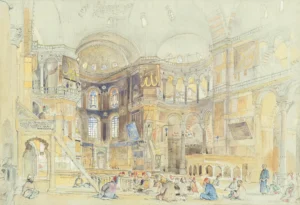
Interior of the Hagia Sophia by John Frederick Lewis
Immediately after the harem scene, another one of Lewis’s works crossed the block, this time a watercolor and pencil work showing the interior of the Hagia Sophia. While mosques were popular subjects for Orientalist artists as a way to show Islamic piety, very rarely do we see specific mosques in paintings. The Hagia Sophia, however, is one of the world’s most famous Islamic religious sites. Originally built as a Byzantine church, it has been one of Istanbul’s most famous buildings for over 1,600 years. Depictions of actual mosques are so rare because, at the time, it was considered distasteful (and in some places actually prohibited) for non-Muslims to step foot inside without express permission of local authorities. While visiting Turkey in 1840, Lewis accompanied the British aristocrat Lady Londonderry on her tour of Istanbul’s religious sites, meaning that he had permission to enter the Hagia Sophia. The work’s rarity made it very popular with buyers on Wednesday, with successive bids pushing it to two-and-a-half times its £60K high estimate, hammering at £150K / $193.3K (or £190.9K / $245.9K w/p).
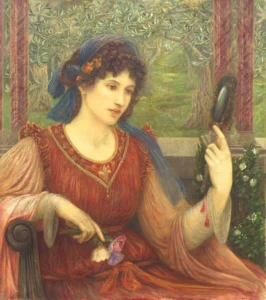
Mia suora Rachel by Marie Spartali Stillman
Two works ended up tied for third at Bonhams. Moving away from the Orientalist paintings, Mia suora Rachel by Marie Spartali Stillman has all the characteristic hallmarks of a Pre-Raphaelite portrait, including the medieval robes, the use of flowers, and an accompanying line originally from Dante’s Divine Comedy: “Ma mia suora Rachele mai non si smaga dal suo miraglio, e siede tutto giorno”, or “But my sister Rachel never leaves her looking glass, and sits all day long”. While the central figure looking into a mirror may suggest vanity, the Dante reference indicates it is a scene of self-reflection. Sharing third place with the Stillman was a landscape by the great French Barbizon painter Jean-Baptiste-Camille Corot. Souvenir de la Rotte, près Rotterdam shows the River Rotte leading from the Dutch countryside into the city of Rotterdam. The painting has a provenance somewhat typical of a Corot landscape, including Georges Bernheim, Galerie Georges Petit, and Knoedler. It being featured at Bonhams on Wednesday marked the work’s first auction appearance in over twenty years. It’s last time crossing the block saw it sell at Christie’s New York for $147K w/p. The Stillman and the Corot each sold for £110K / $141.7K (or £140.1K / $180.5K w/p), the former selling for slightly over its £100K low estimate and the latter selling for slightly below its £120K estimate. While this was only a moderate improvement from the Corot’s previous auction appearance, Mia suora Rachel became one of the top five most expensive works by Stillman ever sold at auction.
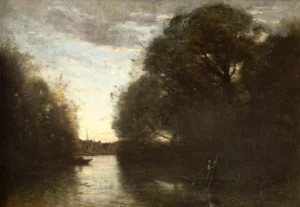
Souvenir de la Rotte, près Rotterdam by Jean-Baptiste-Camille Corot
Despite these successes, unfortunately, the sale fell short because of one lot’s failure. Along with John Frederick Lewis, one of the most prominent Orientalist artists who remained respectful of their subjects was the Turkish painter Osman Hamdi Bey. His painting, The Hearth, has never been seen on the secondary market. It had been in the same family since 1910, after being purchased from the artist. While many European artists chose to depict scenes from the Ottoman harems for erotic titillation, Hamdi sought to push back against harmful Western clichés of Middle Eastern people by showing more realistic representations of harem life. Nothing is explicitly sexual about a wife serving her husband coffee, and the attention to detail in the decorative items like the coffee pot, plates, vases, and inkwells shows dedication to showing how an actual Turkish home may look. The Hearth is one of Hamdi’s earlier works, created in 1879 in the final years of his time in the Ottoman bureaucracy. As one of the artist’s earlier genre scenes, Bonhams’ specialists assigned the Hamdi an astounding estimate range of £1.2 million to £1.8 million. The respective minimum estimates of just Hamdi and the Lewis harem scene comprised 60% of the total minimum presale estimate. When the Hamdi failed to garner enough interest from buyers, the sale was toast. Despite twenty-three of sixty-nine lots selling within their estimates, giving Bonhams’ specialists a 33% accuracy rate, the failure of the Hamdi tanked the total. With ten lots selling below their estimates and seventeen selling for above, Bonhams achieved a 72% accuracy rate. Against the total low estimate of £3.1 million, The Hearth going unsold brought the total down to £2.12 million / $2.7 million.

Bonhams 19th-Century & British Impressionist Art
A Reception in the Harem by John Frederick Lewis
On Wednesday, March 26th, Bonhams’ sale room at New Bond Street, London, hosted their 19th-Century and British Impressionist art sale, featuring works by Heywood Hardy, Rudolf Ernst, Sir Alfred Munnings, and Dame Laura Knight. However, the works of the orientalist painter John Frederick Lewis seemed to have been the fixation of many buyers on Wednesday. His 1873 watercolor A Reception in the Harem made its first appearance at auction in fifty-eight years at Bonhams on Wednesday. They expected it to do well since not only was the Turkish harem an incredibly popular subject for Western European Orientalist artists, but Lewis, in particular, was one of the more culturally sensitive painters active in the genre in the late nineteenth and early twentieth centuries. As I previously noted in my writings discussing the problematic nature of some Orientalist art, Lewis stood out among his contemporaries in that he lived in Cairo for close to a decade. There, he made an effort to paint genre scenes and slices of daily life in the region, representing its people and customs as accurately as possible. Bonhams predicted the watercolor would sell for between £650K and £850K. The bidding pushed up the final hammer price slightly over, with the work selling for £900K / $1.16 million (or £1.14 million / $1.47 million w/p).
Interior of the Hagia Sophia by John Frederick Lewis
Immediately after the harem scene, another one of Lewis’s works crossed the block, this time a watercolor and pencil work showing the interior of the Hagia Sophia. While mosques were popular subjects for Orientalist artists as a way to show Islamic piety, very rarely do we see specific mosques in paintings. The Hagia Sophia, however, is one of the world’s most famous Islamic religious sites. Originally built as a Byzantine church, it has been one of Istanbul’s most famous buildings for over 1,600 years. Depictions of actual mosques are so rare because, at the time, it was considered distasteful (and in some places actually prohibited) for non-Muslims to step foot inside without express permission of local authorities. While visiting Turkey in 1840, Lewis accompanied the British aristocrat Lady Londonderry on her tour of Istanbul’s religious sites, meaning that he had permission to enter the Hagia Sophia. The work’s rarity made it very popular with buyers on Wednesday, with successive bids pushing it to two-and-a-half times its £60K high estimate, hammering at £150K / $193.3K (or £190.9K / $245.9K w/p).
Mia suora Rachel by Marie Spartali Stillman
Two works ended up tied for third at Bonhams. Moving away from the Orientalist paintings, Mia suora Rachel by Marie Spartali Stillman has all the characteristic hallmarks of a Pre-Raphaelite portrait, including the medieval robes, the use of flowers, and an accompanying line originally from Dante’s Divine Comedy: “Ma mia suora Rachele mai non si smaga dal suo miraglio, e siede tutto giorno”, or “But my sister Rachel never leaves her looking glass, and sits all day long”. While the central figure looking into a mirror may suggest vanity, the Dante reference indicates it is a scene of self-reflection. Sharing third place with the Stillman was a landscape by the great French Barbizon painter Jean-Baptiste-Camille Corot. Souvenir de la Rotte, près Rotterdam shows the River Rotte leading from the Dutch countryside into the city of Rotterdam. The painting has a provenance somewhat typical of a Corot landscape, including Georges Bernheim, Galerie Georges Petit, and Knoedler. It being featured at Bonhams on Wednesday marked the work’s first auction appearance in over twenty years. It’s last time crossing the block saw it sell at Christie’s New York for $147K w/p. The Stillman and the Corot each sold for £110K / $141.7K (or £140.1K / $180.5K w/p), the former selling for slightly over its £100K low estimate and the latter selling for slightly below its £120K estimate. While this was only a moderate improvement from the Corot’s previous auction appearance, Mia suora Rachel became one of the top five most expensive works by Stillman ever sold at auction.
Souvenir de la Rotte, près Rotterdam by Jean-Baptiste-Camille Corot
Despite these successes, unfortunately, the sale fell short because of one lot’s failure. Along with John Frederick Lewis, one of the most prominent Orientalist artists who remained respectful of their subjects was the Turkish painter Osman Hamdi Bey. His painting, The Hearth, has never been seen on the secondary market. It had been in the same family since 1910, after being purchased from the artist. While many European artists chose to depict scenes from the Ottoman harems for erotic titillation, Hamdi sought to push back against harmful Western clichés of Middle Eastern people by showing more realistic representations of harem life. Nothing is explicitly sexual about a wife serving her husband coffee, and the attention to detail in the decorative items like the coffee pot, plates, vases, and inkwells shows dedication to showing how an actual Turkish home may look. The Hearth is one of Hamdi’s earlier works, created in 1879 in the final years of his time in the Ottoman bureaucracy. As one of the artist’s earlier genre scenes, Bonhams’ specialists assigned the Hamdi an astounding estimate range of £1.2 million to £1.8 million. The respective minimum estimates of just Hamdi and the Lewis harem scene comprised 60% of the total minimum presale estimate. When the Hamdi failed to garner enough interest from buyers, the sale was toast. Despite twenty-three of sixty-nine lots selling within their estimates, giving Bonhams’ specialists a 33% accuracy rate, the failure of the Hamdi tanked the total. With ten lots selling below their estimates and seventeen selling for above, Bonhams achieved a 72% accuracy rate. Against the total low estimate of £3.1 million, The Hearth going unsold brought the total down to £2.12 million / $2.7 million.