
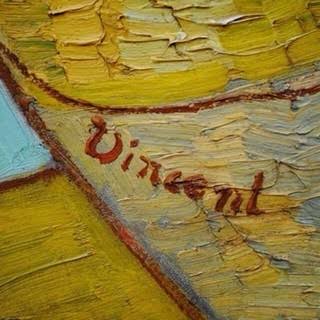
Van Gogh’s signature on his 1888 floral still life Vase with Twelve Sunflowers
Art historian Julia Engelmayer recently published an article on what we can learn about Van Gogh from his signature alone.
Published by the Van Gogh Museum, Julia Engelmayer’s article “Simply ‘Vincent’” identifies a gap in the art historical literature on Van Gogh’s signature. The most comprehensive discussion of the subject to date appears in a chapter by Marieke Jooren in Marije Vellekoop’s Van Gogh’s Studio Practice. However, Jooren’s chapter mainly considers the signature primarily as one of the many “finishing touches” applied to Van Gogh’s paintings, alongside practices such as framing and varnishing. Engelmayer, by contrast, examines the signature as a subject in its own right. Through an analysis of Van Gogh’s signed paintings, she argues that his signature differed markedly from those of his contemporaries in its “style, function and frequency.” She also draws several conclusions about what the signature can reveal about Van Gogh’s personal life and career at the time each work was created.
Van Gogh actually signed very few paintings. Of the 840 surviving paintings he created over his ten-year career, only 133 contain a signature, or about 15.8% of his total oeuvre. Engelmayer notes that this is not especially noteworthy for a late nineteenth-century artist. The rate at which artists signed their work varied from painter to painter. Cézanne and Seurat, for example, signed relatively few of their works, while Signac and Gauguin signed 75% and 60% of their paintings, respectively. Engelmayer notes that this variation in signature use likely had to do with artists signing only completed works. This contrasted with the creative process of certain artists like Van Gogh and Cézanne, who saw most of their work as studies, oil sketches, or technical exercises. Van Gogh was often very critical of his own work, which makes the application of his signature very deliberate.
Then there’s the question of why Van Gogh chose to sign his work using his first name rather than his surname or full name. Letters to the artist’s brother Theo reveal that Van Gogh had a difficult relationship with his father, who was more conservative both personally and professionally. He therefore associated his family name with that traditionalism and opted instead to use his given name as much as possible. Then there is the pronunciation issue. Having lived and worked in Britain and France, Van Gogh was very aware that Dutch is a challenging language for non-native speakers, leading many to mispronounce his last name. Even today, different languages and even different dialects of the same language have different pronunciations, all of which differ in one way or another from the way it is properly said in Dutch. Van Gogh therefore chose to sign his work with just his given name.
Engelmayer also notes that Van Gogh would sign paintings more or less often depending on the subject. The artist worked in landscape more than any other genre, comprising 336 works or about 40% of his total output. However, Van Gogh only signed 49 of these landscapes. For a greater number and proportion of signed canvases, one must look to still life paintings. Though still lifes are Van Gogh’s second most common genre, he produced far fewer still lifes than landscapes. And yet 57 of his still life paintings, or 34.3%, bear his signature. This percentage rises notably when looking solely at floral still lifes, of which 47.9% are signed. Engelmayer states that Van Gogh’s use of his signature on landscapes and still lifes at different points in his career may reflect his strategy for commercial success. She points out that most of his signed floral still life paintings date to Van Gogh’s time living in Paris. Meanwhile, many of his signed landscapes come from later, when he moved to southern France. It could be inferred, then, that he had higher hopes of gaining success in Paris by creating still life paintings. This confidence would later diminish following his move to Arles and his hospitalization in Saint-Rémy.
Engelmayer concludes that Van Gogh’s signatures were both “markers of [his] pride in his creations” as well as “assertions of artistic ownership and identity within the broader context of his oeuvre.” They also “assert the presence of the artist in the depiction, his claim of authorship and satisfaction with the work.”