Naoko Explores the Boss’s Hell by Mitsuru Watanabe
When one of the historical artists we specialize in has a painting come up at auction, we pay extra attention to the results. It offers a bit of a litmus test of the market for their works. However, when one of our contemporary artists comes up at auction, that’s always an extra special occasion. And this past Friday, Mitsuru Watanabe proved his continuing popularity with buyers when his Naoko Explores the Boss’s Hell smashed its presale estimate at Christie’s Hong Kong during their 20th/21st Century sale.
In his work, Watanabe draws on elements from Old Master and nineteenth-century paintings, transforming them with incredibly personal additions. Most notably, he often includes his children Naoko and Shiro in his paintings, inserting them into northern Renaissance masterworks or the paintings of Henri Rousseau.
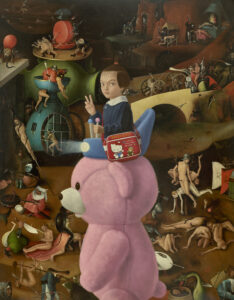
Naoko Explores the Boss’s Hell uses imagery taken from the central panel of The Last Judgment, a triptych by the Netherlandish Renaissance painter Hironymous Bosch (we believe the title given by Christie’s is an error, and that it should be Bosch’s Hell). In the background, the damned are tortured in an innumerable number of creative ways: impaled, burned, hacked to pieces, force-fed, and other ways that are representative of the sins they committed in life. Meanwhile, Naoko wanders past the viewer’s perspective atop a giant pink teddy bear, which she is operating via switches and levers. She breaks the fourth wall and flashes a peace sign to the viewer. Her presence drastically conflicts with the scenes of torture behind her. The subject and the background only serve to reinforce the former’s innocent nature and the latter’s disturbing nature.
Watanabe has been doing incredibly well in the Asian market. Of the roughly fifty Watanabe paintings sold at auction in the last five years, only two have gone unsold. The remaining works have consistently met or exceeded their estimate ranges, with 70% selling above their high estimates. So the work offered in Hong Kong on Friday was not an exception but rather the norm for the market for Watanabe’s paintings. Christie’s specialists expected the painting to sell for no more than HK$100K. However, several interested parties drove the final price beyond double that number, with the hammer coming down at HK$260K, or HK$330.2K w/p (or $42.1K w/p).

Mitsuru Watanabe Shines at Christie’s
Naoko Explores the Boss’s Hell by Mitsuru Watanabe
When one of the historical artists we specialize in has a painting come up at auction, we pay extra attention to the results. It offers a bit of a litmus test of the market for their works. However, when one of our contemporary artists comes up at auction, that’s always an extra special occasion. And this past Friday, Mitsuru Watanabe proved his continuing popularity with buyers when his Naoko Explores the Boss’s Hell smashed its presale estimate at Christie’s Hong Kong during their 20th/21st Century sale.
In his work, Watanabe draws on elements from Old Master and nineteenth-century paintings, transforming them with incredibly personal additions. Most notably, he often includes his children Naoko and Shiro in his paintings, inserting them into northern Renaissance masterworks or the paintings of Henri Rousseau.
Naoko Explores the Boss’s Hell uses imagery taken from the central panel of The Last Judgment, a triptych by the Netherlandish Renaissance painter Hironymous Bosch (we believe the title given by Christie’s is an error, and that it should be Bosch’s Hell). In the background, the damned are tortured in an innumerable number of creative ways: impaled, burned, hacked to pieces, force-fed, and other ways that are representative of the sins they committed in life. Meanwhile, Naoko wanders past the viewer’s perspective atop a giant pink teddy bear, which she is operating via switches and levers. She breaks the fourth wall and flashes a peace sign to the viewer. Her presence drastically conflicts with the scenes of torture behind her. The subject and the background only serve to reinforce the former’s innocent nature and the latter’s disturbing nature.
Watanabe has been doing incredibly well in the Asian market. Of the roughly fifty Watanabe paintings sold at auction in the last five years, only two have gone unsold. The remaining works have consistently met or exceeded their estimate ranges, with 70% selling above their high estimates. So the work offered in Hong Kong on Friday was not an exception but rather the norm for the market for Watanabe’s paintings. Christie’s specialists expected the painting to sell for no more than HK$100K. However, several interested parties drove the final price beyond double that number, with the hammer coming down at HK$260K, or HK$330.2K w/p (or $42.1K w/p).