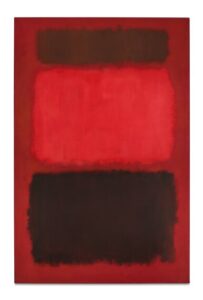
Brown and Blacks in Reds by Mark Rothko
On Thursday, May 14th, Sotheby’s location in New York hosted the first of its May Marquee sales with the collection of Robert Mnuchin. Formerly an executive at Goldman Sachs, Mnuchin retired from banking in 1990 to pursue art collecting full-time, focusing mainly on twentieth-century American artists like Jackson Pollock, Willem de Kooning, Jeff Koons, and others.
While the sale was relatively small, comprising only eleven lots, much of the attention on Thursday evening was directed at Mark Rothko’s Brown and Blacks in Reds. Created in 1957, the painting was first acquired by Seagram & Sons Inc. They displayed it in the lobby of their new Manhattan headquarters at 357 Park Avenue. This later prompted the company to commission the artist to create a series of murals for the building’s Four Seasons restaurant. Sotheby’s specialists wrote that the present work may be one of the best examples of Rothko’s ability as a colorist to evoke the breadth of human emotion. The painting includes “apprehension in maroon and peril in black; what triumphs, however, is the brilliance of hope, impressed upon the viewer in innumerable diaphanous veils of incandescent and incomprehensibly luminous red.”
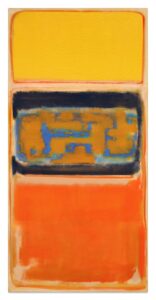
No. 1 by Mark Rothko
As the centerpiece of Mnuchin’s collection, Brown and Blacks in Reds was expected to make no less than $70 million. It surpassed this estimate handily, with the hammer coming down just shy of two-and-a-half minutes of bidding at $74 million (or $85.8 million w/p). This makes it the second-most-expensive painting by the artist to ever sell at auction, coming in just behind Orange, Red, Yellow, which sold at Christie’s in 2012 for $86.8 million w/p.
The work of Mark Rothko was an essential part of Mnuchin’s collection. So it’s not surprising that another example of the artist’s work was present on Thursday evening. No. 1 is an earlier work, dating to around 1949. According to Rothko experts, this was when he was on the cusp of his mature period, during which he perfected his signature color-field paintings. In fact, No. 1 shows the artist’s transitory period between the color fields and his previous series of Multiforms, which he had been working on since 1946. While not as astronomically valuable as the previous Rothko, No. 1 was given an estimate range of $15 million to $20 million. Auctioneer Oliver Barker eventually closed the lot at $17.5 million (or $20.8 million w/p).
After the Rothkos, there was Franz Kline’s 1960 work Harleman. Described as “architectonic” by Sotheby’s specialists, the painting is an eight-and-a-half-foot-wide series of monumental black brushstrokes meant to evoke the emerging urbanity of the post-war era. It has only been at auction once before, at a Christie’s sale in November 1983, where it sold for $460K. This time around, it was estimated to sell for between $12 million and $18 million. The final bid came in right on the low estimate, with Barker closing things at $12 million (or $14.5 million w/p).
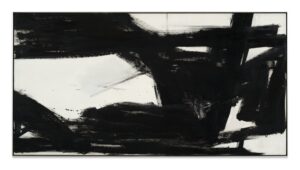
Harleman by Franz Kline
The Mnuchin collection sale at Sotheby’s was a resounding success. It’s not surprising that the short auction did very well, since every one of the eleven lots was a guaranteed property. Of the available lots, seven of them sold within their estimates, giving Sotheby’s a 64% accuracy rate. Only one lot sold below estimate, an untitled work by the sculptor John Chamberlain, which sold for $300K (or $384K w/p) against a $400K low estimate. An additional three lots (27%) sold above estimate. With a total low estimate of $124.9 million, the Mnuchin collection surpassed that mark and achieved $141.25 million, or $166.3 million w/p.

The Mnuchin Collection at Sotheby’s
Brown and Blacks in Reds by Mark Rothko
On Thursday, May 14th, Sotheby’s location in New York hosted the first of its May Marquee sales with the collection of Robert Mnuchin. Formerly an executive at Goldman Sachs, Mnuchin retired from banking in 1990 to pursue art collecting full-time, focusing mainly on twentieth-century American artists like Jackson Pollock, Willem de Kooning, Jeff Koons, and others.
While the sale was relatively small, comprising only eleven lots, much of the attention on Thursday evening was directed at Mark Rothko’s Brown and Blacks in Reds. Created in 1957, the painting was first acquired by Seagram & Sons Inc. They displayed it in the lobby of their new Manhattan headquarters at 357 Park Avenue. This later prompted the company to commission the artist to create a series of murals for the building’s Four Seasons restaurant. Sotheby’s specialists wrote that the present work may be one of the best examples of Rothko’s ability as a colorist to evoke the breadth of human emotion. The painting includes “apprehension in maroon and peril in black; what triumphs, however, is the brilliance of hope, impressed upon the viewer in innumerable diaphanous veils of incandescent and incomprehensibly luminous red.”
No. 1 by Mark Rothko
As the centerpiece of Mnuchin’s collection, Brown and Blacks in Reds was expected to make no less than $70 million. It surpassed this estimate handily, with the hammer coming down just shy of two-and-a-half minutes of bidding at $74 million (or $85.8 million w/p). This makes it the second-most-expensive painting by the artist to ever sell at auction, coming in just behind Orange, Red, Yellow, which sold at Christie’s in 2012 for $86.8 million w/p.
The work of Mark Rothko was an essential part of Mnuchin’s collection. So it’s not surprising that another example of the artist’s work was present on Thursday evening. No. 1 is an earlier work, dating to around 1949. According to Rothko experts, this was when he was on the cusp of his mature period, during which he perfected his signature color-field paintings. In fact, No. 1 shows the artist’s transitory period between the color fields and his previous series of Multiforms, which he had been working on since 1946. While not as astronomically valuable as the previous Rothko, No. 1 was given an estimate range of $15 million to $20 million. Auctioneer Oliver Barker eventually closed the lot at $17.5 million (or $20.8 million w/p).
After the Rothkos, there was Franz Kline’s 1960 work Harleman. Described as “architectonic” by Sotheby’s specialists, the painting is an eight-and-a-half-foot-wide series of monumental black brushstrokes meant to evoke the emerging urbanity of the post-war era. It has only been at auction once before, at a Christie’s sale in November 1983, where it sold for $460K. This time around, it was estimated to sell for between $12 million and $18 million. The final bid came in right on the low estimate, with Barker closing things at $12 million (or $14.5 million w/p).
Harleman by Franz Kline
The Mnuchin collection sale at Sotheby’s was a resounding success. It’s not surprising that the short auction did very well, since every one of the eleven lots was a guaranteed property. Of the available lots, seven of them sold within their estimates, giving Sotheby’s a 64% accuracy rate. Only one lot sold below estimate, an untitled work by the sculptor John Chamberlain, which sold for $300K (or $384K w/p) against a $400K low estimate. An additional three lots (27%) sold above estimate. With a total low estimate of $124.9 million, the Mnuchin collection surpassed that mark and achieved $141.25 million, or $166.3 million w/p.