
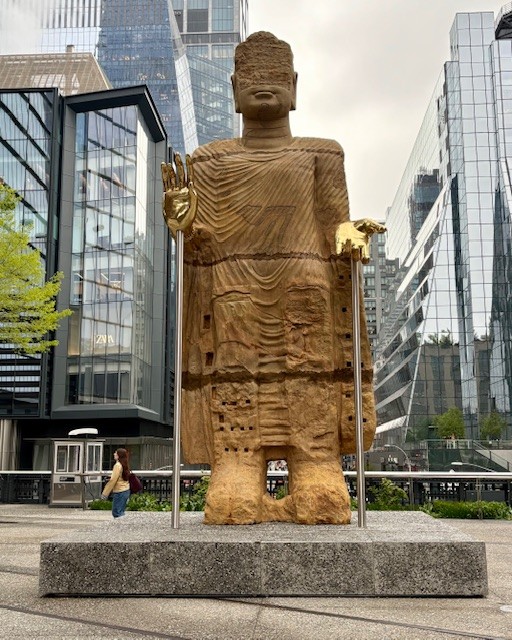
The Light That Shines Through the Universe by Tuan Andrew Nguyen
As part of the public art project on Manhattan’s High Line, Tuan Andrew Nguyen’s The Light That Shines Through the Universe pays homage to destruction and memory by evoking the imagery of Buddha sculptures destroyed by the Taliban.
One of the first articles I ever wrote was about the Buddhas of Bamiyan, a series of colossal Buddhist sculptures in Afghanistan. The sixth-century sculptures, carved directly into a limestone cliff face, were destroyed in 2001 on the orders of the Taliban’s supreme commander, Muhammad Omar, who considered them idols. Writing in September 2021, I remarked that the destruction of these sculptures may be an ominous warning for the artistic community of Afghanistan since the Taliban regained control of the country that year.
The Light That Shines Through the Universe is the fifth sculpture installed on the plinth along the High Line, the former elevated railway transformed into a public walkway and green space on Manhattan’s west side. Similar to the Fourth Plinth in Trafalgar Square—originally an empty pedestal now used for rotating contemporary artworks by international artists—the High Line plinth serves as a dedicated site for temporary public art installations. It is located on a platform overlooking the intersection of 10th Avenue and 30th Street.
Nguyen has been the focus of several major solo exhibitions, including at the New Museum, the Fondació Joan Miró, the Smithsonian American Art Museum, and the Art Institute of Chicago. He is the recipient of the Joan Miró Prize and a MacArthur Fellowship, and recently unveiled major commissions at the National Gallery Singapore and the Princeton University Art Museum.
In his sculpture, Nguyen has created a work that comments on destruction, heritage, censorship, and memory. The buddha, made of sandstone measuring 27 feet tall, is modeled after the design of one of the Buddhas of Bamiyan. Nguyen, however, has added a pair of hands to the sculpture. The hands make two distinct gestures, both found extensively in Buddhist and Hindu iconography. The right hand is raised in the abhayamudra form, signifying peace and calm. Meanwhile, the left hand is made into a varadamudra, meaning generosity. The sculpture’s original hands were destroyed several hundred years ago, so these are a product of the artist’s imagination. Furthermore, the hands are not attached to the whole; they rest on supports in front of where the hands would be. According to the artist, the hands themselves are made from brass repurposed from artillery pieces used in Afghanistan. Nguyen has used repurposed metal in his previous work, primarily unexploded ordnance (bombs, shells, grenades, landmines, etc.) from Vietnam, the country of his birth. The High Line website notes that replacing the Buddha’s hands with metallic ones also alludes to the prosthetic appendages worn by amputees. “By leaving a noticeable gap between the prosthetics and the body, Nguyen poetically suggests that while some damage may be irreparable, there is still hope and potential to heal the land, the spirit, and the people that have experienced tremendous destruction.”
Though the sculpture differs from the destroyed buddha, it was never meant to be an exact replica. According to the High Line’s website, Nguyen’s work is supposed to be “an echo, intended to invoke the memory of these lost cultural treasures.” The Light That Shines Through the Universe replaces Iván Argote’s sculpture Dinosaur, which gained popularity online. Nguyen’s work will be on display on the High Line through the fall of 2027.