
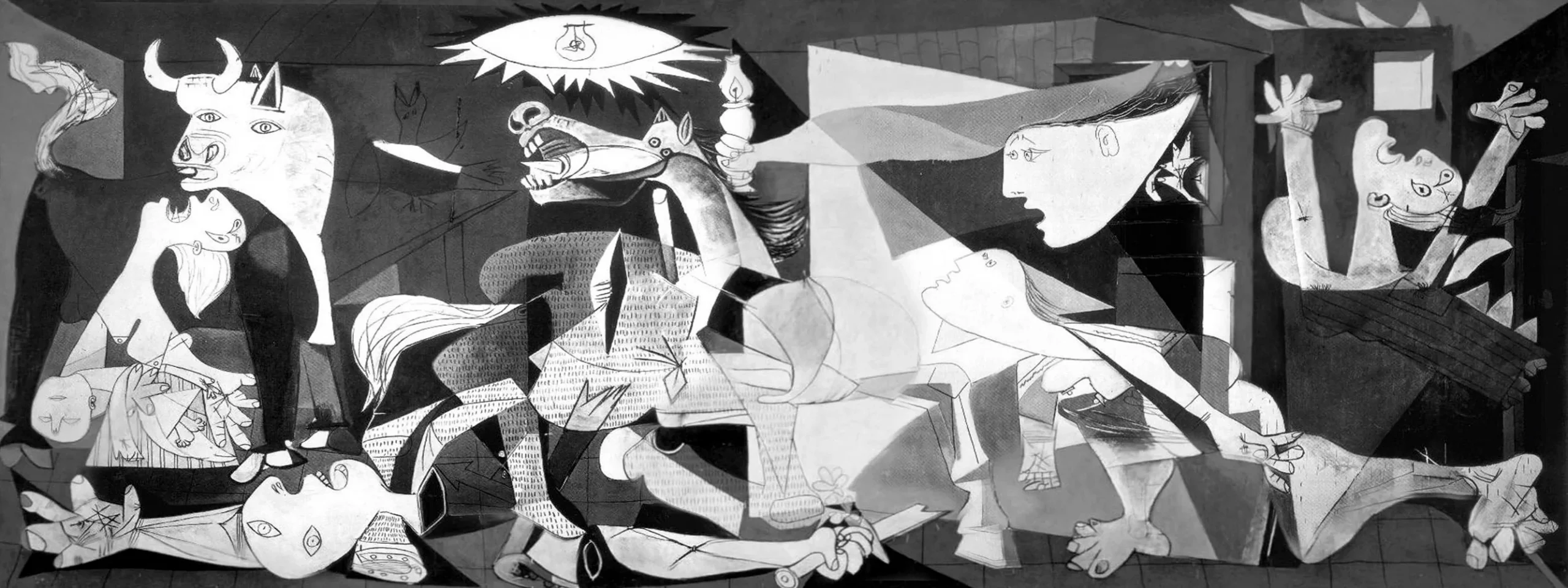
Guernica by Pablo Picasso
Pablo Picasso’s masterpiece Guernica is at the center of a cultural fight in Spain after the Reina Sofía Museum refused to loan it to the Museo Guggenheim Bilbao. The regional government of the Basque Country has submitted a petition to the Ministry of Culture to approve the painting’s temporary transfer to the Guggenheim in honor of the ninetieth anniversary of the Guernica bombing, the event that inspired Picasso to create the painting.
The question of where the painting should be exhibited has a long history. After General Francisco Franco’s victory in the Spanish Civil War in 1939, Picasso had the painting moved to the United States. He entrusted it to the care of the Museum of Modern Art in New York, but the work was temporarily loaned to many American and international institutions. In his lifetime and in his will, Picasso stipulated that Guernica should not be exhibited in Spain unless democracy had been restored to the country. Picasso passed away in 1973, with Franco outliving him only by two years. Following Franco’s death, Spain underwent a transition from an authoritarian dictatorship to a democratic constitutional monarchy, culminating in the adoption of a new constitution in 1978.
MoMA agreed to relinquish its control of the painting in 1981. There was some initial resistance for several reasons. Firstly, the museum was not entirely ready to part with one of its collection highlights. But furthermore, some believed that a constitutional monarchy was not what Picasso had in mind when he spoke of the restoration of democracy. Rather, he meant the restoration of a republic, like the one that existed before the Spanish Civil War. Guernica was moved to the Prado Museum, where Picasso wanted it displayed. Over a million people visited the Prado to see Guernica within a year of its return. In 1992, the painting was moved again, this time to the brand new Reina Sofía Museum, which had a gallery purpose-built for the work. The Reina Sofía was and continues to be the country’s national collection of twentieth-century art.
Since the painting’s return to the country, Basque nationalists have proposed that Guernica be loaned or permanently moved to a museum in the Basque Country. These proposals have been bolstered since the 1997 establishment of the Guggenheim Bilbao, which has become the third-most-visited museum in the country, just slightly behind the Reina Sofía.
Of course, it is evident why Basque politicians wish to keep the painting in a Basque cultural institution. The town of Guernica lies twenty kilometers east of Bilbao. In an attempt to aid Franco during the civil war, the Nazi German and Italian fascist air forces bombed the town, killing several hundred civilians. The incident was not only exemplary of fascist violence and disregard for human life, but it is also a significant part of the Basque people’s history of subjugation.
The central Spanish government, both during the monarchy and under Franco, attempted modern state-building by encouraging the formation of a single, cohesive national identity. In doing so, some of the most distinct aspects of regional Spanish cultures were actively suppressed. In terms of language, Castilian was held up as the only legitimate form of Spanish. The use of other Spanish languages, such as Catalan, Galician, and, importantly, Basque, was suppressed. Franco in particular adopted a strict language policy, forbidding these regional languages in both the administration and the school system. Even giving one’s child a name from these languages was discouraged. Slogans such as “If you are Spanish, speak Spanish!” became particularly popular among Francoists to help shift social norms surrounding language. The bombing of Guernica was therefore significant not only in the context of the Spanish Civil War but also of the Basque struggle for autonomy.
Specialists at the Reina Sofía have said they oppose moving the painting, mainly because of its condition. They have stated that the work is “particularly susceptible” to damage, including “new cracks, lifting and detachment of the paint layer, as well as tears in the support”. To avoid such damage, they recommend keeping the painting at the Reina Sofía, where its condition is stabilized thanks to “rigorous environmental controls”.
Spain’s prime minister, Pedro Sánchez, could intervene on this issue in favor of loaning Guernica to the Guggenheim. This would certainly score him points with the members of the two main Basque political parties represented in Spain’s Parliament, whose support he needs to maintain his governing coalition. Sánchez, however, has previously deferred to his culture ministry when the Basque autonomous government has made similar requests.