
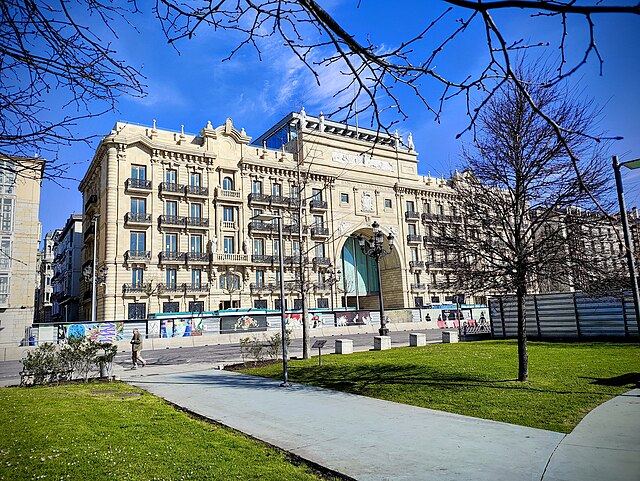
The Faro Santander Building (image courtesy of Emilio Gómez Fernández)
Mexico’s cultural sector is protesting against an agreement that would move an important Mexican art collection, featuring several works by Frida Kahlo and Diego Rivera, to a cultural center in Spain. Some say the move is temporary, but many are skeptical.
The Gelman collection consists of around three hundred works of Mexican art previously owned by the Russian-born Mexican film producer Jacques Gelman and his wife, Natasha. Jacques became well-known in the Mexican film industry, most notably for producing the films of the renowned Mexican comic actor Cantinflas. The Gelmans were also great art patrons, forming relationships with artists like Frida Kahlo and Diego Rivera, with the latter painting Natasha’s portrait in 1943. Important works by Kahlo in their collection include Self-Portrait with Monkeys and Diego on My Mind. They also collected works by other prominent Mexican artists, including José Clemente Orozco, Rufino Tamayo, David Alfaro Siqueiros, and others. Additionally, they amassed a collection of Mexican photography, including works by Kahlo’s father, Guillermo.
In 2023, the Zambrano family, owners of the Mexican building materials company Cemex, purchased the collection. Recently, the family secured a deal with the Spanish bank Santander for one hundred sixty of the collection’s works to be managed by the bank’s new cultural center, the Faro Santander, located in the northern Spanish region of Cantabria. This arrangement has prompted a strong response from Mexico’s cultural sector, as the fear exists that many works, which the Mexican government is legally required to protect, may leave the country permanently. Since 1984, Mexican cultural law has recognized the entire creative output of Frida Kahlo as an “artistic monument”. Rivera and Orozco’s work has been similarly recognized as such since 1959. The decree giving Kahlo’s work this particular status includes the added protection that the National Institute of Fine Arts & Literature (INBAL) is therefore required to ensure that any of her works are only permitted to leave Mexico temporarily. However, based on what has been said about the agreement with Santander, the Gelman collection may be exhibited in Spain for a longer period than is legally permitted.
Concerned Mexican cultural workers have attached their names to an open letter opposing the Gelman collection’s move to Spain. The letter states that “the Ministry of Culture and INBAL have maintained a lack of transparency regarding the agreement”. The letter highlights that Santander may intend for the works to remain in Spain more or less permanently. The director of Faro Santander, Daniel Vega Pérez, was quoted in the Spanish newspaper El País in January, describing the cultural law that protects the artists’ work as “flexible”. He further said that INBAL can grant extensions to the export licenses it issues, and that the Gelman collection would be a “permanent but dynamic presence” at the new institution. The letter further states, “The citizens of this country have the right to be fully informed about the reasons that have led these authorities to allow the indefinite removal of eleven Kahlo canvases from the country”. The signatories claim that INBAL “has failed to fulfill its mandate” and they call upon the organization to “rectify this unfortunate situation by complying with and enforcing the legislation”. By the end of March 2026, the letter had nearly four hundred signatures.
At a press conference on March 26th, Mexico’s president, Claudia Sheinbaum, stated, speaking on behalf of herself and her culture minister, Claudia Curiel de Icaza, that “we wish for [the collection] to remain in Mexico”. Curiel de Icaza also stated that the collection would return to Mexico by 2028.