
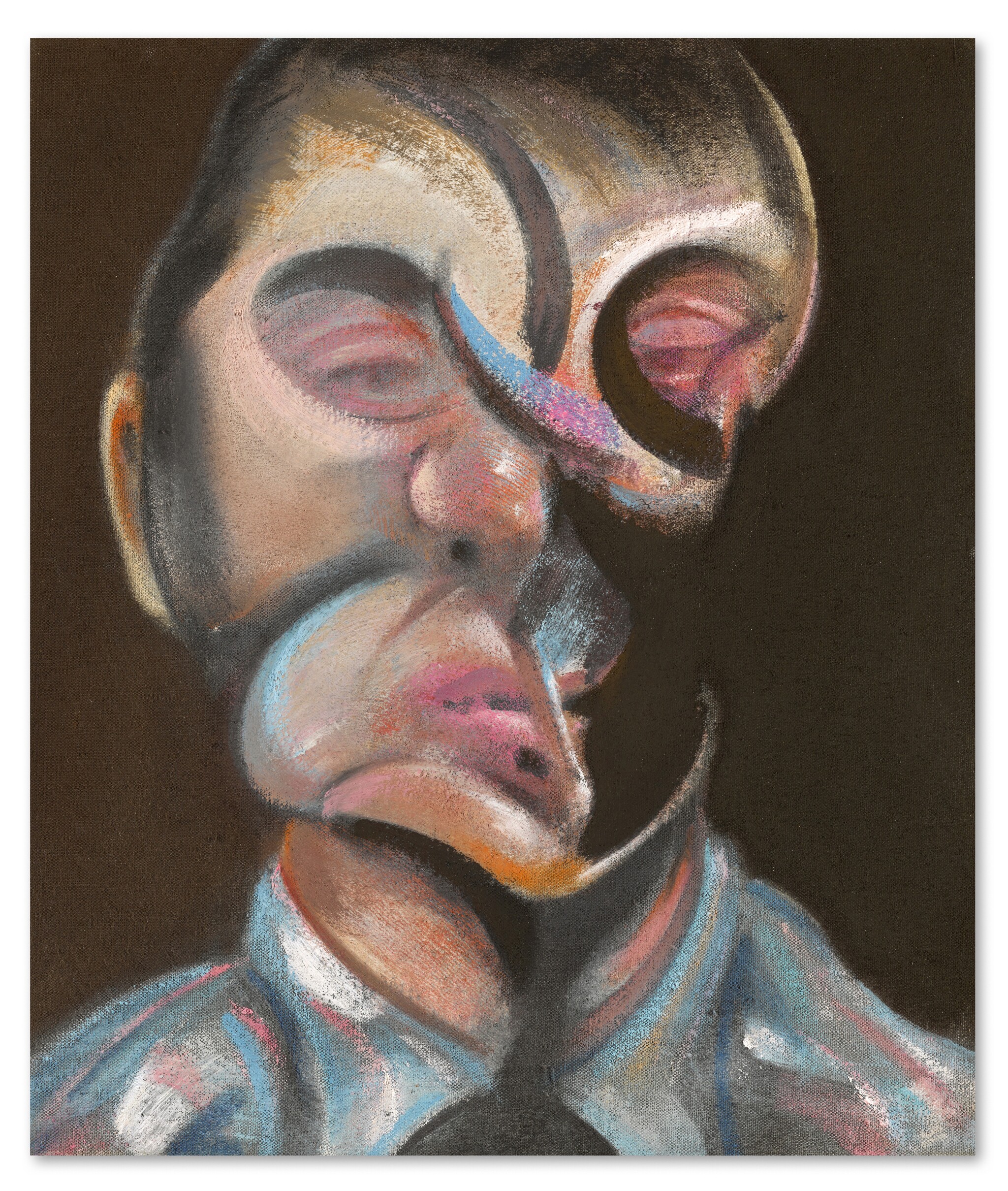
Self-Portrait by Francis Bacon
On Wednesday, March 4th, Sotheby’s kicked off a series of modern art sales at their location in London with their Modern & Contemporary Art evening auction. The evening featured fifty-three lots, mainly showcasing late nineteenth- and twentieth-century European and North American painting and sculpture.
Of course, the expected star of the show was Francis Bacon’s 1972 self-portrait. This was one of nine self-portraits Bacon created that year, and marks the early years of the artist’s morose, introspective turn following the death of his partner George Dyer. According to Martin Harrison, the editor of Bacon’s catalogue raisonné, this self-portrait shows a strong influence from the pastels of Edgar Degas, as seen in the blue and pink shades accenting the artist’s face. But despite these brighter colors, the composition hints at Bacon’s fixation with death and decay. Sotheby’s specialists write that the self-portrait gives us “a face in the act of becoming undone, yet held, paradoxically by an intelligence of paint so controlled that the very brutality becomes a kind of order.”
The painting has had only two owners since the artist gave it away in 1983. The collector who consigned it to Sotheby’s had previously bought it at that same location in 1994, where it sold for £364.5K w/p. With the market for Bacon’s work becoming far more robust in the last thirty years, it wasn’t terribly surprising that Sotheby’s specialists gave the Bacon self-portrait an estimate range of £8 million to £12 million. Bidders on Wednesday fought over the painting, driving the final hammer price beyond the high estimate, landing at £13.5 million (or £16.04 million / $21.4 million w/p).
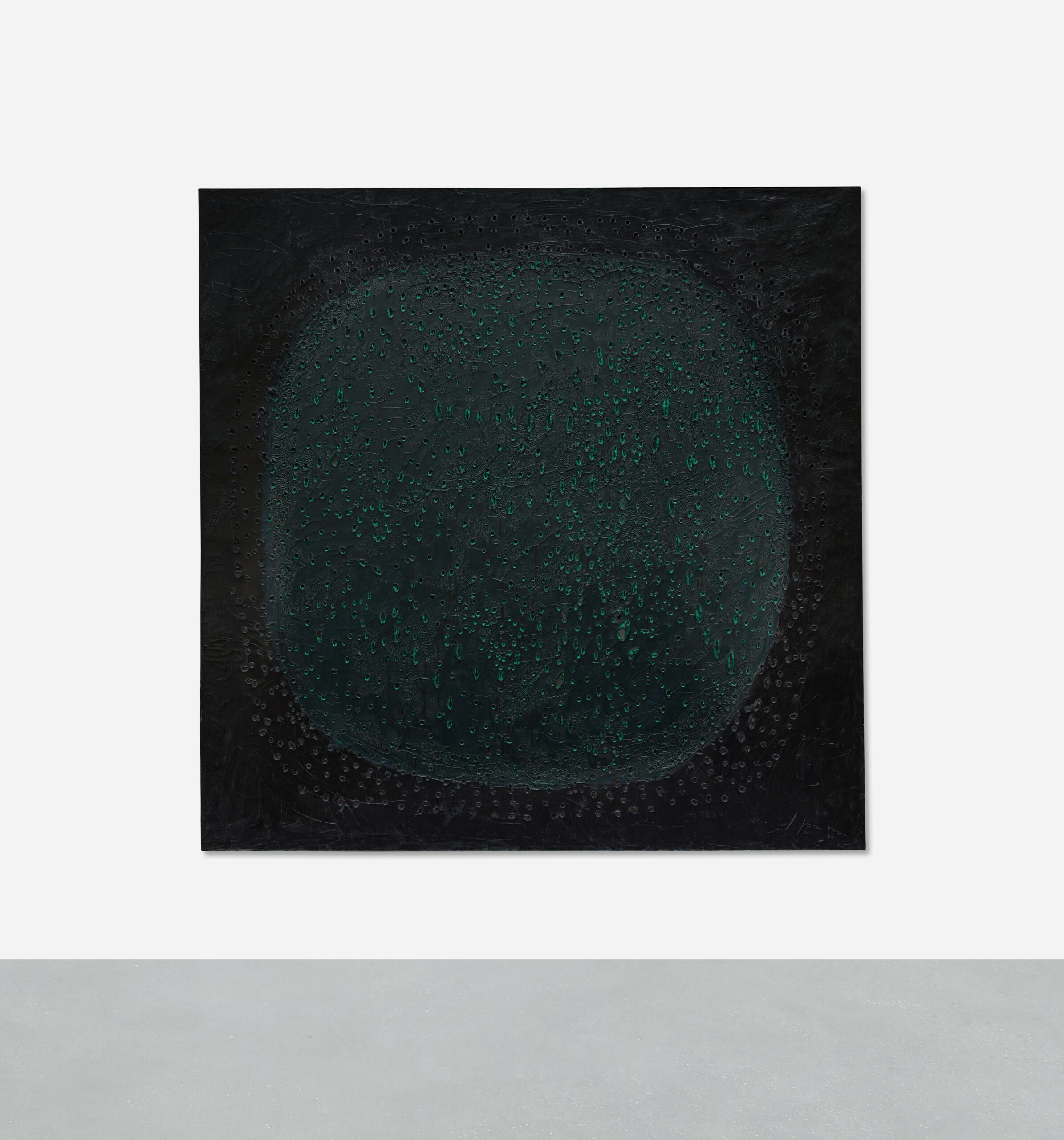
Concetto spaziale by Lucio Fontana
Along with the Bacon self-portrait, Concetto spaziale by Lucio Fontana was the only other work in the sale with a high estimate above £10 million. Created in 1960, the work is an example of Fontana’s experimentations with altering the canvas itself as a form of artistic expression. A canvas painted a single color disrupted by slashes is probably the most recognizable way Fontana chose to mess with the support. However, here, he has created a series of holes highlighted by oil paint applied in a thick impasto. While the linear slash was a much more recent development in Fontana’s work, punching holes in the canvas was something he had been doing since 1948. Both the slash and the holes, however, are part of the same experimentation with artistic media. As Fontana said, “I have not attempted to decorate a surface, but on the contrary; I have tried to break its dimensional limitations.” Concetto spaziale, however, fell just short of its £8.5 million low estimate, selling for £8.1 million (or £9.8 million / $13.1 million w/p).
And finally, it wouldn’t quite be a modern art sale without a major Impressionist. Claude Monet created Maison de jardinier in 1884 during a trip to Bordighera, a small town on the Mediterranean coast in Liguria in northern Italy. He had planned to stay for three weeks, but ended up staying for three months. In a letter to his wife, Alice, Monet said he found it very difficult to capture the lush, varied vegetation surrounding the town, including wildflowers, citrus trees, and palms. The painting offered at Sotheby’s features houses among a grove of orange and lemon trees. The painting’s first owner was Monet’s friend and artistic contemporary John Singer Sargent, who wrote to Monet when he first acquired it, receiving it in exchange for an Alexandre Falguière painting. The painting last crossed the block in 2007, where it sold at Sotheby’s for £4.05 million w/p. It fared somewhat better this time around, selling slightly above the low estimate at £6.7 million (or £8.22 million / $10.9 million w/p).
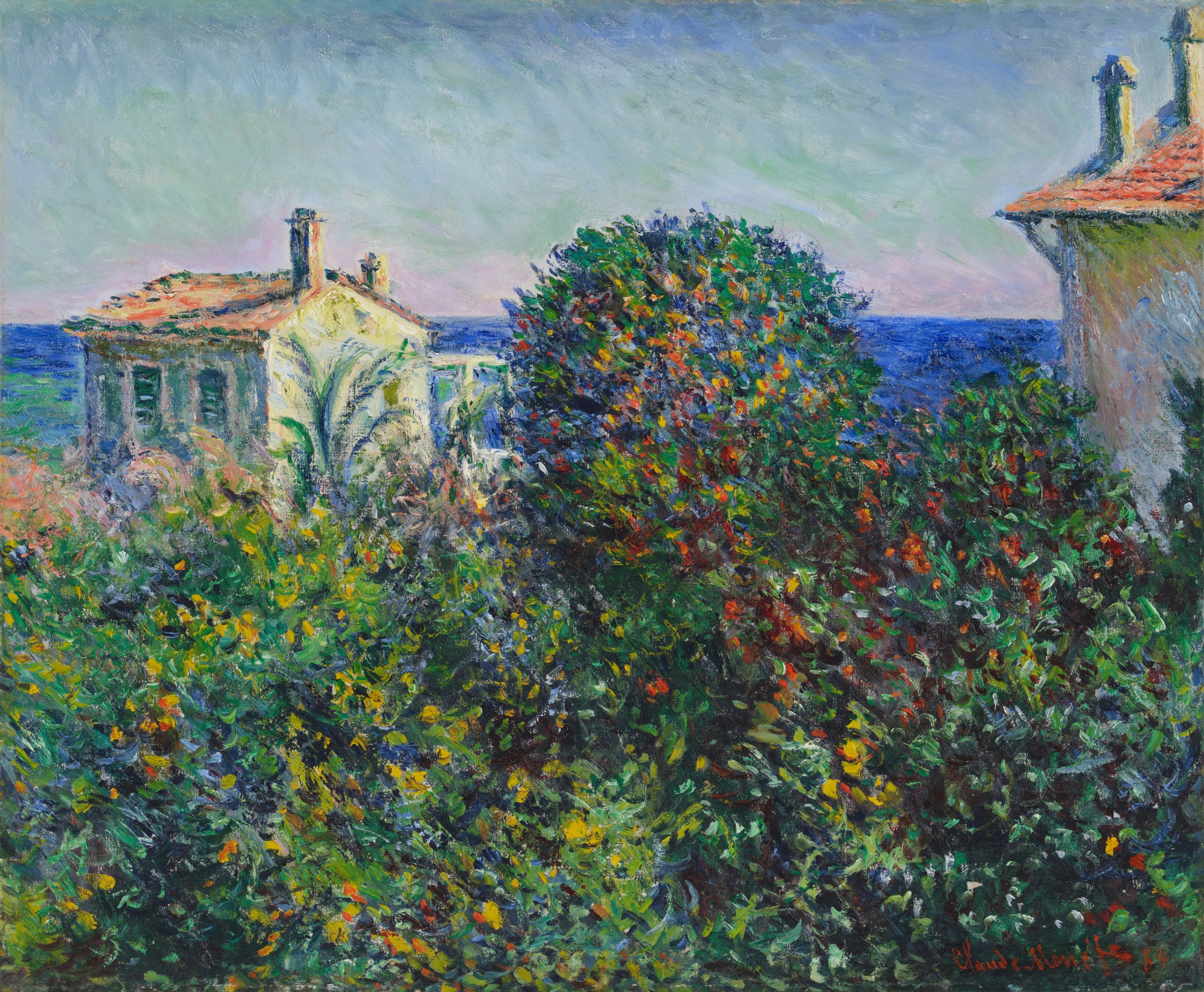
Maison de jardinier by Claude Monet
While a good portion of Wednesday’s lots sold above their estimates, only one lot was a true surprise. Children’s Swimming pool, 11 o’clock Saturday morning, August by the post-war British artist Leon Kossoff is considered one of the artist’s most iconic works. It was created in 1969 as part of a series Kossoff executed between 1969 and 1972. The subject is a public swimming pool in the northwest London neighborhood of Willesden. With a high estimate of £800K, the Kossoff achieved more than five times what Sotheby’s specialists expected. With a hammer price of £4.2 million (or £5.2 million / $6.9 million w/p), Children’s Swimming pool set the new auction record for the artist, blowing away the previous titleholder, Willesden Junction – Autumn Afternoon, which sold at Christie’s in 2018 for £1.38 million w/p.
In some regards, the evening sale did rather well. With eighteen of the fifty-three available lots selling within their estimates, Sotheby’s specialists walked away with a 34% accuracy rate. With another twenty-two lots (42%) selling below and eleven lots (21%) above, the sale overall achieved a 96% sell-through rate. Against a total pre-sale minimum estimate of £97.15 million, the available lots brought in £102.5 million, or £130.9 million / $174.9 million w/p.