
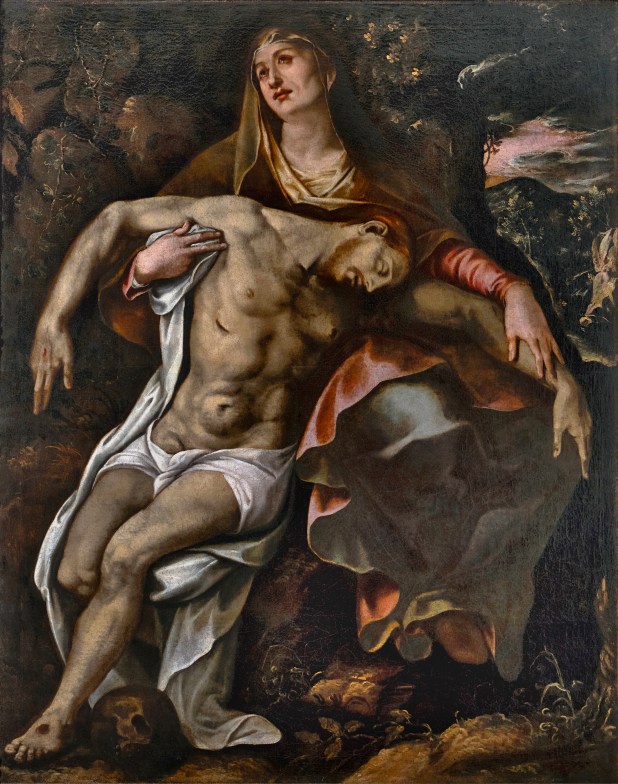
Pietà Spirituali
A segment of the art-historical community may find itself divided into camps after one man has attributed a painting to the Renaissance master Michelangelo.
While the frescoes of the Sistine Chapel are some of Michelangelo’s best-known works, he first and foremost considered himself a sculptor. While he received his artistic training in the workshop of the painter Domenico Ghirlandaio, Michelangelo famously disliked painting. This is why so few of Michelangelo’s paintings exist. Apart from frescoes he did at the Vatican, only two paintings are confirmed to have been created by the master: The Entombment at London’s National Gallery and the Doni Tondo at the Uffizi, both created while the artist was in his late twenties and early thirties. Another two paintings, the Manchester Madonna and The Torment of Saint Anthony, are often attributed to Michelangelo, but there is no scholarly consensus on their authorship. One art historian, however, now claims he has found another painting potentially by Michelangelo, which would be an incredible discovery.
The Belgian scholar Michel Draguet, a professor at the Université Libre de Bruxelles and former director of the Royal Museums of Fine Arts, has now asserted the authenticity of a painting he calls the Pietà Spirituali. A pietà is a work of religious art showing the Virgin Mary cradling the lifeless body of Jesus following his crucifixion. The most famous version of a pietà is a sculpture that Michelangelo created when he was around 24 years old.
Pietà Spirituali originally appeared at the Genoa auction house Wannenes in 2020. Despite the modest high estimate of €3,000, it eventually sold for €87,600 w/p. The auction house did not attribute the painting to any artist, only describing it as the work of a sixteenth- or seventeenth-century painter. The catalogue authors wrote that the painting appears to draw heavily on “Tuscan-Roman influences,” including the works of Andrea del Sarto, Pontormo, Francesco Salviati, and Michelangelo. They further wrote that the work also appears inspired by late Mannerist artists like Federico Zuccari and Jacopino del Conte.
In his report, Draguet wrote that several parts of the painting indicate Michelangelo’s technique. He claims that the figures bear anatomical similarities to several of Michelangelo’s graphic works, like Il Sogno and Bacchanal of Children. He also claims that at the bottom of the canvas is a symbol that resembles a monogram Michelangelo sometimes used in letters. Additional chemical tests performed at Belgium’s Royal Institute for Cultural Heritage confirmed that the materials used date to 1520 to 1580, which slightly overlaps with Michelangelo’s lifespan.
Draguet also points to documentary evidence of the painting’s existence in Viterbo in the 1540s. Letters refer to a pietà painting by Michelangelo owned by the English cardinal Reginald Pole. This is where Draguet came up with the painting’s title. The Spirituali were a Catholic movement in sixteenth-century Italy that sought to bridge some of the gaps between the Church and the protestant sects that had emerged in recent decades. Cardinal Pole was associated with the Spirituali, as was Michelangelo’s close friend, the poet Vittoria Colonna.
Some have criticized Draguet for perhaps jumping the gun a little. First of all, he is not a specialist in Renaissance art. His area of study, rather, is the work of nineteenth- and twentieth-century Belgian surrealists and symbolists, namely René Magritte and Fernand Khnopff. Others say that the presence of the monogram may be evidence contradicting the claim that Michelangelo created the painting. Michelangelo never signed any of his works, except for his pietà sculpture at the Vatican. In covering the story, the French newspaper Le Figaro spoke with a French art historian specializing in the Renaissance, who said the painting appears to be a genuine sixteenth-century work. Still, they have doubts about Draguet’s authorship claims. “I don’t believe in Michelangelo’s monograms. The majority of great Italian artists rarely signed their works. This signature is rather detrimental to the painting”. The British art historian and Renaissance specialist David Ekserdjian also commented that stylistically, the painting does not match anything that Michelangelo did. He also asked why, if this was a painting by Michelangelo, hadn’t anyone mentioned it until now? Ekserdjian and others have noted that Michelangelo was, among Renaissance artists, “incomparably, the most documented in terms of artistic biography”. Two of his contemporaries, Giorgio Vasari and Ascanio Condivi, wrote separate biographies on him. If Michelangelo had created this painting, surely one or both of them would have mentioned it.
Le Figaro also claimed that the paintings’ two owners may be trying to replicate the success of Salvator Mundi, a rediscovered painting purportedly by Leonardo that sold at Christie’s in 2017 for $450 million. Draguet, however, denied that this was the case as the owners have no plans to sell the work.