
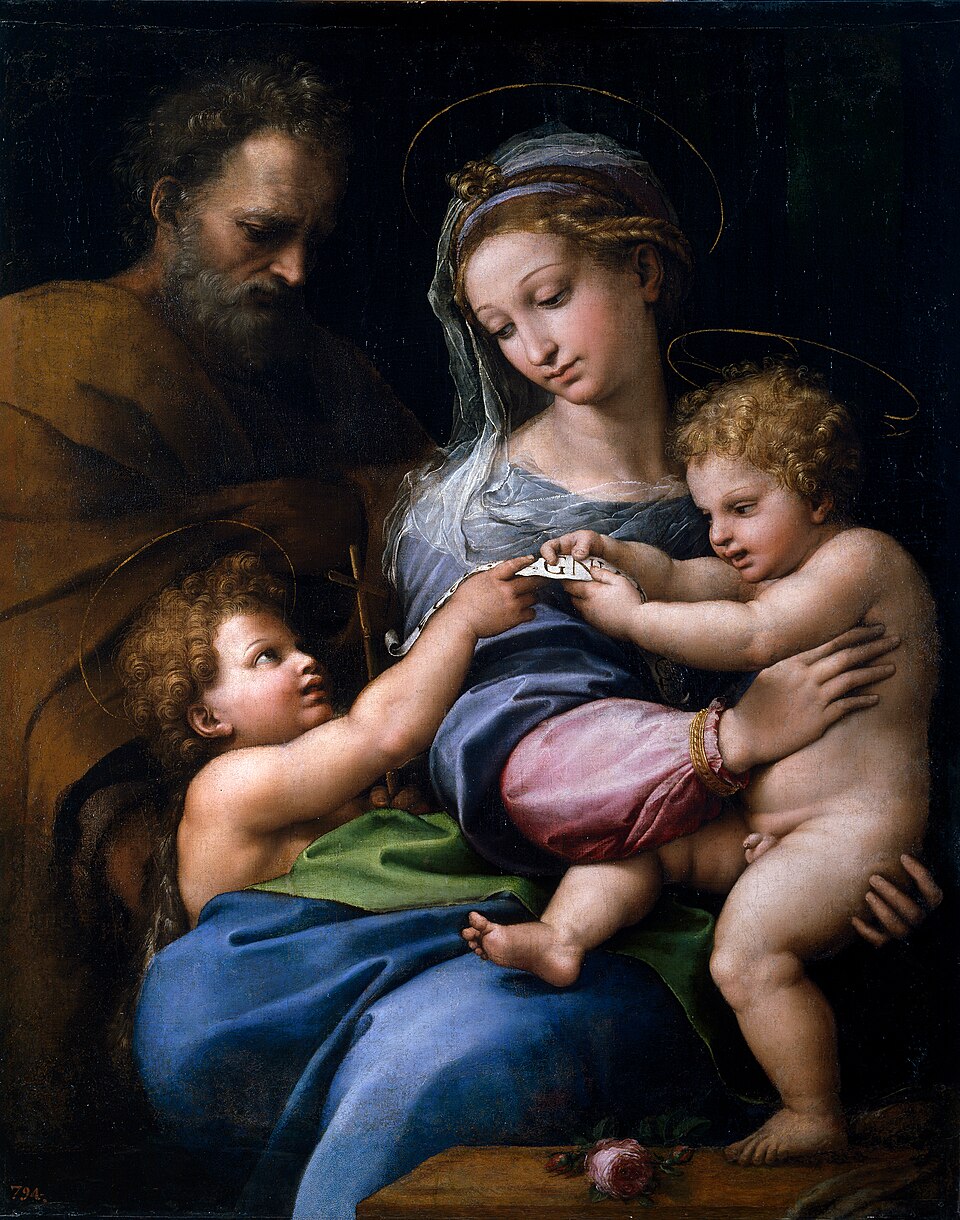
Madonna of the Rose by Raphael
On Sunday, March 29th, New York’s Metropolitan Museum of Art opened the first-ever retrospective of the Renaissance master Raphael by an American museum.
The exhibition, titled Sublime Poetry, was a monumental undertaking that required collaboration with dozens of cultural institutions and private collectors. The museums that loaned works to the Met for the exhibition include the Louvre, the Uffizi, the Vatican Museums, the Galleria Borghese, the Palazzo Barberini, the Rijksmuseum, the Prado, the British Museum, the Ashmolean Museum, the Victoria & Albert Museum, London’s National Gallery, Boston’s Gardner Museum, the Getty Museum, the Morgan Library, and the royal collections of both Britain and Spain. Since the exhibition is a retrospective, the Met curators were not trying to make a specific art-historical argument. Rather, this was a comprehensive overview of Raphael’s life and work.
They begin, appropriately, at the beginning, with Raphael’s background in Urbino. The first galleries mainly feature work by Raphael’s predecessors, such as Fra Carnevale, Pietro Perugino (in whose workshop Raphael was apprenticed), and the artist’s own father, Giovanni Santi. Their inclusion underscores Raphael’s role as heir to a legacy of naturalism and detail. However, they also show how Raphael, even as a young artist, defied some of the painting conventions that his teachers still adhered to. This included having the figures’ size proportional to their importance. This was seen in several Perugino paintings, such as Saint Augustine and the Madonna della Consolazione. The titular figures are significantly larger than the others, eschewing realism in favor of stylization and symbolism.
Raphael completely omits this practice and makes all human figures the same size, furthering his dedication to naturalism. Met curators managed to secure a loan from the Pinacoteca Comunale in Città di Castello, the town in Umbria where Raphael worked in his early career. The Processional Banner of the Confraternity of the Santissima Trinità is credited as the first work Raphael ever painted independently of his master, Perugino. The work is two paintings that used to be the recto and verso of the same piece, but are now separated and displayed side-by-side. One half shows the Crucifixion with Saints Sebastian and Roch, the other shows God taking one of Adam’s ribs to create Eve. The paintings are in poor condition, yet it is clear that, regardless of importance, all the figures are proportional to each other.
Later on, Sublime Poetry features work by the other Renaissance giants. For example, curators display sketches by Da Vinci and paintings made in the Leonardesque style to show the differences between Raphael and his contemporaries. Leonardo worked in a quick, almost impressionistic style in sketches and drawings, very different from Raphael’s smooth, precise draughtsmanship. But Raphael was also greatly influenced by Michelangelo, specifically his sculptural monumentality. Raphael and Michelangelo never had the best personal relationship, since they were both competing for commissions at the papal court. However, despite the tension, Raphael expressed great admiration for Michelangelo and his work in sculpture. Both artists were also greatly influenced by classical Greco-Roman sculpture, a second-century example of which was on display next to Raphael’s preparatory drawings for his 1507 painting The Deposition.
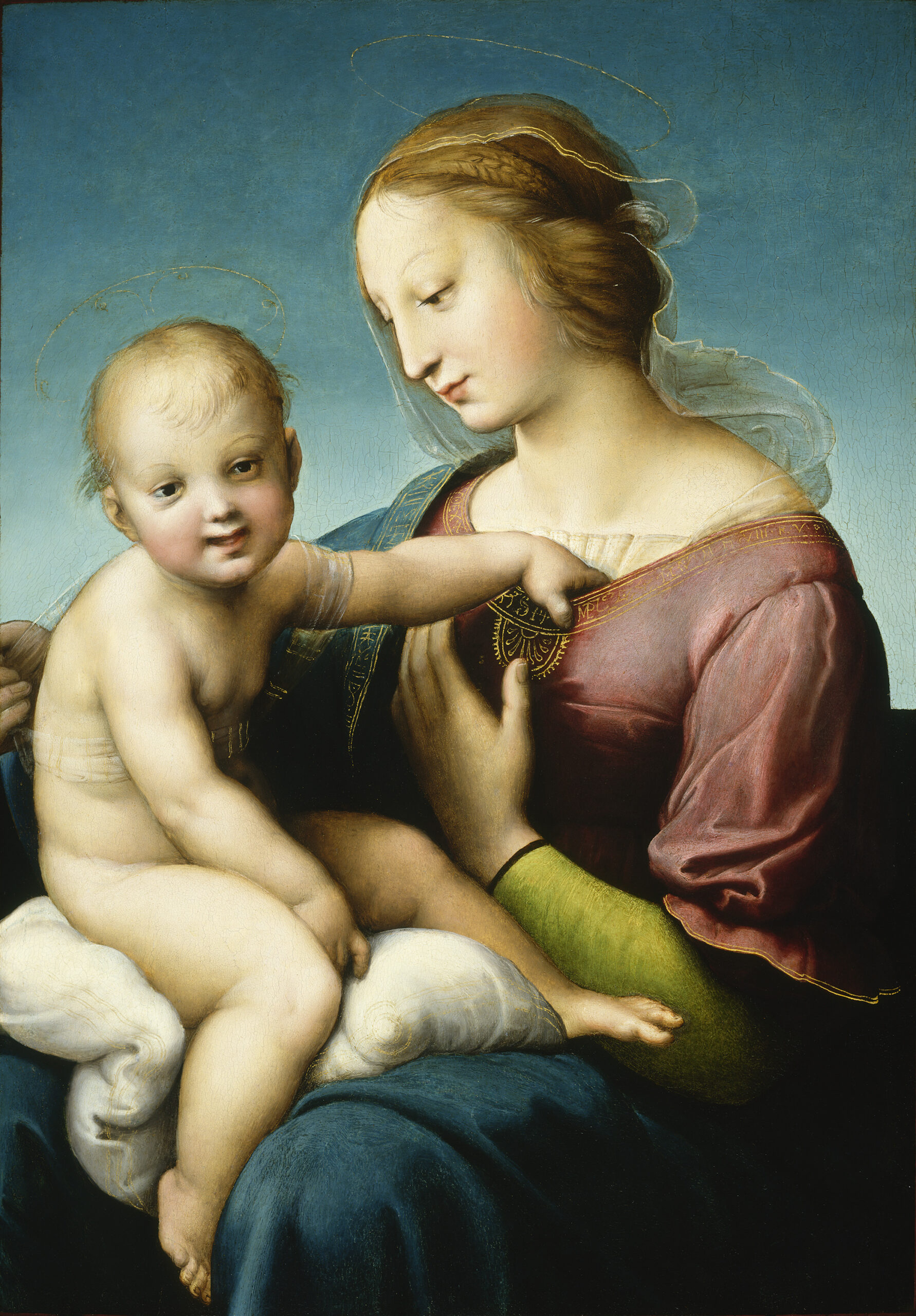
The Niccolini-Cowper Madonna by Raphael
In the exhibition, great attention was given to one of Raphael’s most famous objects: the Madonna and Child. Exhibition curators provide several sources of inspiration for the artist, including the history of this subject, dating back to the Madonna Eleusa, an influential Byzantine icon also known as the Virgin of Tenderness. However, they also go into detail about the importance of affectionate motherhood in an era where relatively little scientific information was available about pregnancy. Raphael’s own mother died from childbirth-related complications in 1491. And yet Raphael often attempted to introduce not only realism but playfulness into his mother-and-child paintings. The Niccolini-Cowper Madonna, for example, features the Christ Child innocently tugging at his mother’s shirt. The Madonna of the Rose features the Baby Jesus and an infant John the Baptist fighting over a piece of ribbon or scroll containing a fragment of text. Similarly, the Esterhazy Madonna features infant John the Baptist examining a similar ribbon, with the Baby Jesus reaching out his hand to see it. Additionally, the Alba Madonna tondo features Jesus trying to take John’s small, reed cross. Rather than stoic, miniature adults, as was common in many Madonna paintings of the time, including those of his master, Perugino, Raphael shows children behaving like children. Similar to the figural proportionality, Raphael forgoes stylization in favor of strict realism. Having the infant Jesus behave less like a symbol and more like an actual child makes the subject more familiar and intimate, bringing the devout closer and creating a more impactful emotional response.
And of course, no Raphael exhibition would be complete without mention of the Vatican frescoes. The curators ease into this by providing some background on his move from Florence to Rome. Florence was a rather saturated market for great painters at the time. Raphael did receive commissions, mainly painting portraits for wealthy merchant families. However, he did decide to move to Rome, where he became a favorite of the papal court. Though he was young and relatively inexperienced at the time, his Urbino origins offered him a step up, given the duchy’s extensive connections to Roman power centers. Donato Bramante was also from Urbino and was Pope Julius II’s favorite architect. Bramante’s advocacy for the papacy’s patronage of Raphael rubbed others the wrong way, especially Michelangelo.
After passing through a room of Raphael’s preparatory sketches, visitors enter a small room where life-size versions of the Vatican frescoes are projected onto the walls. Of course, the School of Athens is the most famous example from these works, yet that segment of the wall alone does not convey the monumentality of the complete work. Even if one views these frescoes in person, their height on the walls of these chambers keeps anyone without scaffolding from examining these works in great detail. Seeing them life-size, one after another like a slideshow, makes it more apparent how Raphael possibly spread himself too thin, leading to his premature death at the age of thirty-seven.
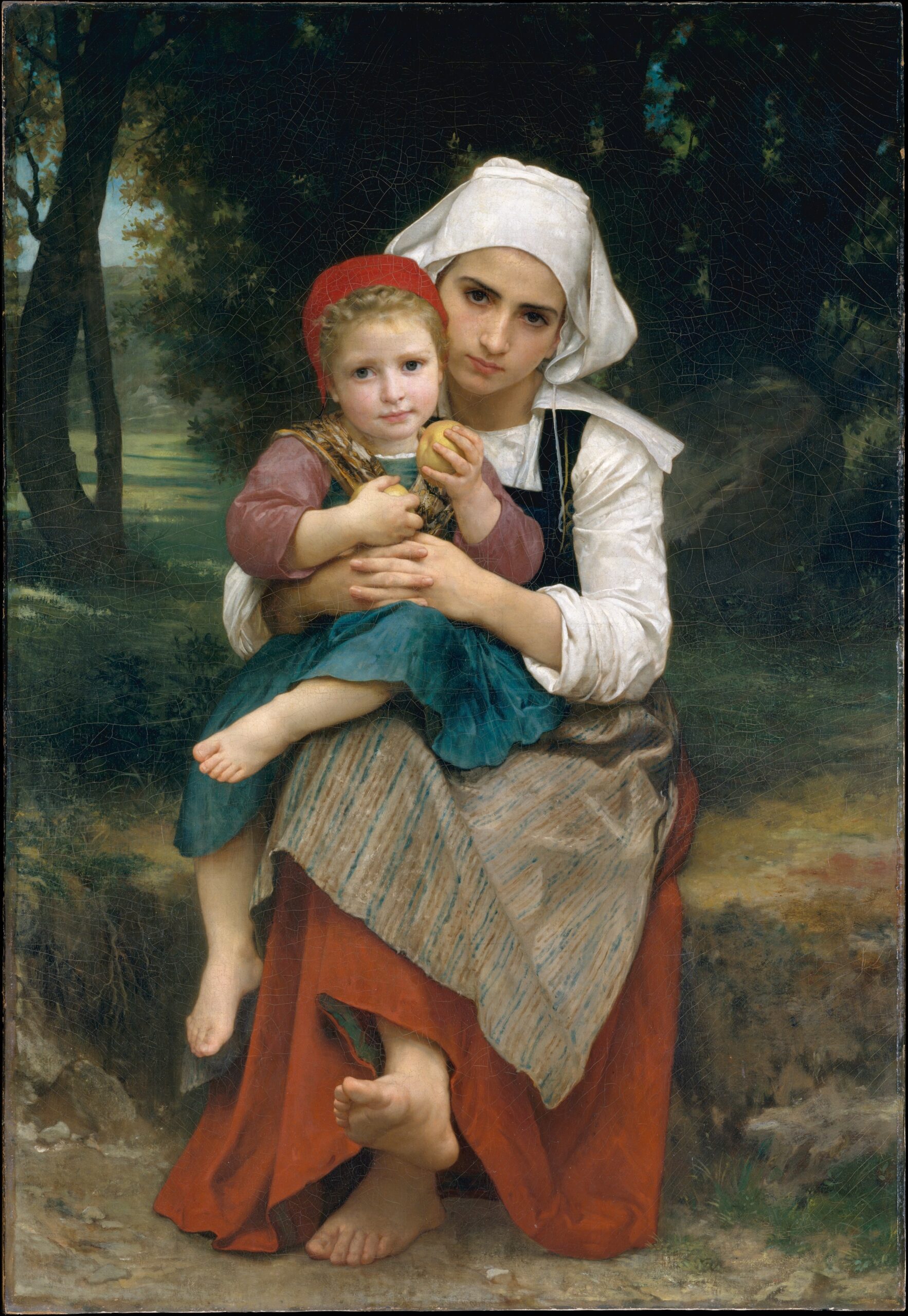
Breton Brother and Sister by William-Adolphe Bouguereau
Raphael’s influence brings to mind a noteworthy quote by the fantasy author Terry Pratchett. While commenting on the influence of Lord of the Rings author J.R.R. Tolkien, Pratchett likened his influence to Mount Fuji in Japanese art: “Sometimes it’s big and up close. Sometimes it’s a shape on the horizon. Sometimes it’s not there at all, which means that the artist either has made a deliberate decision against the mountain, which is interesting in itself, or is in fact standing on Mt. Fuji.” Raphael was known as the “prince of painters” for a reason. His strict naturalism set the example for centuries to come. And when a generation of modernists came along in the nineteenth century, what did some of them do? Some explicitly rejected Raphael and his place of pride among the European academies, calling themselves “pre-Raphaelite” to emphasize their preference for medieval and early Renaissance aesthetics. Yet their explicit rejection of Raphael does not weaken the Italian master’s impact, but rather reinforces it. And it was very interesting to walk directly from the exhibition into the nineteenth-century European paintings section. After a short time, I came face-to-face with William-Adolphe Bouguereau’s Breton Brother and Sister. And while I did see a pair of siblings in traditional northwestern French folk costume, the first thing I saw was a Madonna and Child, not dissimilar from those that I saw within Sublime Poetry.
Raphael: Sublime Poetry will be on display at the Metropolitan Museum of Art through June 28th.