

The house at Calle Peironcely 10 (image courtesy of Diario de Madrid)
A Madrid house immortalized by a famous photograph by Robert Capa was set to be turned into a museum. However, after some changes were made, Capa’s estate now refuses to allow the project to use the photographer’s name, face, or works.
Calle Peironcely 10 is a small single-story house in the Puente de Vallecas neighborhood of Madrid. It’s a rather unremarkable building, had it not been for Robert Capa. In 1936, Capa arrived in Spain shortly after General Francisco Franco invaded the country from Morocco. He did so to overthrow the democratically elected Republican government, launching a three-year-long civil war that would become the first fight against fascism in Europe. Understanding this, Nazi Germany and Fascist Italy provided aid and material support to Franco, most notoriously using Spain as a testing ground for Germany’s air force, the Luftwaffe. The Nazis would experiment with bombing tactics against Spanish cities on Franco’s behalf, which led to the Nazis’ development of blitzkrieg warfare. Most infamously, German bombers attacked the city of Guernica, resulting in the deaths of several hundred civilians. This war crime became memorialized in the Pablo Picasso painting named after the town. But Guernica was far from the only place that suffered from fascist bombing campaigns.
For most of the Spanish Civil War, the capital city of Madrid was under siege by Franco’s forces, during which German airplanes heavily bombed many of the city’s residential areas. Capa was in Madrid during these bombings, during which he took many photographs to document the conflict. Just one month before, he had taken probably his most famous photograph, The Falling Soldier. While in Madrid, Capa took another of his better-known photographs, later titled Children in Madrid. A group of children plays on the sidewalk in front of a house that’s been peppered with shrapnel from the German bombs. It is a brief look, depending on your interpretation, at the persistence or destruction of childhood in wartime. Capa’s work, including Children in Madrid, would be published in newspapers like The New York Times, bringing news of the conflict and its impact to a global audience. The image became a symbol of Spanish resilience as well as a testament to the destruction wrought by the fascists. Its power was such that Franco’s government went to great lengths to clamp down on the photo’s distribution.
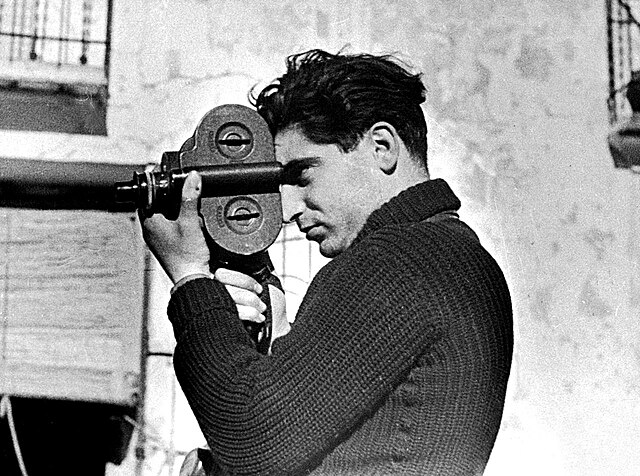
Robert Capa while in Madrid
After Franco claimed victory in 1939, Peironcely 10 was repaired and converted into apartments. Initially, the building was intended for demolition. But after it was identified in 2010 as the building in Capa’s photo, the community stepped in to save it, recognizing it as an iconic part of the city and the country’s historical memory. In 2018, Madrid’s city council adopted an initiative to convert the building into the Centro Robert Capa, dedicated to educating the public about the Siege of Madrid and Robert Capa’s role in covering the Spanish Civil War. Construction and renovation have been ongoing since 2021. However, recently, there has been talk of changing the project’s purpose. Starting in 2024, Madrid’s local government has instead tried to convert the building into more of a multi-use cultural center. Their specific language was that it would become “a center for cultural experimentation, especially for children and young people at risk of social exclusion, offering them tools to develop their creativity and use culture as a vehicle for inclusion, learning, and opportunities”.
This move sparked opposition from the original SalvaPeironcely10 organization and the Federation of Madrid Neighborhood Associations. José María Uría, one of the original project’s organizers, commented on the municipality’s decision: “They’ve done this without talking to anyone and we’re all very surprised to see them acting like this […]. They were very keen on it before and then there’s been this 180-degree turn, which also obviously points towards a kind of opacity when it comes to the question of the city’s [historical] memory.” To their credit, Peironcely 10 is not just an empty building waiting for whoever is most ready to occupy it. The building has been preserved because of Robert Capa’s photograph; therefore, its future use should be tied to his work.
Despite these protests, the local government seems committed to changing the center’s purpose. But now the project has encountered a complication. The International Center of Photography, the organization that manages the Robert Capa Foundation, has said it will rescind its permission to use Capa’s name and works in the project if the building’s purpose is changed from what was originally agreed. Additionally, the Capa Haus, a memorial and exhibition space in Leipzig, has raised objections to the municipality’s changes to the building’s future use.
SalvaPeironcely10 has made offers of compromise to help the planned cultural center find an alternative location. However, Madrid’s city council has not commented on whether more changes will be made.