
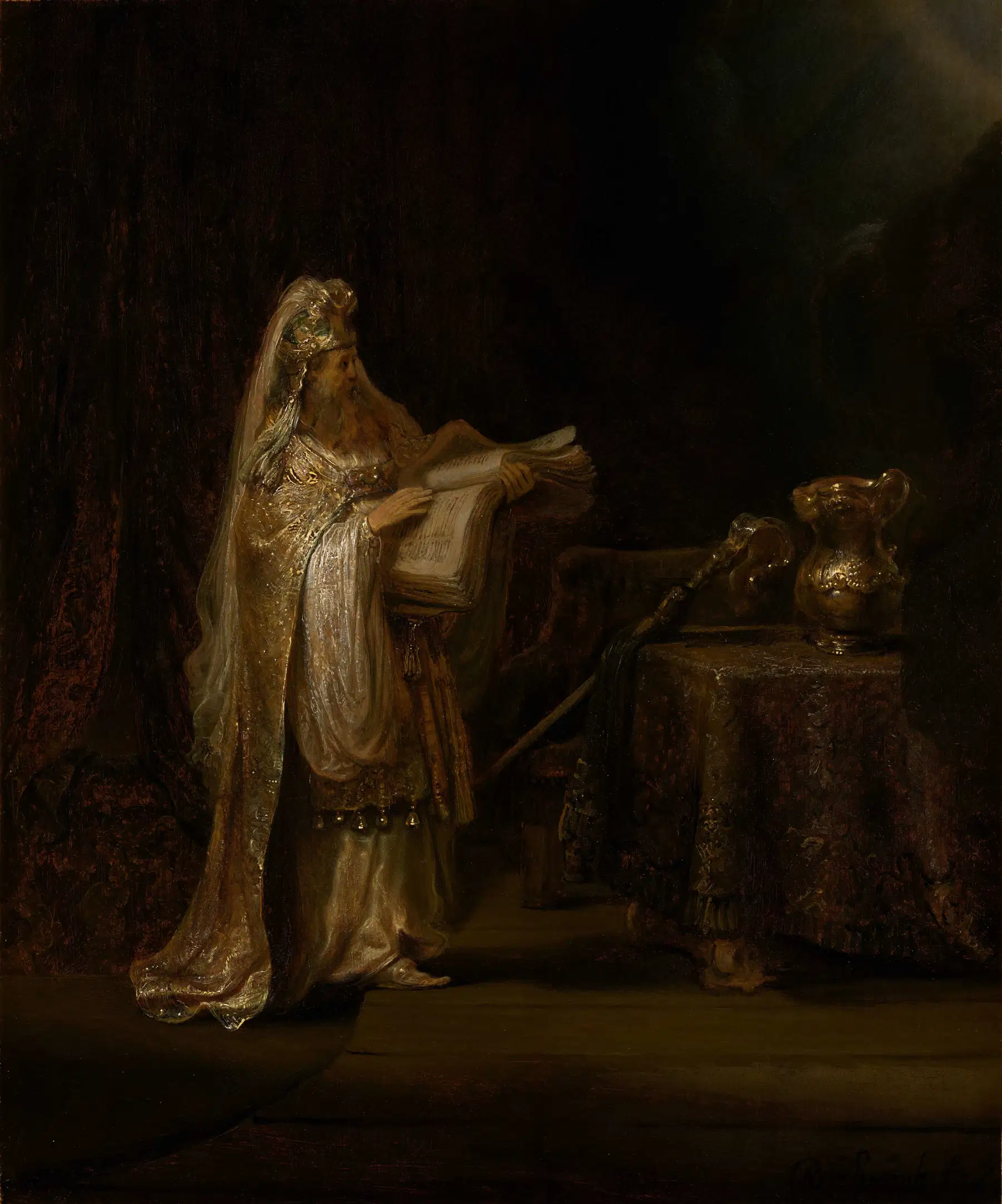
Vision of Zechariah in the Temple by Rembrandt van Rijn
A painting initially dismissed as a copy has officially been confirmed as an original by the Dutch Golden Age master Rembrandt van Rijn.
Vision of Zechariah in the Temple shows a story from the New Testament, specifically the first chapter of the Gospel according to Luke. The painting’s main figure is the priest Zechariah, who, while performing his duties in the temple, receives a vision from the Archangel Gabriel. The angel announces that despite his and his wife’s advanced age, they will have a son who will “make ready for the Lord a people prepared.” Zechariah’s son became John the Baptist, who, as the angel described, became a forerunner to Jesus.
In the painting, we see Zachariah in his priestly garments poring over a text. The painting captures the moment he is disturbed from his duties by a golden glow emanating from the upper right corner. Rembrandt’s choice to keep the angel out of view is not only an opportunity for the artist to play with light, but it also shows off his mastery of drama even as a young artist.
In 1969, Vision of Zechariah in the Temple was examined by Rembrandt scholar Horst Gerson. He dismissed the painting as a creation of Rembrandt’s workshop, a copy of an original work thought to be lost. Some theorized it may have been created by one of Rembrandt’s contemporaries, such as Jan Lievens or Salomon Koninck. The painting has been in the same private collection since 1961, and has gone unexamined for many decades. However, this changed two years ago, when scholars associated with the Rijksmuseum’s research project Operation Night Watch were permitted access to the painting.
Jonathan Bikker, the Rijksmuseum’s curator of seventeenth-century Dutch paintings, claims that Gerson’s dismissal of the painting stems from his not viewing the work in person, relying instead on low-resolution images. A more thorough analysis of the work reveals that the paint matches the pigments used by Rembrandt in his early career. That data, along with an analysis of the signature and the wooden panel, has allowed researchers to determine that Rembrandt likely painted the work in 1633, when the artist was 27 years old. The subject is also consistent with the artist’s early work, when he frequently used biblical subjects to hone his storytelling skills.
The owners have decided to loan the painting to the Rijksmuseum for a long-term display, offering visitors a rare opportunity to view this newly authenticated Rembrandt starting Wednesday, March 4th.