
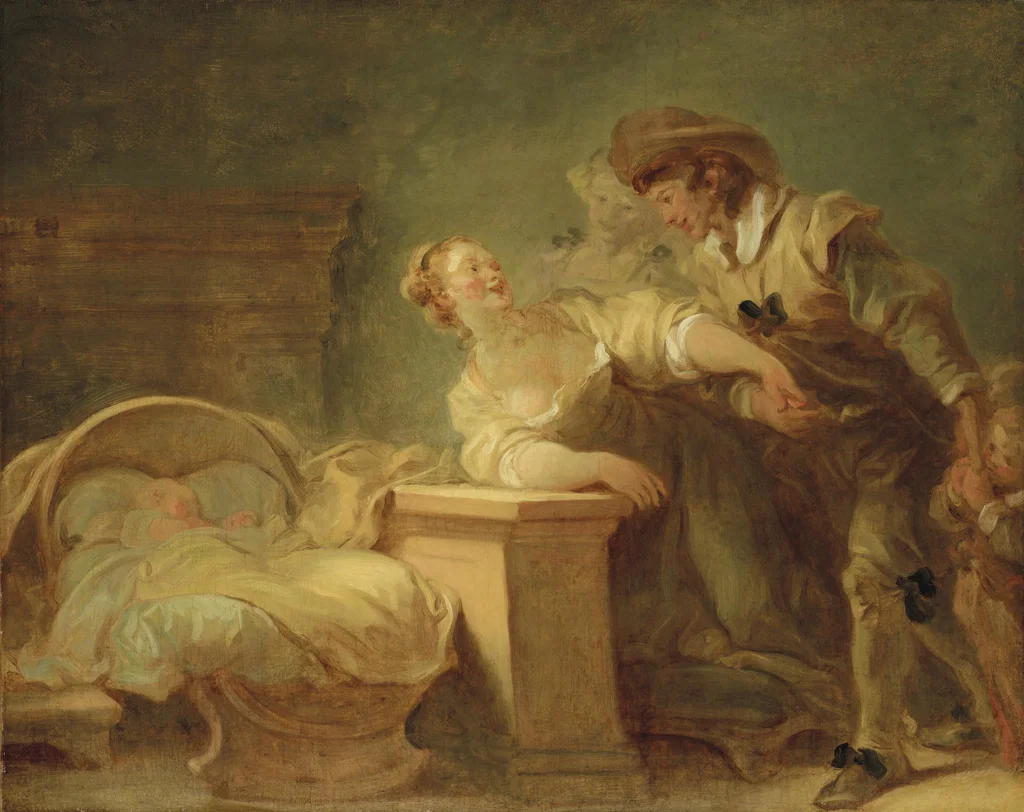
L'Heureuse Famille by Jean-Honoré Fragonard
On Wednesday, March 25th, Christie’s Paris offered a collection of Old Master works from the Veil-Picard family. The Veil-Picard family is a prominent French Jewish family. They started as bankers but moved into business in the late nineteenth century when they bought the absinthe producer Pernod. Much of the family art collection was assembled by Arthur Georges Veil-Picard, who preferred eighteenth-century French art. Among the thirty available lots at Christie’s on Wednesday were works by some of the biggest names in French portraiture, Rococo, and Baroque art, such as Antoine Watteau and Élisabeth Vigée Le Brun.
The expected star of the sale, the only lot with a minimum estimate over €1 million, was the Jean-Honoré Fragonard painting L’Heureuse Famille, or The Happy Family. Veil-Picard acquired the work around 1906 and remained with the family until the family’s art collection was confiscated during the Nazi occupation of northern France. The present work, also known as Young Couple Contemplating a Sleeping Child, The Return Home, and The Reconciliation, dates to the 1770s, with two other versions in private collections. The artist began to paint other similar scenes with maternal themes around this time. Christie’s specialists indicate that the painting may be based on a popular story called “Miss Sarah”, first published in a book by the Marquis de Saint-Lambert in 1765. The story goes that a traveler stops by a farmhouse and enjoys the hospitality of the farmer, his wife, and several children. After spending some time with them, it is revealed that the wife is actually an English aristocrat who fell in love with the farmer and lives as his wife. However, because of social expectations, she feels that she cannot marry him. The tale seems almost like a satire on the absurdity of social norms, feeling obligated to violate some yet hold others sacred. The Fragonard was given an estimate range of €1.5 million to €2.5 million, with the hammer coming down on the higher side at €2.3 million (or €2.86 million / $3.32 million w/p). This one painting accounted for 30% of the sale’s total.

Un Artiste présente un portrait à Madame Geoffrin and Le Déjeuner de Madame Geoffrin by Hubert Robert
Next up was a pair of works by Hubert Robert, an early French Romantic painter. The paintings were commissioned by their subject, Marie-Thérèse Geoffrin, the host of one of the great Paris salons in the eighteenth century. Her house on the rue Saint-Honoré became one of the most esteemed gathering places for philosophers, writers, and artists, including Montesquieu, Rousseau, Voltaire, Diderot, Rameau, and Bouchardon. In one painting, we see her in her chambers with an artist presenting a portrait. It is not certain whether the painting depicts someone else or whether this artist was commissioned to create a portrait of Madame Geoffrin as her younger self. We also do not know if Robert meant to represent himself as the artist in the painting. In the other painting, the subject takes her breakfast as a serving man stands behind her. The label at the bottom of the frame explains that the servant is reading to her aloud while she eats. Arthur Veil-Picard acquired the pair in 1922, and after the Nazis confiscated the family’s collection, it was transferred to the lieu before being placed in the infamous salt mines in Altaussee, Austria. This mine and several others were uncovered by the Allied Monuments, Fine Arts, and Archives program, popularly known as the Monuments Men. The Robert paintings are some of the last works Madame Geoffrin commissioned, the artist finishing them in 1771, several years before her death. The pair were expected to do very well, with Christie’s anticipating they would sell for at least €800K. The final bid surpassed both the amount and the €1.2 million high estimate, landing at €1.95 million (or €2.44 million / $2.83 million w/p).

La Petite Coquette by Jean-Honoré Fragonard
Rounding things out with another work by Fragonard, The Little Coquette. Much of the artist’s popular work fits nicely within the realm of Rococo painting, featuring great ornamentation, soft colors, and a somewhat overbearing sensuality. However, this work is a rather small portrait, measuring only 12 ¾ x 9 1⁄3 inches. It’s an intimate look at a young girl, done in an incredibly painterly way. Christie’s specialists refer to the loose brushwork as an example of the “pictorial energy, so characteristic of Fragonard”. The work was given an estimate range of €400K to €600K, given the rarity of its style and its excellent provenance. The portrait seemed more popular than expected, with bidders driving the final price beyond its high estimate to €800K (or €1 million / $1.18 million w/p).
For a relatively small sale, there were many surprises. Five lots, 16.6% of the works available, sold for more than double their high estimates. One of them being a small 1776 pencil and chalk drawing by Gabriel de Saint-Aubin, which was expected to sell for no more than €200K yet shot up to €490K (or €622.3K / $721K w/p). Additionally, there were two paintings by the nineteenth-century Italian artist Giovanni Boldini, one of which was expected to sell for between €50K and €80K, but sold for €180K (or €228.6K / $264.8K w/p).
Of the thirty available lots, ten sold within their estimates, giving Christie’s specialists a 33% accuracy rate. Three lots (10%) sold below estimate, and thirteen lots (43%) sold above estimate. With four lots going unsold, the sale achieved an 87% sell-through rate. Before the auction, Christie’s placed the total minimum estimate at €4.8 million. With the number of lots selling above their estimates, some exponentially so, the sale not only did very well, but it exceeded its €7.4 million high estimate. The total hammer ended up at €7.5 million, or €9.4 million w/p.