
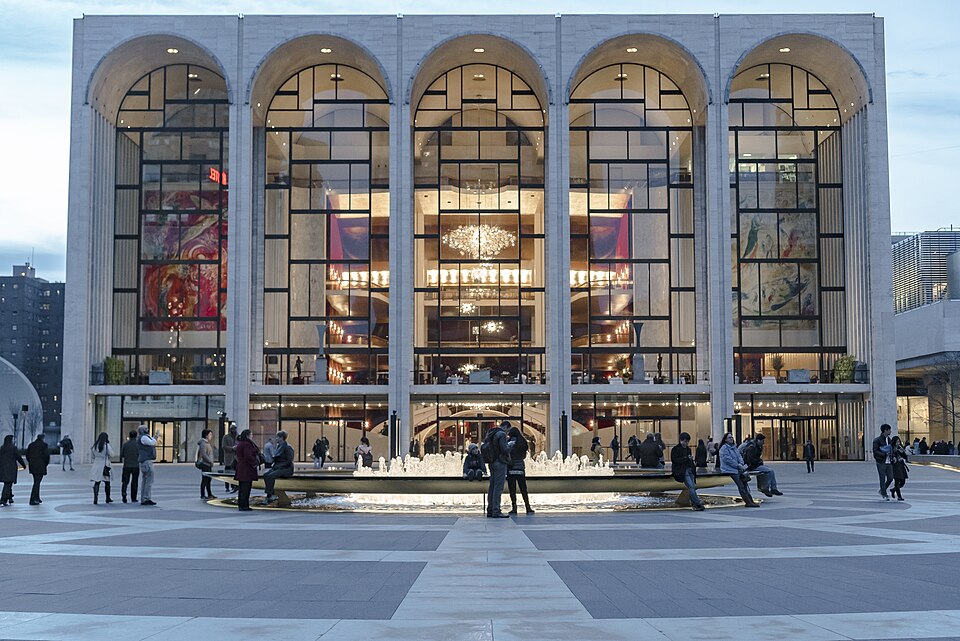
The Metropolitan Opera House, with the Chagall murals visible through the glass facade (image courtesy of Billie Grace Ward)
New York’s Metropolitan Opera House may be forced to sell two of its most iconic possessions: a pair of murals by Marc Chagall.
The Metropolitan Opera has existed since 1883, but the current opera house first opened in September 1966. Though close to sixty years old, it remains the largest opera house in the world, as well as one of the most technologically advanced. However, the company took a significant financial hit during the Covid pandemic. Since then, it has been forced to take steps to remain financially solvent, including reducing the number of performances and drawing about $120 million from its endowment. The most immediate source of financial issues stems from director Peter Gelb’s plan to begin a five-year winter residency in Riyadh, Saudi Arabia, in exchange for $200 million from the Saudi government. With this money failing to come through on time, the opera is considering selling off one of its greatest assets.
When the Metropolitan Opera House opened in 1966, it featured two massive murals, each measuring over 1,000 square feet, by the modernist master Marc Chagall. The Sources of Music and The Triumph of Music are not very visible from inside the lobby, though. The best view of them is from outside the opera house, through its enormous glass façade. The plan to sell the murals includes the condition that they remain in the opera house, with a plaque identifying the future owner on site. Specialists from Sotheby’s value the murals at $55 million.
Opera house murals by Chagall are actually not unheard of outside New York. The artist was also commissioned to create murals for the Palais Garnier, the home of the Paris Opera, which was unveiled in 1964. Before creating the New York murals, the Metropolitan Opera had also commissioned Chagall to create designs for a new production of Mozart’s 1791 opera Die Zauberflöte. The Chagall production proved so popular that the Metropolitan Opera used it for the next fifteen years.
The Sources of Music is primarily bright yellow with blue accents, framing a crowned figure in the center holding a lyre, likely representing either King David or Orpheus. Surrounding this figure are angels playing violin, harp players, groups playing woodwinds and horns, many animals, and touches of modern urban life, such as skyscrapers. Many claim that Chagall added figures representing Mozart, Beethoven, Wagner, Verdi, and other composers. The features highlight the inspiration behind musical expression, both ancient and modern. It also draws on mythological and folkloric imagery, with humans, animals, and music itself emerging from nature. Its companion, The Triumph of Music, burns bright red, centered on an angel sounding their triumphal horn. Figures similar to those in The Sources of Music appear, but everything seems to be floating upwards, with music transcending the mundane and material world.
This would not be the first time the Chagall murals were used by the opera house to ensure its survival. During the 2008-9 financial crisis, the Metropolitan Opera used the murals as collateral for a $35 million loan from J.P. Morgan. The opera is also considering selling the theater’s naming rights. Should the opera find a buyer, the murals will likely become the most valuable Chagall work in the world.