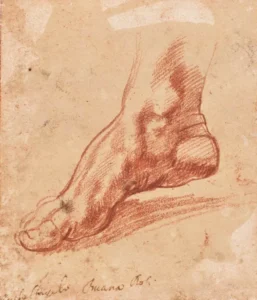
Study for a foot of the Libyan Sibyl by Michelangelo
This week saw a series of Old Master sales in New York at Christie’s and Sotheby’s. While several great pieces crossed the block at both auction houses, it is without doubt that the highlight of the week turned out to be… a foot? Not just any foot, but an original chalk drawing by Michelangelo made as a preparatory drawing for the Sistine Chapel ceiling.
The red chalk drawing was part of Christie’s Old Master & British Drawings sale on the afternoon of Thursday, February 5th. It had only recently been rediscovered after being kept away in the same private collection, that of an aristocratic Swiss family, for over two centuries. Though just a foot, the sketch is actually a preparatory drawing Michelangelo made while working on the Sistine Chapel ceiling. Part of the ceiling features twelve figures on the spandrels, the triangular spaces between the chapel windows where the ceiling begins to arch upward. These figures are seven prophets of the Old Testament and five of the ancient Sybils, the classical Greco-Roman oracles associated with specific holy sites. The sibyls on the ceiling included the Cumaean Sibyl, the Delphic Sibyl, the Erythraean Sibyl, the Persian Sibyl, and, most importantly in this case, the Libyan Sibyl.
The drawing offered at Christie’s is a study for the Libyan Sibyl’s right foot, which, in the completed fresco, is shown arched as the figure turns in her seat, trying to reach a large codex behind her. While Michelangelo was obsessively fixated on mastering his ability to capture the human form, I understand why the foot may have been a point of focus for him. The foot is notoriously difficult to draw. Even great masters like Sandro Botticelli struggled to render his subjects’ feet, as seen in several of his paintings. So depicting the feet accurately, and in a somewhat unusual pose no less, was likely something Michelangelo cared about very much.
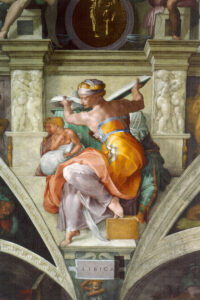
The Libyan Sibyl in the Sistine Chapel
Michelangelo made hundreds of sketches and drawings during the four years he worked on the Sistine Chapel ceiling. However, most of these drawings are now considered lost. Those that survive now mainly belong in museum collections. Because so few works by the artist remain in private hands, the drawing’s rarity alone made this an incredibly exciting auction moment.
While Christie’s expected the drawing to sell for between $1.5 and $2 million, things went a little out of hand. There were several interested parties that afternoon, driving the final price ever higher. At one point, I left my desk and came back to find the current bid was quadruple the high estimate. And the bidding was not over yet. After what must have been over twenty-five minutes of bidding, auctioneer Georgina Hilton brought down the hammer at a mind-blowing $23.1 million (or $27.2 million w/p). It is now the most expensive work by Michelangelo ever sold at auction, and the third most valuable Old Masters work on paper ever sold at auction.
The sale as a whole, consisting of one hundred thirty-one lots, was only expected to bring in no more than $5.46 million. But even if the Michelangelo drawing only reached its high estimate of $2 million, the sale would have still done rather well. Some other highlights included the William Blake drawing The Grave: The Reunion of the Soul and the Body (which sold for $750K against an estimate range of $800K to $1.2 million) and an eighteenth-century ink drawing Study of four figures by Giovanni Battista Piranesi (which sold for $220K against a $120K high estimate).
Of the one hundred thirty-one lots, twenty-nine sold within their estimates, giving Christie’s a 22% accuracy rate. An additional thirty-seven lots (28%) sold below, while an impressive forty-three lots (33%) sold above. With twenty-two lots unsold, Christie’s achieved an 83% sell-through rate on Thursday afternoon. The entire sale brought in $25.7 million (or $30.5 million w/p), with the Michelangelo accounting for 89.9% of the total.

Best Foot Forward: Michelangelo Sketch Sells for Record Price
Study for a foot of the Libyan Sibyl by Michelangelo
This week saw a series of Old Master sales in New York at Christie’s and Sotheby’s. While several great pieces crossed the block at both auction houses, it is without doubt that the highlight of the week turned out to be… a foot? Not just any foot, but an original chalk drawing by Michelangelo made as a preparatory drawing for the Sistine Chapel ceiling.
The red chalk drawing was part of Christie’s Old Master & British Drawings sale on the afternoon of Thursday, February 5th. It had only recently been rediscovered after being kept away in the same private collection, that of an aristocratic Swiss family, for over two centuries. Though just a foot, the sketch is actually a preparatory drawing Michelangelo made while working on the Sistine Chapel ceiling. Part of the ceiling features twelve figures on the spandrels, the triangular spaces between the chapel windows where the ceiling begins to arch upward. These figures are seven prophets of the Old Testament and five of the ancient Sybils, the classical Greco-Roman oracles associated with specific holy sites. The sibyls on the ceiling included the Cumaean Sibyl, the Delphic Sibyl, the Erythraean Sibyl, the Persian Sibyl, and, most importantly in this case, the Libyan Sibyl.
The drawing offered at Christie’s is a study for the Libyan Sibyl’s right foot, which, in the completed fresco, is shown arched as the figure turns in her seat, trying to reach a large codex behind her. While Michelangelo was obsessively fixated on mastering his ability to capture the human form, I understand why the foot may have been a point of focus for him. The foot is notoriously difficult to draw. Even great masters like Sandro Botticelli struggled to render his subjects’ feet, as seen in several of his paintings. So depicting the feet accurately, and in a somewhat unusual pose no less, was likely something Michelangelo cared about very much.
The Libyan Sibyl in the Sistine Chapel
Michelangelo made hundreds of sketches and drawings during the four years he worked on the Sistine Chapel ceiling. However, most of these drawings are now considered lost. Those that survive now mainly belong in museum collections. Because so few works by the artist remain in private hands, the drawing’s rarity alone made this an incredibly exciting auction moment.
While Christie’s expected the drawing to sell for between $1.5 and $2 million, things went a little out of hand. There were several interested parties that afternoon, driving the final price ever higher. At one point, I left my desk and came back to find the current bid was quadruple the high estimate. And the bidding was not over yet. After what must have been over twenty-five minutes of bidding, auctioneer Georgina Hilton brought down the hammer at a mind-blowing $23.1 million (or $27.2 million w/p). It is now the most expensive work by Michelangelo ever sold at auction, and the third most valuable Old Masters work on paper ever sold at auction.
The sale as a whole, consisting of one hundred thirty-one lots, was only expected to bring in no more than $5.46 million. But even if the Michelangelo drawing only reached its high estimate of $2 million, the sale would have still done rather well. Some other highlights included the William Blake drawing The Grave: The Reunion of the Soul and the Body (which sold for $750K against an estimate range of $800K to $1.2 million) and an eighteenth-century ink drawing Study of four figures by Giovanni Battista Piranesi (which sold for $220K against a $120K high estimate).
Of the one hundred thirty-one lots, twenty-nine sold within their estimates, giving Christie’s a 22% accuracy rate. An additional thirty-seven lots (28%) sold below, while an impressive forty-three lots (33%) sold above. With twenty-two lots unsold, Christie’s achieved an 83% sell-through rate on Thursday afternoon. The entire sale brought in $25.7 million (or $30.5 million w/p), with the Michelangelo accounting for 89.9% of the total.