
Volume 302
20 West 55th Street, New York, NY 10019
(212) 355-5710
www.rehs.com www.rehscgi.com
WELCOME TO THE FEBRUARY 2026 EDITION OF COMMENTS ON THE ART MARKET
In this edition, we recap the start of the year, marked by record-breaking weather and auction results amid continued stock-market volatility. We take a closer look at works by John Bentham-Dinsdale and Bryan Larsen and share the upcoming Palm Beach Show, where we look forward to seeing friends, family, and familiar faces in warmer weather. We also round out the issue with highlights from the past month’s art-world headlines, spanning everything from Caravaggio to Bad Bunny.
_____
UPCOMING FAIRS
THE PALM BEACH SHOW
February 12-17, 2026
Palm Beach Convention Center
If you would like complimentary tickets to the show, please email us at [email protected].
_____
THE ECONOMIC CANVAS
I hope everyone is handling this frigid weather better than I am. I took two trips this month – one for work to Los Angeles and one personal to Florida – and somehow, the cold followed me both times. Unfortunately, the financial markets have also had an icy start to the year.
We entered 2026 facing a high degree of uncertainty, which quickly translated into some notable volatility. Investors continue to weigh persistent geopolitical tensions and renewed trade policy concerns, alongside early signs of a cooling labor market and a weakening US Dollar. Against that backdrop, January felt less about chasing returns and more about recalibrating risk.
Early in the month, it appeared markets were looking to extend the momentum that closed out a frothy 2025, but that faded by mid-month… fortunately, the early gains provided enough padding that the major indexes still finished in positive territory. The S&P was up 1.3%, the Dow was up about 1%, and Nasdaq was just shy of 1%. In some ways, these overall figures obscure the choppy trading we have seen. That said, it’s worth pointing out that political headlines have played a sizable role in market movements recently… notably, renewed tariff rhetoric on January 20th triggered a swift selloff across all indexes.
Currency markets were also particularly active… the US Dollar Index weakened to a four-year low. The Dollar has tumbled by 10% over the past year – some will spin this as a positive, particularly for large multi-national companies who do business overseas but broadly speaking, it will make imported goods more expensive. In turn, that can have an inflationary impact at a time when inflation has finally begun leveling off. Both the Pound and Euro, as well as the Yen, were up more than 1% against the Dollar in January.
Crude prices have steadily crept up amid geopolitical tensions with Venezuela… I’m not even going to speculate how that whole situation may play out, but we have already seen crude futures rise nearly 15% this month. And then there’s the madness we saw with precious metals… gold and silver have gotten out of control. On the final day of the month both saw steep corrections – gold dropped more than 8% and silver dropped more than 25%! Even still, they turned in gains of more than 12% and 10%, respectively. Just for perspective, in the past year – gold is up nearly 80% and silver is up a mind-boggling 170%.
Cryptocurrencies struggled to maintain momentum amid this shifting environment. Bitcoin declined from early-January levels near $88,700 to the mid-$80,000 range by month-end… a slide of about 5%. Ethereum and Litecoin posted even larger drops, down roughly 10% and 17%, respectively. Unlike equities, crypto assets failed to attract consistent dip-buying interest.
So far, 2026 is about repricing expectations. Equities finished higher, but only after navigating sharp volatility. Rather than offering a clear direction, January underscored the market’s sensitivity to policy and risk — a dynamic likely to define trading conditions as the year unfolds.
-Lance
_____
Historical Artist Spotlight: John Bentham-Dinsdale (1927–2008)
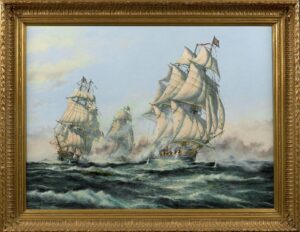 John Bentham-Dinsdale occupies a distinctive place in twentieth-century British maritime painting, combining rigorous draftsmanship, architectural training, and a historian’s respect for accuracy. Born in Ilkley, West Yorkshire, Dinsdale was educated locally before attending Leeds School of Art, where he earned a degree in architecture and became an associate of the Royal Institute of British Architects. This formal grounding in structure and proportion would later underpin the clarity and conviction of his compositions at sea.
Following a brief commissioned service in the Royal Air Force during the final year of the Second World War, Dinsdale entered the theatre world, designing scenery for several West End productions. He later transitioned to television, working first as an assistant designer at Associated Television and eventually becoming Head of Design and Construction at Tyne Tees Television in Newcastle. Throughout these years, painting remained a parallel pursuit—an outlet for his technical skill and lifelong fascination with maritime history.
In 1965, Dinsdale made a decisive shift, returning to Yorkshire to devote himself fully to painting. His focus increasingly centered on historic naval subjects and clipper ships under sail, rendered with both narrative clarity and atmospheric force. In 1970, he helped found the British Sea Painters Group, which solidified his position within the genre, and in 1974, he held his first solo exhibition in London.
Dinsdale’s reputation rests not only on his meticulous depiction of ships but also on his nuanced treatment of the sea itself. Drawing on an extensive personal library of marine history, he portrayed specific vessels at precise moments in their service lives, while simultaneously conveying the shifting moods of wind, light, and water that define life at sea. This balance of historical fidelity and painterly sensitivity remains a hallmark of his work.
While another work by Dinsdale, Action off Belfast Lough (sold), depicts the HMS Brilliant of a later period, Chase of the Brilliant focuses on her eighteenth-century predecessor, launched in 1779. This vessel saw active service in both the Mediterranean and the North Atlantic during the French Revolutionary and Napoleonic Wars.
The scene captures a specific historical encounter on July 26, 1798. Two French frigates, the Vertu and the Régénérée, were en route from the Canary Islands to Rochefort when they intercepted the British Brilliant off the coast of Tenerife. Dinsdale presents the dramatic pursuit with precision and restraint: the tension lies not in explosive action, but in the measured choreography of sails, sea, and distance. The Brilliant ultimately evaded French gunfire, while her pursuers abandoned the chase and returned to Tenerife.
In this work, Dinsdale’s strengths are fully evident. The ships are rendered with architectural exactitude, yet the painting is equally driven by the movement of the water and the charged atmosphere of the open ocean. It is this synthesis, historical narrative anchored within a living, breathing seascape, that defines Dinsdale’s enduring appeal to collectors of maritime art.
_____
Contemporary Artist Spotlight: Bryan Larsen
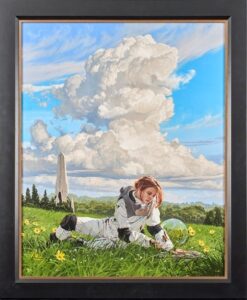 Bryan Larsen’s paintings are grounded in realism yet driven by imagination, curiosity, and an enduring sense of optimism about the future. As a child, Larsen might have said he wanted to be an astronaut, but drawing quickly became his true constant. Encouraged by supportive parents and teachers, he developed his artistic abilities early, eventually weighing paths in children’s book illustration and aerospace engineering before committing fully to fine art.
Influenced by masters such as William Bouguereau, Lawrence Alma-Tadema, Maxfield Parrish, and Norman Rockwell, Larsen set out to create works that are not only technically accomplished but narrative-driven, paintings that celebrate human knowledge, mathematics, architecture, science, and engineering. From the outset, his fascination with space was evident; his first sold painting depicted a father and son watching the launch of a Saturn V rocket. Over time, these interests coalesced into a body of work centered on curiosity, innovation, and the timeless human drive to explore new frontiers, all while maintaining a deep reverence for natural beauty.
Many of Larsen’s recent works are inspired by his children and feature young figures engaged in moments of discovery. These scenes often unfold in environments where sweeping natural landscapes intersect with futuristic or speculative elements, creating a romanticized vision of a possible future—one that feels aspirational rather than fantastical.
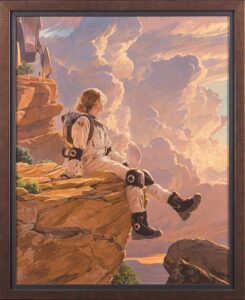
In Alma Mater, Larsen presents a contemplative meditation on learning and legacy. The work reflects his ongoing interest in education and intellectual curiosity, rendered with a quiet monumentality that invites reflection. Evening Breeze, by contrast, offers a more intimate and atmospheric moment, balancing serenity and forward-looking wonder through subtle gestures, light, and setting.
Larsen is careful to note that his work is not intended as science fiction. Instead, he seeks to build visual worlds that invite viewers—and their children—to imagine themselves within them. By leaving aspects of each narrative open-ended, he encourages personal interpretation and emotional engagement. The futuristic settings, paired with familiar human experiences, underscore the timelessness of exploration and discovery. An astronaut gazing back at Earth, for example, becomes a reminder that even in a galaxy of wonders, the natural beauty around us remains extraordinary and rare.
Together, Larsen’s paintings offer a vision of a future worth striving for: thoughtful, curious, beautiful, and deeply human.
_____
THE ART MARKET
At Auction
Christie’s Western Art Sale Shatters Records in New York
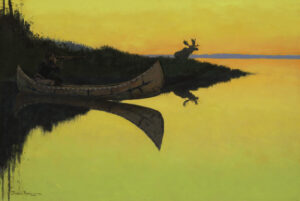 Christie’s New York Western Art sale in January delivered record-breaking results across several categories. The two-part auction, Visions of the West: The William I. Koch Collection, held January 20–21, realized just over $84.1 million with fees, making it the most valuable single-owner Western Art sale ever staged at auction, by a factor of three.
The evening sale was led by Frederic Remington, who reset his own auction record twice in the same evening. The top-selling lot, Coming to the Call (1905), achieved $13.29 million (est. $6M–$8M, 66% above estimate), establishing a new high for the artist. Less than 15 minutes earlier, Remington’s An Argument with the Town Marshall sold for $11.85 million (est. $4M–$6M, 97% above estimate), briefly holding the record before being surpassed. Following suit and rounding out the top three lots, all by the same artist, was the bronze sculpture Coming Through the Rye, which garnered $9.95 million (est. $4M–$6M, 66% above estimate).
Of the top five lots sold, four broke artist records, including Charles Marion Russell’s Dust at $5.81 million (est. $5M–$7M) and Alfred Jacob Miller’s The Buffalo Hunt at $4.71 million (est. $2M–$3M, 57% above estimate). The Miller work reclaimed its own auction record, which it had held from 2002 to 2012, when it originally sold for $1.7 million at Sotheby’s.
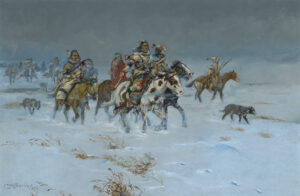
The following day saw equally compelling momentum. The top lot was Charles Marion Russell’s The Whoop-Up Trail. Estimated at $1.2–$1.8 million, the painting achieved $3,247,000, more than doubling its low estimate (80% above estimate). It was followed by Frederic Remington’s An Apache, which sold for $1,143,000 (est. $600,000–$800,000, 43% above estimate). In third position
was Maynard Dixon’s Cattle Country (California Coast Range). Estimated at $250,000–$350,000, the work realized $990,600, nearly tripling its low estimate and ranking among the strongest over-performers of the entire sale (183% above estimate).
Beyond the top three lots, a new record was set for David Mann’s Buffalo Hunt, which sold for $66,040 against an estimate of $7,000–$10,000 – a whopping 560% above estimate.
Across both sessions, the auction achieved approximately 165% of its low estimate, with a sell-through rate of roughly 95% by lot.
In total, 71 lots sold across the evening and day sessions. Of those, 52 sold above their high estimates, 13 sold within estimate, and just six sold below their low estimates. The evening sale alone saw nearly 70% of lots exceed their high estimates, while the day sale performed even better, with roughly three quarters of sold lots clearing the top end of their estimated ranges.
_____
BEYOND THE FRAME
Exhibitions, discoveries, and cultural commentary
Rijksmuseum Set for Major Expansion with €60 Million Sculpture Garden
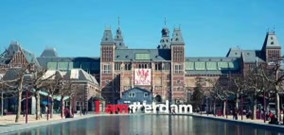 Thanks to a large donation, Amsterdam’s Rijksmuseum will soon include a public sculpture garden featuring works by great modernists.
The Don Quixote Foundation is the Rijksmuseum’s single largest private benefactor. It is a philanthropic organization co-founded by Dutch aristocrat and venture capital executive Rolly van Rappard. It has provided millions of euros to enable the museum to stage its annual sculpture exhibition in the gardens outside. And now, the foundation has given the museum €60 million to create a new public sculpture garden directly across the Boerenwetering canal from the Rijksmuseum. The new garden will be situated on a sort of promontory among the canals, where the Carel Willinkplantsoen park currently sits. The buildings in the park will be repurposed and built out into pavilions open to the public. Several mature trees and new varieties of flowers will also be planted at the site. The contract for redesigning the existing structures has been given to Foster + Partners, the same firm overseeing the Queen Elizabeth Memorial in London’s Saint James Park. Meanwhile, the green spaces will be designed by Piet Blanckaert, a Belgian landscape architect known mainly for the Flanders Fields Memorial Garden in London.
The Rijksmuseum is primarily known for its collection of Dutch Old Master paintings, including works by Rembrandt, Frans Hals, Johannes Vermeer, Jacob van Ruisdael, and Jan Steen. Though not Dutch, other Old Masters feature prominently in the museum collection, including Rubens, Van Dyck, El Greco, and Francisco de Goya. Its modern art collection often does not get the attention it deserves. Some of the highlights include works by Karel Appel, Hans Arp, Marlene Dumas, Robert Mapplethorpe, Graham Sutherland, and even an Yves Saint-Laurent dress modeled after the work of Piet Mondrian. Many of the temporary exhibitions have attempted to draw attention to the museum’s modern and contemporary collections, yet its reputation as a hub for Old Masters has remained. Museum director Taco Dibbits referred to the project as “an unprecedented enhancement of the Rijksmuseum’s collection of 20th-century art”. When the project is completed, the Don Quixote Foundation also plans on loaning several works to the Rijksmuseum for display in the gardens. They include works by Louise Bourgeois, Alexander Calder, Alberto Giacometti, and Henry Moore.
The new sculpture garden is part of an expansion project for the Rijksmuseum that also includes a satellite museum in Eindhoven. The gardens are expected to open in the autumn of 2026.
From £5 to £3 Million: A Scottish Town’s Hidden Masterpiece Faces an Export Ban
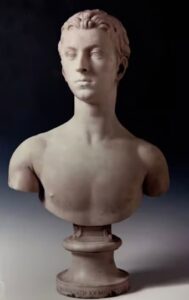 In late 2023, the Highland town of Invergordon faced an extraordinary decision: whether to sell an 18th-century marble bust by French master sculptor Edmé Bouchardon after an interested buyer offered £2.5 million for the work. The sculpture, Bust of Sir John Gordon, had been owned by the town since 1930, when it was purchased for just £5. Now recognized as a work of national importance, it has become the subject of a temporary UK export ban intended to keep it in Britain.
The export bar, imposed by the British government, prevents the sculpture from leaving the country while giving UK institutions or buyers time to match the recommended price of £3.1 million. Such bans are designed to safeguard culturally significant objects and to allow domestic purchasers to acquire them for public benefit.
The bust depicts Sir John Gordon, a member of the prominent Gordon family from which Invergordon takes its name. Created in 1728, the sculpture dates from Gordon’s early adulthood, when he was traveling through continental Europe as part of the Grand Tour. Gordon would later go on to serve as a Member of Parliament and as Secretary for Scotland to the Prince of Wales.
Its creator, Edmé Bouchardon, is widely regarded by art historians as one of the most important sculptors working in France during the reign of Louis XV. He played a crucial role in the transition away from the ornate excesses of Baroque and Rococo sculpture toward the clarity and restraint of early Neoclassicism. The Gordon bust is especially rare: it is one of only two known neoclassical sculptures by a French artist portraying a British subject.
Despite its importance, the sculpture’s value went largely unrecognized for decades. After being acquired by Invergordon in 1930, it fell into obscurity and was not rediscovered until 1998. Since then, it has been housed at the Inverness Museum, a short drive from the town.
The export ban was issued following a review by the Reviewing Committee on the Export of Works of Art and Objects of Cultural Interest (RCEWA), which operates under the Department for Culture, Media and Sport. The committee applies the Waverley Criteria, which assess whether an object is closely connected to British history, of outstanding aesthetic importance, or of exceptional significance for the study of art or history. In this case, the committee concluded that the bust met all three standards.
Committee member Stuart Lochhead noted that the sculpture “tells a unique story about Scotland, Jacobite intrigue, Rome as a cultural crucible during the Grand Tour, and a radical new portrait style.” These layered historical and artistic connections helped justify halting its export.
The ban will remain in force until April 8, 2026, allowing a three-month window for a UK buyer to raise the necessary funds, including taxes and the cost of producing a replica for Invergordon to retain. If the bust sells near the suggested price, it would rank among the most valuable Bouchardon works ever sold. The current record stands at €3 million, paid by the Louvre in 2012 for a 1736 bust sold at auction in Paris—underscoring just how remarkable this Scottish-held masterpiece has become.
New York Welcomes Caravaggio’s First Masterpiece
 New York museums often put on incredible exhibitions, securing loans from institutions worldwide. However, it is very rare for a museum to receive an iconic masterwork. This distinction usually happens only once a year. Last year, the Hamburger Kunsthalle loaned Wanderer Above the Sea of Fog to the Metropolitan Museum for its Caspar David Friedrich retrospective.
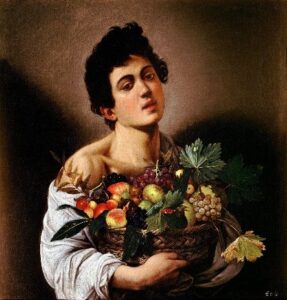
It is even rarer for a relatively small museum to secure a similar loan. The Morgan Library made that happen when, on Friday, January 16th, it opened a small exhibition dedicated to Michelangelo da Caravaggio’s first masterpiece, Boy with a Basket of Fruit.
If you’re accustomed to exhibitions at the Met or the MoMA, the Morgan Library may feel underwhelming in scale. Its temporary exhibitions are small, consisting of one or two rooms in what was once J.P. Morgan’s Madison Avenue mansion. The Caravaggio exhibition occupies a single room, with fewer than a dozen works on display.
Still, the size can be deceiving. The curators tell a compelling story about the history of European painting. They lay out the influences behind Caravaggio’s creation of Boy with a Basket of Fruit. Those influences, in turn, shaped the trajectory of Baroque painting.
The curators begin by examining the state of painting during Caravaggio’s early career. They do this through Girl with Cherries, a loan from the Metropolitan Museum attributed to Marco d’Oggiono, a student of Leonardo da Vinci. The painting shows Leonardo’s legacy, particularly his emphasis on naturalism. It also reflects a preference for ambiguity. Viewers cannot easily tell whether the figure represents a girl with cherries or Pomona, the Roman goddess of fruit.
Caravaggio grew up twenty-five miles east of Milan, where Leonardo spent significant time. As a result, Caravaggio likely received instruction grounded in Leonardo’s naturalistic style.
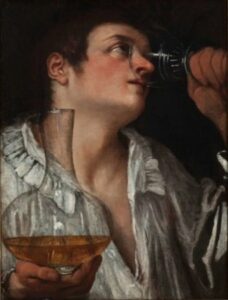 Leonardo, however, was not Caravaggio’s only influence. The Bolognese painter Annibale Carracci also shaped the young artist, especially through his choice of subject. Carracci became known for depicting everyday life and ordinary people. Works such as The Beaneater and The Fishing Scene illustrate this approach.
At the Morgan, the curators highlight that influence through Carracci’s 1583 painting, A Boy Drinking. The museum is exhibiting the work there for the first time.
Boy with a Basket of Fruit was the first painting Caravaggio created after moving from northern Italy to Rome in 1593. John Marciari, the exhibition’s primary curator, calls it “a turning point in Italian painting.” In the work, Caravaggio synthesizes Leonardo’s naturalism with Carracci’s interest in common subjects.
The figure is neither saint nor deity, nor does he serve an allegorical role. He is simply an artist’s model. Caravaggio renders the boy’s features and the fruit with painstaking detail. He even includes defects. The fruit shows dark marks, and the leaves on the right are yellow and wither.
Caravaggio also preferred to paint directly on the canvas. He avoided preparatory drawings and worked from life. In doing so, he pushed naturalistic painting to its limits. This warts-and-all approach was uncommon at the time. As the Morgan curators note, his paintings “are less a demonstration of the correct practice of careful study and more a direct demonstration of the painter’s craft.”
The remaining half of the room features works that illustrate Caravaggio’s impact on Italian painting. Later artists who adopted his style, known as the Caravaggisti, emphasized imperfections in their subjects. In doing so, they revealed what the exhibition calls “the fiction of art.”
Works such as A Monk Sleeping against a Pile of Books by Rutilio Manetti and Basket of Fruit by Bartolomeo Cavarozzi show a clear break from the academic precision of Renaissance and Mannerist traditions. The combination of naturalism and ordinary subject matter reshaped seventeenth-century painting. It also helped establish still life as a genre in its own right.
Even artists unaware of Caravaggio’s working methods adopted his visual language. Many still created works in his style.
To conclude the exhibition, the curators display a sketch by Gian Lorenzo Bernini of Cardinal Scipione Borghese, the painting’s eventual owner. Borghese, the nephew of Pope Paul V, became a prolific collector in the early seventeenth century. His collection later formed the foundation of the Villa Borghese in Rome, which loaned Boy with a Basket of Fruit to the Morgan.
The sketch feels dynamic. It reflects Bernini’s preference for having his subjects move and speak as he worked. In that sense, it reconciles Caravaggio’s direct engagement with life and the Renaissance tradition of preparatory drawing.
Overall, the one-room exhibition offers a concise and accessible experience. It clearly explains why Caravaggio remains a central figure in art history. Boy with a Basket of Fruit will remain on view at the Morgan Library through April 19th.
Bad Bunny Crossing the Delaware (and to the Super Bowl)

Bad Bunny (Photo courtesy of Glenn Francis)
A Puerto Rican artist has commemorated Bad Bunny’s upcoming Super Bowl halftime show with a reimagining of Washington Crossing the Delaware.
Puerto Rican painter and actor Ektor Rivera used Emanuel Leutze’s 1851 painting as his model. He created the work not only to honor Bad Bunny, but also to highlight Puerto Rico’s contributions to American and global culture. In the painting, Bad Bunny stands heroically in the boat, echoing George Washington’s pose in the original. He wears a pava hat, with the Puerto Rican flag draped over his shoulders. Behind him, the United States flag also appears, mirroring Leutze’s composition.
Other figures in the boat represent prominent Puerto Ricans known for their contributions to art, music, sports, law, and politics. Recognizable faces include Lin-Manuel Miranda, Ricky Martin, Benicio Del Toro, Marc Anthony, Jennifer Lopez, Sonia Sotomayor, and Roberto Clemente. In the distance, Levi’s Stadium appears on the horizon. The Santa Clara, California venue will host the Super Bowl on February 8, 2026.
On the right side of the composition, George Washington remains present. He looks on from his own boat as he recedes into the background. In the boat on the left, two figures dressed in pirate-like costumes represent ignorance. In a social media post, Rivera wrote, “I know, so many are missing. If there were room for one more person on this boat, who would you add?” Commenters suggested figures such as poet Julia de Burgos, actor Raúl Juliá, salsa singer Héctor Lavoe, former Surgeon General Antonia Novello, and tennis player Monica Puig.
Florida art collector Seth Goldberg commissioned the painting in response to both the excitement and backlash surrounding Bad Bunny’s selection as the halftime show headliner. The performance will mark the first time a solo Latin artist headlines the Super Bowl halftime show. Latin artists have appeared before, but never as a solo act. Given Bad Bunny’s global popularity, the choice felt inevitable to many.
Bad Bunny ranked as Spotify’s most-streamed artist in 2020, 2021, 2022, and 2025. While audiences often categorize his music as Latin trap or reggaeton, his work draws from a wide range of influences. His most recent album, Debí tirar más fotos, pulls from salsa, jíbaro, and other traditional Puerto Rican genres. At the same time, it incorporates modern musical forms. The songs address tourism, gentrification, immigration, Puerto Rico’s relationship with the United States, and the island’s diaspora. The album has received a nomination for Album of the Year at this year’s Grammys, after already winning the same award at the Latin Grammys.
Still, some critics objected to the NFL’s decision to feature Bad Bunny. Many pointed to the fact that most of his music is performed in Spanish. Those reactions have fueled online conversations that reveal widespread confusion about Puerto Rico’s political status. The island became a United States territory in 1898 after the Spanish-American War. All Puerto Ricans are natural-born American citizens.
Despite this status, Puerto Rico cannot participate in presidential elections. As a result, 3.2 million American citizens cannot vote for their president. The island elects one representative to the House of Representatives, but that representative cannot vote. Goldberg said this lack of understanding motivated him to commission the work. “It simply made me sad that people were asking if Bad Bunny was American, or American enough,” he said. “I wondered how people could question something I thought was widely understood and not up for debate.”
Even the painting’s title, The Discovery of Americans, reflects that sentiment. Goldberg explained that the conversations surrounding Bad Bunny have prompted many people to learn about Puerto Rico’s place in American politics and culture. They have also drawn attention to the island’s contributions and its disenfranchisement.
Rivera shared the painting on Instagram on January 10. He has often used his work to commemorate prominent Puerto Ricans. While working on the Puerto Rican production of In the Heights, Lin-Manuel Miranda commissioned Rivera to paint a mural honoring Rita Moreno. Moreno also appears among the figures in the boat. That mural now belongs to the permanent collection of the Centro de Bellas Artes de Santurce.
Speaking about his latest work, Rivera said, “Bad Bunny represents our culture, our island, and it is going to be seen in the whole world.”
When Protest Becomes Criminal: A Student Eats an AI Art Installation
A student in Alaska has been arrested for destroying an AI art installation by eating it.
Previously, I’ve written about how gallery visitors have repeatedly eaten Maurizio Cattelan’s installation The Comedian, popularly known as the banana taped to the wall. This time, however, the work consumed was not edible. Graham Granger, a University of Alaska Fairbanks student, was arrested and charged with criminal mischief after he damaged an art installation by fellow student Nick Dwyer.
The work, titled Shadow Searching: ChatGPT Psychosis, consists of 160 Polaroid-style images that explore how artificial intelligence affects daily life. Dwyer used AI-generated images to reflect on his experience with AI psychosis. According to Marlynn Wei of Psychology Today, AI psychosis—or chatbot psychosis—is not a clinical diagnosis. Instead, the term describes situations in which AI models amplify, validate, or even co-create psychotic symptoms. In these cases, chatbots may reinforce delusional or disorganized thinking through unintended misalignment, creating serious safety risks. In Dwyer’s case, he developed a romantic connection with a chatbot originally designed to act as an AI therapist.
The inclusion of AI-generated material provoked Granger, a film and performing arts student, to destroy part of the installation. In an act he later described as part protest and part performance art, Granger tore images from the wall, shoved them into his mouth, and chewed them. He ultimately destroyed fifty-seven images.
In an interview with The Nation, Granger said, “I saw the AI piece, and as an artist myself, it was insulting to see something of such little effort alongside all these beautiful pieces in the gallery. It shouldn’t be acceptable for this ‘art’ to sit alongside real, great pieces.” He added that while the work was deeply personal, it lost substance because the artist did not physically make it himself. Granger also acknowledged AI’s broader utility, saying, “I think artificial intelligence is a very valuable tool. I think it has no place in the arts. It takes away a lot of the human effort that makes art.”
Dwyer countered by calling AI “an extension of humanity.” When The Nation’s Colin Warren asked whether using AI contradicted the work’s warning against reliance on the technology, Dwyer replied, “I’m trying to wean myself off.” Although he initially considered pressing charges against Granger, he ultimately decided to let the state handle the matter.
Thank you for following along with our Comments on the Art Market. Stay tuned for more art news, discoveries, and gallery highlights in next month’s newsletter.
The Rehs Family
© Rehs Galleries, Inc., New York – February 2026

Comments on the Art Market – Volume 302
Volume 302
20 West 55th Street, New York, NY 10019
(212) 355-5710
www.rehs.com www.rehscgi.com
WELCOME TO THE FEBRUARY 2026 EDITION OF COMMENTS ON THE ART MARKET
In this edition, we recap the start of the year, marked by record-breaking weather and auction results amid continued stock-market volatility. We take a closer look at works by John Bentham-Dinsdale and Bryan Larsen and share the upcoming Palm Beach Show, where we look forward to seeing friends, family, and familiar faces in warmer weather. We also round out the issue with highlights from the past month’s art-world headlines, spanning everything from Caravaggio to Bad Bunny.
_____
UPCOMING FAIRS
THE PALM BEACH SHOW
February 12-17, 2026
Palm Beach Convention Center
If you would like complimentary tickets to the show, please email us at [email protected].
_____
THE ECONOMIC CANVAS
I hope everyone is handling this frigid weather better than I am. I took two trips this month – one for work to Los Angeles and one personal to Florida – and somehow, the cold followed me both times. Unfortunately, the financial markets have also had an icy start to the year.
We entered 2026 facing a high degree of uncertainty, which quickly translated into some notable volatility. Investors continue to weigh persistent geopolitical tensions and renewed trade policy concerns, alongside early signs of a cooling labor market and a weakening US Dollar. Against that backdrop, January felt less about chasing returns and more about recalibrating risk.
Early in the month, it appeared markets were looking to extend the momentum that closed out a frothy 2025, but that faded by mid-month… fortunately, the early gains provided enough padding that the major indexes still finished in positive territory. The S&P was up 1.3%, the Dow was up about 1%, and Nasdaq was just shy of 1%. In some ways, these overall figures obscure the choppy trading we have seen. That said, it’s worth pointing out that political headlines have played a sizable role in market movements recently… notably, renewed tariff rhetoric on January 20th triggered a swift selloff across all indexes.
Currency markets were also particularly active… the US Dollar Index weakened to a four-year low. The Dollar has tumbled by 10% over the past year – some will spin this as a positive, particularly for large multi-national companies who do business overseas but broadly speaking, it will make imported goods more expensive. In turn, that can have an inflationary impact at a time when inflation has finally begun leveling off. Both the Pound and Euro, as well as the Yen, were up more than 1% against the Dollar in January.
Crude prices have steadily crept up amid geopolitical tensions with Venezuela… I’m not even going to speculate how that whole situation may play out, but we have already seen crude futures rise nearly 15% this month. And then there’s the madness we saw with precious metals… gold and silver have gotten out of control. On the final day of the month both saw steep corrections – gold dropped more than 8% and silver dropped more than 25%! Even still, they turned in gains of more than 12% and 10%, respectively. Just for perspective, in the past year – gold is up nearly 80% and silver is up a mind-boggling 170%.
Cryptocurrencies struggled to maintain momentum amid this shifting environment. Bitcoin declined from early-January levels near $88,700 to the mid-$80,000 range by month-end… a slide of about 5%. Ethereum and Litecoin posted even larger drops, down roughly 10% and 17%, respectively. Unlike equities, crypto assets failed to attract consistent dip-buying interest.
So far, 2026 is about repricing expectations. Equities finished higher, but only after navigating sharp volatility. Rather than offering a clear direction, January underscored the market’s sensitivity to policy and risk — a dynamic likely to define trading conditions as the year unfolds.
-Lance
_____
Historical Artist Spotlight: John Bentham-Dinsdale (1927–2008)
Following a brief commissioned service in the Royal Air Force during the final year of the Second World War, Dinsdale entered the theatre world, designing scenery for several West End productions. He later transitioned to television, working first as an assistant designer at Associated Television and eventually becoming Head of Design and Construction at Tyne Tees Television in Newcastle. Throughout these years, painting remained a parallel pursuit—an outlet for his technical skill and lifelong fascination with maritime history.
In 1965, Dinsdale made a decisive shift, returning to Yorkshire to devote himself fully to painting. His focus increasingly centered on historic naval subjects and clipper ships under sail, rendered with both narrative clarity and atmospheric force. In 1970, he helped found the British Sea Painters Group, which solidified his position within the genre, and in 1974, he held his first solo exhibition in London.
Dinsdale’s reputation rests not only on his meticulous depiction of ships but also on his nuanced treatment of the sea itself. Drawing on an extensive personal library of marine history, he portrayed specific vessels at precise moments in their service lives, while simultaneously conveying the shifting moods of wind, light, and water that define life at sea. This balance of historical fidelity and painterly sensitivity remains a hallmark of his work.
While another work by Dinsdale, Action off Belfast Lough (sold), depicts the HMS Brilliant of a later period, Chase of the Brilliant focuses on her eighteenth-century predecessor, launched in 1779. This vessel saw active service in both the Mediterranean and the North Atlantic during the French Revolutionary and Napoleonic Wars.
The scene captures a specific historical encounter on July 26, 1798. Two French frigates, the Vertu and the Régénérée, were en route from the Canary Islands to Rochefort when they intercepted the British Brilliant off the coast of Tenerife. Dinsdale presents the dramatic pursuit with precision and restraint: the tension lies not in explosive action, but in the measured choreography of sails, sea, and distance. The Brilliant ultimately evaded French gunfire, while her pursuers abandoned the chase and returned to Tenerife.
In this work, Dinsdale’s strengths are fully evident. The ships are rendered with architectural exactitude, yet the painting is equally driven by the movement of the water and the charged atmosphere of the open ocean. It is this synthesis, historical narrative anchored within a living, breathing seascape, that defines Dinsdale’s enduring appeal to collectors of maritime art.
_____
Contemporary Artist Spotlight: Bryan Larsen
Influenced by masters such as William Bouguereau, Lawrence Alma-Tadema, Maxfield Parrish, and Norman Rockwell, Larsen set out to create works that are not only technically accomplished but narrative-driven, paintings that celebrate human knowledge, mathematics, architecture, science, and engineering. From the outset, his fascination with space was evident; his first sold painting depicted a father and son watching the launch of a Saturn V rocket. Over time, these interests coalesced into a body of work centered on curiosity, innovation, and the timeless human drive to explore new frontiers, all while maintaining a deep reverence for natural beauty.
Many of Larsen’s recent works are inspired by his children and feature young figures engaged in moments of discovery. These scenes often unfold in environments where sweeping natural landscapes intersect with futuristic or speculative elements, creating a romanticized vision of a possible future—one that feels aspirational rather than fantastical.
In Alma Mater, Larsen presents a contemplative meditation on learning and legacy. The work reflects his ongoing interest in education and intellectual curiosity, rendered with a quiet monumentality that invites reflection. Evening Breeze, by contrast, offers a more intimate and atmospheric moment, balancing serenity and forward-looking wonder through subtle gestures, light, and setting.
Larsen is careful to note that his work is not intended as science fiction. Instead, he seeks to build visual worlds that invite viewers—and their children—to imagine themselves within them. By leaving aspects of each narrative open-ended, he encourages personal interpretation and emotional engagement. The futuristic settings, paired with familiar human experiences, underscore the timelessness of exploration and discovery. An astronaut gazing back at Earth, for example, becomes a reminder that even in a galaxy of wonders, the natural beauty around us remains extraordinary and rare.
Together, Larsen’s paintings offer a vision of a future worth striving for: thoughtful, curious, beautiful, and deeply human.
_____
THE ART MARKET
At Auction
Christie’s Western Art Sale Shatters Records in New York
The evening sale was led by Frederic Remington, who reset his own auction record twice in the same evening. The top-selling lot, Coming to the Call (1905), achieved $13.29 million (est. $6M–$8M, 66% above estimate), establishing a new high for the artist. Less than 15 minutes earlier, Remington’s An Argument with the Town Marshall sold for $11.85 million (est. $4M–$6M, 97% above estimate), briefly holding the record before being surpassed. Following suit and rounding out the top three lots, all by the same artist, was the bronze sculpture Coming Through the Rye, which garnered $9.95 million (est. $4M–$6M, 66% above estimate).
Of the top five lots sold, four broke artist records, including Charles Marion Russell’s Dust at $5.81 million (est. $5M–$7M) and Alfred Jacob Miller’s The Buffalo Hunt at $4.71 million (est. $2M–$3M, 57% above estimate). The Miller work reclaimed its own auction record, which it had held from 2002 to 2012, when it originally sold for $1.7 million at Sotheby’s.
The following day saw equally compelling momentum. The top lot was Charles Marion Russell’s The Whoop-Up Trail. Estimated at $1.2–$1.8 million, the painting achieved $3,247,000, more than doubling its low estimate (80% above estimate). It was followed by Frederic Remington’s An Apache, which sold for $1,143,000 (est. $600,000–$800,000, 43% above estimate). In third position
was Maynard Dixon’s Cattle Country (California Coast Range). Estimated at $250,000–$350,000, the work realized $990,600, nearly tripling its low estimate and ranking among the strongest over-performers of the entire sale (183% above estimate).
Beyond the top three lots, a new record was set for David Mann’s Buffalo Hunt, which sold for $66,040 against an estimate of $7,000–$10,000 – a whopping 560% above estimate.
Across both sessions, the auction achieved approximately 165% of its low estimate, with a sell-through rate of roughly 95% by lot.
In total, 71 lots sold across the evening and day sessions. Of those, 52 sold above their high estimates, 13 sold within estimate, and just six sold below their low estimates. The evening sale alone saw nearly 70% of lots exceed their high estimates, while the day sale performed even better, with roughly three quarters of sold lots clearing the top end of their estimated ranges.
_____
BEYOND THE FRAME
Exhibitions, discoveries, and cultural commentary
Rijksmuseum Set for Major Expansion with €60 Million Sculpture Garden
The Don Quixote Foundation is the Rijksmuseum’s single largest private benefactor. It is a philanthropic organization co-founded by Dutch aristocrat and venture capital executive Rolly van Rappard. It has provided millions of euros to enable the museum to stage its annual sculpture exhibition in the gardens outside. And now, the foundation has given the museum €60 million to create a new public sculpture garden directly across the Boerenwetering canal from the Rijksmuseum. The new garden will be situated on a sort of promontory among the canals, where the Carel Willinkplantsoen park currently sits. The buildings in the park will be repurposed and built out into pavilions open to the public. Several mature trees and new varieties of flowers will also be planted at the site. The contract for redesigning the existing structures has been given to Foster + Partners, the same firm overseeing the Queen Elizabeth Memorial in London’s Saint James Park. Meanwhile, the green spaces will be designed by Piet Blanckaert, a Belgian landscape architect known mainly for the Flanders Fields Memorial Garden in London.
The Rijksmuseum is primarily known for its collection of Dutch Old Master paintings, including works by Rembrandt, Frans Hals, Johannes Vermeer, Jacob van Ruisdael, and Jan Steen. Though not Dutch, other Old Masters feature prominently in the museum collection, including Rubens, Van Dyck, El Greco, and Francisco de Goya. Its modern art collection often does not get the attention it deserves. Some of the highlights include works by Karel Appel, Hans Arp, Marlene Dumas, Robert Mapplethorpe, Graham Sutherland, and even an Yves Saint-Laurent dress modeled after the work of Piet Mondrian. Many of the temporary exhibitions have attempted to draw attention to the museum’s modern and contemporary collections, yet its reputation as a hub for Old Masters has remained. Museum director Taco Dibbits referred to the project as “an unprecedented enhancement of the Rijksmuseum’s collection of 20th-century art”. When the project is completed, the Don Quixote Foundation also plans on loaning several works to the Rijksmuseum for display in the gardens. They include works by Louise Bourgeois, Alexander Calder, Alberto Giacometti, and Henry Moore.
The new sculpture garden is part of an expansion project for the Rijksmuseum that also includes a satellite museum in Eindhoven. The gardens are expected to open in the autumn of 2026.
From £5 to £3 Million: A Scottish Town’s Hidden Masterpiece Faces an Export Ban
The export bar, imposed by the British government, prevents the sculpture from leaving the country while giving UK institutions or buyers time to match the recommended price of £3.1 million. Such bans are designed to safeguard culturally significant objects and to allow domestic purchasers to acquire them for public benefit.
The bust depicts Sir John Gordon, a member of the prominent Gordon family from which Invergordon takes its name. Created in 1728, the sculpture dates from Gordon’s early adulthood, when he was traveling through continental Europe as part of the Grand Tour. Gordon would later go on to serve as a Member of Parliament and as Secretary for Scotland to the Prince of Wales.
Its creator, Edmé Bouchardon, is widely regarded by art historians as one of the most important sculptors working in France during the reign of Louis XV. He played a crucial role in the transition away from the ornate excesses of Baroque and Rococo sculpture toward the clarity and restraint of early Neoclassicism. The Gordon bust is especially rare: it is one of only two known neoclassical sculptures by a French artist portraying a British subject.
Despite its importance, the sculpture’s value went largely unrecognized for decades. After being acquired by Invergordon in 1930, it fell into obscurity and was not rediscovered until 1998. Since then, it has been housed at the Inverness Museum, a short drive from the town.
The export ban was issued following a review by the Reviewing Committee on the Export of Works of Art and Objects of Cultural Interest (RCEWA), which operates under the Department for Culture, Media and Sport. The committee applies the Waverley Criteria, which assess whether an object is closely connected to British history, of outstanding aesthetic importance, or of exceptional significance for the study of art or history. In this case, the committee concluded that the bust met all three standards.
Committee member Stuart Lochhead noted that the sculpture “tells a unique story about Scotland, Jacobite intrigue, Rome as a cultural crucible during the Grand Tour, and a radical new portrait style.” These layered historical and artistic connections helped justify halting its export.
The ban will remain in force until April 8, 2026, allowing a three-month window for a UK buyer to raise the necessary funds, including taxes and the cost of producing a replica for Invergordon to retain. If the bust sells near the suggested price, it would rank among the most valuable Bouchardon works ever sold. The current record stands at €3 million, paid by the Louvre in 2012 for a 1736 bust sold at auction in Paris—underscoring just how remarkable this Scottish-held masterpiece has become.
New York Welcomes Caravaggio’s First Masterpiece
It is even rarer for a relatively small museum to secure a similar loan. The Morgan Library made that happen when, on Friday, January 16th, it opened a small exhibition dedicated to Michelangelo da Caravaggio’s first masterpiece, Boy with a Basket of Fruit.
If you’re accustomed to exhibitions at the Met or the MoMA, the Morgan Library may feel underwhelming in scale. Its temporary exhibitions are small, consisting of one or two rooms in what was once J.P. Morgan’s Madison Avenue mansion. The Caravaggio exhibition occupies a single room, with fewer than a dozen works on display.
Still, the size can be deceiving. The curators tell a compelling story about the history of European painting. They lay out the influences behind Caravaggio’s creation of Boy with a Basket of Fruit. Those influences, in turn, shaped the trajectory of Baroque painting.
The curators begin by examining the state of painting during Caravaggio’s early career. They do this through Girl with Cherries, a loan from the Metropolitan Museum attributed to Marco d’Oggiono, a student of Leonardo da Vinci. The painting shows Leonardo’s legacy, particularly his emphasis on naturalism. It also reflects a preference for ambiguity. Viewers cannot easily tell whether the figure represents a girl with cherries or Pomona, the Roman goddess of fruit.
Caravaggio grew up twenty-five miles east of Milan, where Leonardo spent significant time. As a result, Caravaggio likely received instruction grounded in Leonardo’s naturalistic style.
At the Morgan, the curators highlight that influence through Carracci’s 1583 painting, A Boy Drinking. The museum is exhibiting the work there for the first time.
Boy with a Basket of Fruit was the first painting Caravaggio created after moving from northern Italy to Rome in 1593. John Marciari, the exhibition’s primary curator, calls it “a turning point in Italian painting.” In the work, Caravaggio synthesizes Leonardo’s naturalism with Carracci’s interest in common subjects.
The figure is neither saint nor deity, nor does he serve an allegorical role. He is simply an artist’s model. Caravaggio renders the boy’s features and the fruit with painstaking detail. He even includes defects. The fruit shows dark marks, and the leaves on the right are yellow and wither.
Caravaggio also preferred to paint directly on the canvas. He avoided preparatory drawings and worked from life. In doing so, he pushed naturalistic painting to its limits. This warts-and-all approach was uncommon at the time. As the Morgan curators note, his paintings “are less a demonstration of the correct practice of careful study and more a direct demonstration of the painter’s craft.”
The remaining half of the room features works that illustrate Caravaggio’s impact on Italian painting. Later artists who adopted his style, known as the Caravaggisti, emphasized imperfections in their subjects. In doing so, they revealed what the exhibition calls “the fiction of art.”
Works such as A Monk Sleeping against a Pile of Books by Rutilio Manetti and Basket of Fruit by Bartolomeo Cavarozzi show a clear break from the academic precision of Renaissance and Mannerist traditions. The combination of naturalism and ordinary subject matter reshaped seventeenth-century painting. It also helped establish still life as a genre in its own right.
Even artists unaware of Caravaggio’s working methods adopted his visual language. Many still created works in his style.
To conclude the exhibition, the curators display a sketch by Gian Lorenzo Bernini of Cardinal Scipione Borghese, the painting’s eventual owner. Borghese, the nephew of Pope Paul V, became a prolific collector in the early seventeenth century. His collection later formed the foundation of the Villa Borghese in Rome, which loaned Boy with a Basket of Fruit to the Morgan.
The sketch feels dynamic. It reflects Bernini’s preference for having his subjects move and speak as he worked. In that sense, it reconciles Caravaggio’s direct engagement with life and the Renaissance tradition of preparatory drawing.
Overall, the one-room exhibition offers a concise and accessible experience. It clearly explains why Caravaggio remains a central figure in art history. Boy with a Basket of Fruit will remain on view at the Morgan Library through April 19th.
Bad Bunny Crossing the Delaware (and to the Super Bowl)
Bad Bunny (Photo courtesy of Glenn Francis)
A Puerto Rican artist has commemorated Bad Bunny’s upcoming Super Bowl halftime show with a reimagining of Washington Crossing the Delaware.
Puerto Rican painter and actor Ektor Rivera used Emanuel Leutze’s 1851 painting as his model. He created the work not only to honor Bad Bunny, but also to highlight Puerto Rico’s contributions to American and global culture. In the painting, Bad Bunny stands heroically in the boat, echoing George Washington’s pose in the original. He wears a pava hat, with the Puerto Rican flag draped over his shoulders. Behind him, the United States flag also appears, mirroring Leutze’s composition.
Other figures in the boat represent prominent Puerto Ricans known for their contributions to art, music, sports, law, and politics. Recognizable faces include Lin-Manuel Miranda, Ricky Martin, Benicio Del Toro, Marc Anthony, Jennifer Lopez, Sonia Sotomayor, and Roberto Clemente. In the distance, Levi’s Stadium appears on the horizon. The Santa Clara, California venue will host the Super Bowl on February 8, 2026.
On the right side of the composition, George Washington remains present. He looks on from his own boat as he recedes into the background. In the boat on the left, two figures dressed in pirate-like costumes represent ignorance. In a social media post, Rivera wrote, “I know, so many are missing. If there were room for one more person on this boat, who would you add?” Commenters suggested figures such as poet Julia de Burgos, actor Raúl Juliá, salsa singer Héctor Lavoe, former Surgeon General Antonia Novello, and tennis player Monica Puig.
Florida art collector Seth Goldberg commissioned the painting in response to both the excitement and backlash surrounding Bad Bunny’s selection as the halftime show headliner. The performance will mark the first time a solo Latin artist headlines the Super Bowl halftime show. Latin artists have appeared before, but never as a solo act. Given Bad Bunny’s global popularity, the choice felt inevitable to many.
Bad Bunny ranked as Spotify’s most-streamed artist in 2020, 2021, 2022, and 2025. While audiences often categorize his music as Latin trap or reggaeton, his work draws from a wide range of influences. His most recent album, Debí tirar más fotos, pulls from salsa, jíbaro, and other traditional Puerto Rican genres. At the same time, it incorporates modern musical forms. The songs address tourism, gentrification, immigration, Puerto Rico’s relationship with the United States, and the island’s diaspora. The album has received a nomination for Album of the Year at this year’s Grammys, after already winning the same award at the Latin Grammys.
Still, some critics objected to the NFL’s decision to feature Bad Bunny. Many pointed to the fact that most of his music is performed in Spanish. Those reactions have fueled online conversations that reveal widespread confusion about Puerto Rico’s political status. The island became a United States territory in 1898 after the Spanish-American War. All Puerto Ricans are natural-born American citizens.
Despite this status, Puerto Rico cannot participate in presidential elections. As a result, 3.2 million American citizens cannot vote for their president. The island elects one representative to the House of Representatives, but that representative cannot vote. Goldberg said this lack of understanding motivated him to commission the work. “It simply made me sad that people were asking if Bad Bunny was American, or American enough,” he said. “I wondered how people could question something I thought was widely understood and not up for debate.”
Even the painting’s title, The Discovery of Americans, reflects that sentiment. Goldberg explained that the conversations surrounding Bad Bunny have prompted many people to learn about Puerto Rico’s place in American politics and culture. They have also drawn attention to the island’s contributions and its disenfranchisement.
Rivera shared the painting on Instagram on January 10. He has often used his work to commemorate prominent Puerto Ricans. While working on the Puerto Rican production of In the Heights, Lin-Manuel Miranda commissioned Rivera to paint a mural honoring Rita Moreno. Moreno also appears among the figures in the boat. That mural now belongs to the permanent collection of the Centro de Bellas Artes de Santurce.
Speaking about his latest work, Rivera said, “Bad Bunny represents our culture, our island, and it is going to be seen in the whole world.”
When Protest Becomes Criminal: A Student Eats an AI Art Installation
A student in Alaska has been arrested for destroying an AI art installation by eating it.
Previously, I’ve written about how gallery visitors have repeatedly eaten Maurizio Cattelan’s installation The Comedian, popularly known as the banana taped to the wall. This time, however, the work consumed was not edible. Graham Granger, a University of Alaska Fairbanks student, was arrested and charged with criminal mischief after he damaged an art installation by fellow student Nick Dwyer.
The work, titled Shadow Searching: ChatGPT Psychosis, consists of 160 Polaroid-style images that explore how artificial intelligence affects daily life. Dwyer used AI-generated images to reflect on his experience with AI psychosis. According to Marlynn Wei of Psychology Today, AI psychosis—or chatbot psychosis—is not a clinical diagnosis. Instead, the term describes situations in which AI models amplify, validate, or even co-create psychotic symptoms. In these cases, chatbots may reinforce delusional or disorganized thinking through unintended misalignment, creating serious safety risks. In Dwyer’s case, he developed a romantic connection with a chatbot originally designed to act as an AI therapist.
The inclusion of AI-generated material provoked Granger, a film and performing arts student, to destroy part of the installation. In an act he later described as part protest and part performance art, Granger tore images from the wall, shoved them into his mouth, and chewed them. He ultimately destroyed fifty-seven images.
In an interview with The Nation, Granger said, “I saw the AI piece, and as an artist myself, it was insulting to see something of such little effort alongside all these beautiful pieces in the gallery. It shouldn’t be acceptable for this ‘art’ to sit alongside real, great pieces.” He added that while the work was deeply personal, it lost substance because the artist did not physically make it himself. Granger also acknowledged AI’s broader utility, saying, “I think artificial intelligence is a very valuable tool. I think it has no place in the arts. It takes away a lot of the human effort that makes art.”
Dwyer countered by calling AI “an extension of humanity.” When The Nation’s Colin Warren asked whether using AI contradicted the work’s warning against reliance on the technology, Dwyer replied, “I’m trying to wean myself off.” Although he initially considered pressing charges against Granger, he ultimately decided to let the state handle the matter.
Thank you for following along with our Comments on the Art Market. Stay tuned for more art news, discoveries, and gallery highlights in next month’s newsletter.
The Rehs Family
© Rehs Galleries, Inc., New York – February 2026