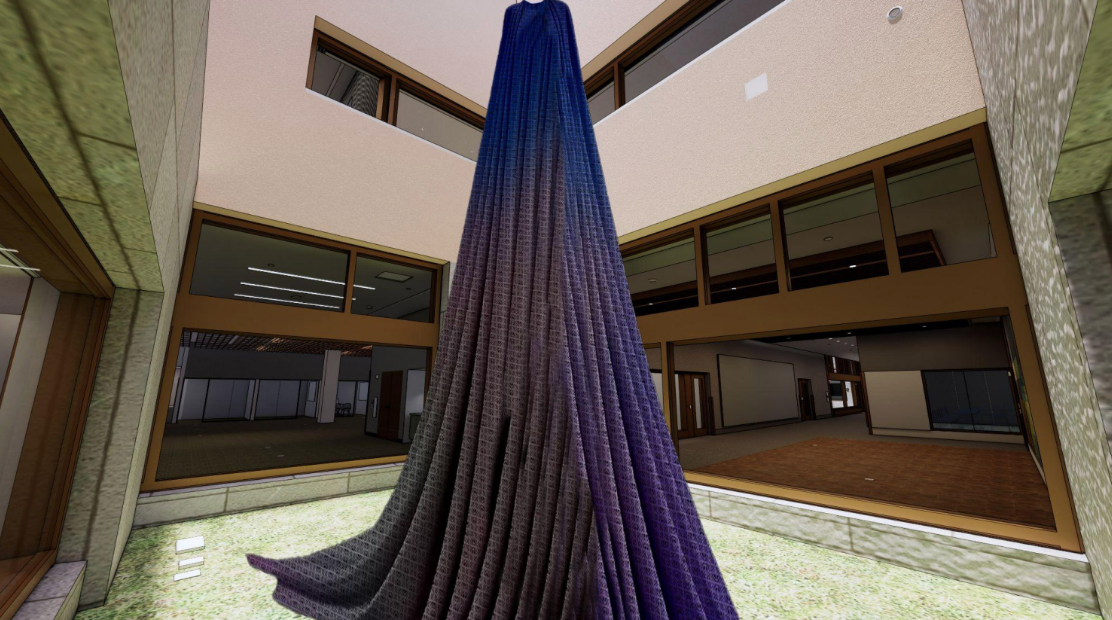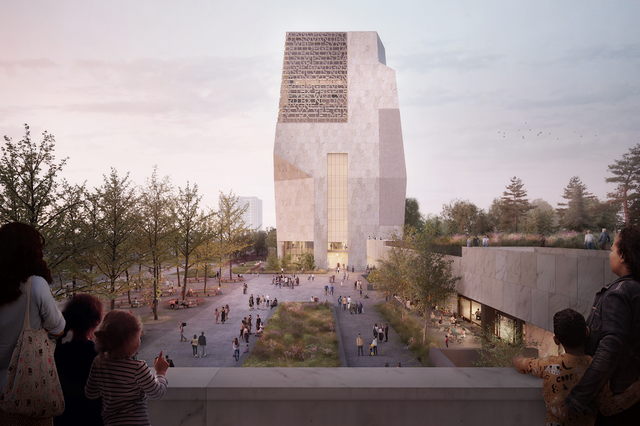
The Barack Obama Presidential Center in a 3D artist’s rendering
American artist Theaster Gates has been selected to create a new work for the Barack Obama Presidential Center, set to open in Chicago in spring 2026.
Gates is a professor in the University of Chicago’s Department of Visual Arts, as well as the director of artist initiatives at the Colby College Museum of Art’s Lunder Institute for American Art. His work primarily focuses on the intersection of space and race, examining urban life and underserved or marginalized communities. He has exhibited at museums and cultural institutions around the world, including the Victoria & Albert Museum in London, Tate Liverpool, the Palais de Tokyo in Paris, the National Gallery of Art in Washington, and the Fondazione Prada in Milan. Obama Foundation CEO Valerie Jarrett referred to him as “the ideal artist for this marquee space. His boundless creativity, commitment to public art, passion for educating and sharing art with others, and gift for translating history into the present make him a singular talent.”
While much of his work is primarily sculptural or installation-based, Gates’s commission for the Obama Center will be a pair of friezes for the Hadiya Pendleton Atrium. Regarding the subject, he plans to focus on daily life among Black Americans in the twentieth century. To do so, he will draw on a source of great cultural significance: the Johnson Publishing Company (JPC) archives, the former owner of Ebony and Jet magazines. Both publications were not only news sources but also spaces where Black American writers, photographers, and artists could have their work published and distributed free from the constraints of mainstream American media. For much of the twentieth century, a large swath of American media frequently excluded or belittled Black Americans, their lives, and their culture. In periodicals such as Ebony and Jet, however, Black Americans could more freely represent their communities by highlighting Black achievements, showcasing fashion and beauty, and drawing attention to civil rights issues, especially in the 1950s and 1960s.


In 2016, JPC liquidated its assets while retaining control of its archives. The company ultimately donated the contents to a consortium of cultural and charitable organizations, including the Getty Research Institute and the Smithsonian, ensuring they would be made available to the public. Having worked for JPC before its dissolution, Gates has extensive knowledge of these archives, having spent almost a decade organizing their contents and ensuring accessibility. The new work will heavily feature photographs drawn from these archives.
The frieze will feature approximately twenty images from the JPC archives printed on large aluminum-alloy bands. Gates spoke about his connection to the archival material and the source’s importance, saying that he often strives to create artworks “that don’t have to do with the creation of a consumable good for the market. And I think that being active in archives is essentially a way of being an informal historian. Lord knows, we need to keep certain truths about history alive so that those histories don’t succumb to these falsehoods that are being generated today.”
The Obama Center has commissioned several artists to create new work for the space, including Nick Cave, Nekisha Durrett, Jenny Holzer, Julie Mehretu, Kiki Smith, and Marie Watt. According to Virginia Shore, curator of art commissions, President Obama has been involved in selecting these artists. Durrett has created a sculpture titled Hem of Heaven, made from painted ceramic tiles in a reimagining of Harriet Tubman’s shawl. Meanwhile, Holzer will make a “text-based painting draw[ing] from FBI files on the Civil Rights–era Freedom Riders.” In a press release announcing the Gates commission, the Obama Center commented that the work “reflects on the power of collective resilience and honors the everyday individuals whose lives and practices sustain and enshrine movements for justice and change.”