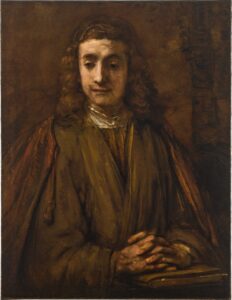
Saint John on Patmos by Rembrandt van Rijn
This past week, the major London auction houses hosted a series of Old Masters sales for Classics Week; the Sotheby’s Old Master & 19th Century evening sale on Wednesday was certainly the highlight of the week. Thirty lots crossed the block, with impressive examples by Rubens, Van Dyck, Dürer, Turner, and Aivazovsky.
The star of the sale was no doubt Rembrandt’s half-length portrait of Saint John of Patmos. Collectors were likely very excited to see this work at auction since it has been kept out of view in the same family collection since the 1920s. Furthermore, for several decades, it was mistakenly attributed to Rembrandt’s student Carel Fabritius, of Goldfinch fame. However, the authorship was corrected when it was sold in New York in 1913 to Dutch Golden Age art historian Wilhelm Reinhold Valentiner.
The likeness of the saint is widely believed to have been based on the artist’s son, Titus, whom Rembrandt painted several times. After centuries of wear and tear, some of the finer details became obscured, including a palm tree and the head of an eagle in profile to the right of the subject. These two emblems, along with the man’s hands folded over a book, identify the subject as Saint John of Patmos, author of the Book of Revelation. Nowadays, most Christian denominations recognize John of Patmos and Saint John the Evangelist as two distinct figures. However, in the seventeenth century, these two saints were often combined into a single character. Thus, the palm tree and the faint remnants of a rocky landscape representing the Mediterranean island of Patmos, and the eagle’s head, which represents John the Evangelist, are included.
Given its time away from public view and its impressive provenance, including the Thyssen family, the Rembrandt portrait was expected to be the top lot on Wednesday, with an estimate of £5 million to £7 million. The hammer eventually came down at £5.5 million / $7.3 million (or £6.75 million / $9 million w/p). It is the most expensive painting by Rembrandt to sell at auction since December 2023, when Adoration of the Kings sold at Sotheby’s for £10.9 million w/p.
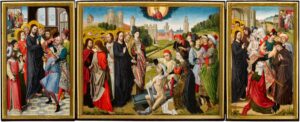
The Sherborne Almshouse Triptych
Coming in right behind the Rembrandt was a late fifteenth-century triptych attributed to an artist whose real name has been lost. However, since this is the only known surviving work by this artist, Sotheby’s specialists have given them the name of Master of the Sherborne Almshouse Triptych. When the triptych is closed, the wings’ exteriors show rather statuesque depictions of saints Paul, James, Thomas, and Peter. When the wings open up, they reveal a series of incredibly vibrant depictions of Christ’s miracles. The central panel shows Lazarus rising from his tomb. Meanwhile, the left wing shows Jesus healing a boy possessed by a demon, and the right wing shows another resurrection, this time the son of a widow of Nain.
It is believed that the painting has been kept in the same place for centuries. It was the property of the St. John’s Almshouse, founded in the fifteenth century to care for the poor and the elderly in the area around the town of Sherborne, Dorset. The organization had to close its accommodation units for retirees in 2023 due to a lack of funds. However, the sale of this painting should allow the almshouse to continue in its work. The triptych is incredibly rare since it is a work of religious art that survived the Reformation in England. Both the dissolution of the monasteries under King Henry VIII and the iconoclasm campaigns of some of the more puritanical Protestant denominations resulted in many works of religious art being confiscated or destroyed. The Almshouse Triptych, however, seems not only to have survived but also to have remained intact and well preserved. However, no direct evidence supports keeping the painting in the almshouse for all that time, which has led some to theorize that it may have been brought over from the Netherlands later, possibly in the eighteenth century.
Sotheby’s initially believed that the work would sell for no more than £3.5 million. However, given the rarity of the painting and the story behind the organization that consigned it, it’s not terribly surprising that it became such a hot item. Bidding ended up surpassing the high estimate, landing at £5.2 million / $6.9 million (or £5.7 million / $5.6 million w/p).
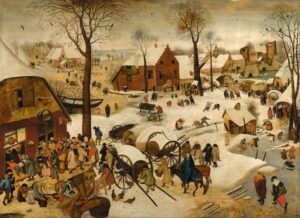
The Census at Bethlehem by Pieter Brueghel the Younger
And finally, in third place was the Census at Bethlehem by Pieter Brueghel the Younger. The painting, a copy of a 1566 work by his father Pieter Brueghel the Elder, shows a scene from the beginning of the New Testament. However, Brueghel set the scene in a European village in the middle of winter. The residents of the town bustle throughout, to the point that it can be easy to miss the Virgin Mary wrapped in a blue cloak atop a donkey. Joseph leads them along the path, his back turned and his broad-brimmed hat concealing his face. According to the Gospel of Luke, the Emperor Augustus ordered a census of the entire Roman Empire, prompting many to return to their birthplaces to be registered. This is what prompted Joseph to travel from Nazareth to Bethlehem, taking his pregnant wife, Mary, with him. While in Bethlehem for the census, Mary gave birth to Jesus.
The Brueghel offered at Sotheby’s on Wednesday is one of several versions created by the artist and is considered to be in the best condition. Other versions of the Census at Bethlehem are on display at the Royal Museum of Fine Arts in Brussels, the Musée des Beaux-Arts in Caen, and the private collection of the Prince of Liechtenstein. Since Brueghel did not make many copies of this scene, it is one of the rarer subjects he reproduced from his father’s paintings. Estimated to sell between £3 million and £5 million, the Census at Bethlehem sold for £4.2 million / $5.6 million (or £5.2 million / $6.9 million w/p).
Overall, the auction delivered some impressive results for an Old Masters sale. Of the thirty available lots, fifteen sold within their estimates. This gave Sotheby’s an accuracy rate of 50%, which is impressive regardless of the kind of art you’re selling. Only two lots (7%) sold below, while six lots (20%) sold above. Seven lots went unsold, including Willem van de Velde the Elder’s monochrome pen painting of Dutch ships anchored off Vlieland, which was estimated to sell for at least £1.2 million. With a 77% sell-through rate, the evening sale achieved £25.34 million ($33.8 million), exceeding a low total estimate of £22.46 million. With all the fees added on top, on Wednesday evening, Sotheby’s brought in £30.67 million (or $40.9 million).

Sotheby’s London Old Masters Evening Sale
Saint John on Patmos by Rembrandt van Rijn
This past week, the major London auction houses hosted a series of Old Masters sales for Classics Week; the Sotheby’s Old Master & 19th Century evening sale on Wednesday was certainly the highlight of the week. Thirty lots crossed the block, with impressive examples by Rubens, Van Dyck, Dürer, Turner, and Aivazovsky.
The star of the sale was no doubt Rembrandt’s half-length portrait of Saint John of Patmos. Collectors were likely very excited to see this work at auction since it has been kept out of view in the same family collection since the 1920s. Furthermore, for several decades, it was mistakenly attributed to Rembrandt’s student Carel Fabritius, of Goldfinch fame. However, the authorship was corrected when it was sold in New York in 1913 to Dutch Golden Age art historian Wilhelm Reinhold Valentiner.
The likeness of the saint is widely believed to have been based on the artist’s son, Titus, whom Rembrandt painted several times. After centuries of wear and tear, some of the finer details became obscured, including a palm tree and the head of an eagle in profile to the right of the subject. These two emblems, along with the man’s hands folded over a book, identify the subject as Saint John of Patmos, author of the Book of Revelation. Nowadays, most Christian denominations recognize John of Patmos and Saint John the Evangelist as two distinct figures. However, in the seventeenth century, these two saints were often combined into a single character. Thus, the palm tree and the faint remnants of a rocky landscape representing the Mediterranean island of Patmos, and the eagle’s head, which represents John the Evangelist, are included.
Given its time away from public view and its impressive provenance, including the Thyssen family, the Rembrandt portrait was expected to be the top lot on Wednesday, with an estimate of £5 million to £7 million. The hammer eventually came down at £5.5 million / $7.3 million (or £6.75 million / $9 million w/p). It is the most expensive painting by Rembrandt to sell at auction since December 2023, when Adoration of the Kings sold at Sotheby’s for £10.9 million w/p.
The Sherborne Almshouse Triptych
Coming in right behind the Rembrandt was a late fifteenth-century triptych attributed to an artist whose real name has been lost. However, since this is the only known surviving work by this artist, Sotheby’s specialists have given them the name of Master of the Sherborne Almshouse Triptych. When the triptych is closed, the wings’ exteriors show rather statuesque depictions of saints Paul, James, Thomas, and Peter. When the wings open up, they reveal a series of incredibly vibrant depictions of Christ’s miracles. The central panel shows Lazarus rising from his tomb. Meanwhile, the left wing shows Jesus healing a boy possessed by a demon, and the right wing shows another resurrection, this time the son of a widow of Nain.
It is believed that the painting has been kept in the same place for centuries. It was the property of the St. John’s Almshouse, founded in the fifteenth century to care for the poor and the elderly in the area around the town of Sherborne, Dorset. The organization had to close its accommodation units for retirees in 2023 due to a lack of funds. However, the sale of this painting should allow the almshouse to continue in its work. The triptych is incredibly rare since it is a work of religious art that survived the Reformation in England. Both the dissolution of the monasteries under King Henry VIII and the iconoclasm campaigns of some of the more puritanical Protestant denominations resulted in many works of religious art being confiscated or destroyed. The Almshouse Triptych, however, seems not only to have survived but also to have remained intact and well preserved. However, no direct evidence supports keeping the painting in the almshouse for all that time, which has led some to theorize that it may have been brought over from the Netherlands later, possibly in the eighteenth century.
Sotheby’s initially believed that the work would sell for no more than £3.5 million. However, given the rarity of the painting and the story behind the organization that consigned it, it’s not terribly surprising that it became such a hot item. Bidding ended up surpassing the high estimate, landing at £5.2 million / $6.9 million (or £5.7 million / $5.6 million w/p).
The Census at Bethlehem by Pieter Brueghel the Younger
And finally, in third place was the Census at Bethlehem by Pieter Brueghel the Younger. The painting, a copy of a 1566 work by his father Pieter Brueghel the Elder, shows a scene from the beginning of the New Testament. However, Brueghel set the scene in a European village in the middle of winter. The residents of the town bustle throughout, to the point that it can be easy to miss the Virgin Mary wrapped in a blue cloak atop a donkey. Joseph leads them along the path, his back turned and his broad-brimmed hat concealing his face. According to the Gospel of Luke, the Emperor Augustus ordered a census of the entire Roman Empire, prompting many to return to their birthplaces to be registered. This is what prompted Joseph to travel from Nazareth to Bethlehem, taking his pregnant wife, Mary, with him. While in Bethlehem for the census, Mary gave birth to Jesus.
The Brueghel offered at Sotheby’s on Wednesday is one of several versions created by the artist and is considered to be in the best condition. Other versions of the Census at Bethlehem are on display at the Royal Museum of Fine Arts in Brussels, the Musée des Beaux-Arts in Caen, and the private collection of the Prince of Liechtenstein. Since Brueghel did not make many copies of this scene, it is one of the rarer subjects he reproduced from his father’s paintings. Estimated to sell between £3 million and £5 million, the Census at Bethlehem sold for £4.2 million / $5.6 million (or £5.2 million / $6.9 million w/p).
Overall, the auction delivered some impressive results for an Old Masters sale. Of the thirty available lots, fifteen sold within their estimates. This gave Sotheby’s an accuracy rate of 50%, which is impressive regardless of the kind of art you’re selling. Only two lots (7%) sold below, while six lots (20%) sold above. Seven lots went unsold, including Willem van de Velde the Elder’s monochrome pen painting of Dutch ships anchored off Vlieland, which was estimated to sell for at least £1.2 million. With a 77% sell-through rate, the evening sale achieved £25.34 million ($33.8 million), exceeding a low total estimate of £22.46 million. With all the fees added on top, on Wednesday evening, Sotheby’s brought in £30.67 million (or $40.9 million).