
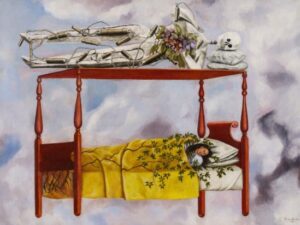
Frida Kahlo – El sueño (La cama)
To close out the week of blockbuster New York sales, Sotheby’s hosted a pair of auctions dedicated to surrealist art, titled Exquisite Corpus. This is a rather clever art historical reference to a surrealist practice called the exquisite corpse. This is where a group of artists would each draw a different body part in their own style, then assemble them into a single surrealist character.
Of course, the star of the evening sale on Thursday was El sueño (La cama) by Frida Kahlo. Kahlo shows herself asleep in a wooden four-poster bed, with vines and leaves creeping up the bright yellow blanket covering her. Meanwhile, on top of the canopy, a skeleton lies, mirroring Kahlo‘s pose. It holds flowers in its hands and has sticks of dynamite attached all over its surface.
When Kahlo created this painting in 1940, she had recently gotten divorced and remarried to Diego Rivera. She had also been diagnosed with polio. That and the chronic pain from the injuries she sustained in a bus accident in 1925 made her more reflective on her pain and impending death. According to Sotheby’s specialists, the painting “encapsulat[es] her lifelong preoccupation with mortality, physicality, and the emotional complexities of selfhood.”
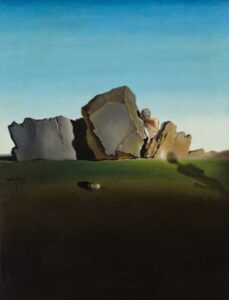
Salvador Dalí – Symbiose de la tête aux coquillages
The painting also plays with classic surrealist concepts, such as consciousness, and draws on older artistic subjects, such as the reclining nude and the nineteenth-century orientalist odalisque. The skeleton on top of the bed also draws on Mexican folk art and pre-Columbian indigenous culture. The painting was guaranteed by a third party, meaning it was bound to set an auction record for the artist regardless of who else bid. Against a low estimate of $40 million, El sueño (La cama) achieved a hammer price of $47 million (or $54.6 million w/p). Not only was this an auction record for Frida Kahlo, but it also set the record for most expensive work of art by a Latin American artist, as well as most expensive work by a female artist, beating out Georgia O’Keeffe’s Jimson Weed/White Flower No. 1 that sold at Sotheby’s in 2014 for $44.4 million w/p.
There was a significant gap between the first- and second-place lots at Sotheby’s on Thursday. Salvador Dalí’s 1931 painting Symbiose de la tête aux coquillages was created the same year that the artist officially joined André Breton’s Surrealist group. Though he had been pursuing art for some time, his decision to join what was then the most avant-garde group of artists in Europe led to his being disinherited by his father.
Many of Dalí’s paintings at this time feature desolate landscapes with craggy outcroppings and little plant life. This is also when he developed his paranoiac-critical method, where he would cause himself to hallucinate, inspiring works featuring optical illusions and the use of double imagery. Regarding the landscape elements, Dalí produces a dichotomy between the monumental, unchanging rock formations and the fleeting, momentary human shapes the mind can sometimes see in inanimate substances. Estimated to sell for between $2 million and $3 million, the Dalí slightly exceeded its high estimate, with the hammer coming down at $3.4 million (or $4.2 million w/p).
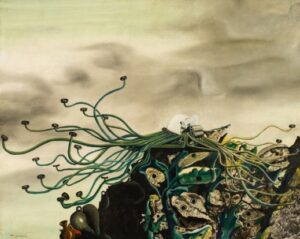
Oscar Domínguez – La Machine à écrire ou La Jeu de la logique
And in third, a duo of lots each received a final bid of $3 million (or $3.7 million w/p). The first was a 1938 oil painting by the Spanish surrealist Oscar Domínguez, entitled La Machine à écrire ou La Jeu de la logique, which translates to The Typewriter or The Logic Game. The subject is one of the artist’s best-known works, a pair of typewriters seemingly alive and embracing one another. Their keys extend outward like vines crawling across the rocky crevice they sit on.
The work is important from a technical perspective, as it employs the decalcomania technique, primarily pioneered by Domínguez and Max Ernst. This consisted of applying paint to one surface, such as paper or glass, and then pressing it against the canvas to create various patterns of shapes that would provide a foundation for the artist. Domínguez has combined technology and modernity with eroticism, with the rough landscape and pale, milky sky providing an excellent stage for a dive into the subconscious. Expected to sell for no more than $1.5 million, the Domínguez achieved exactly double its high estimate.
Meanwhile, the 1962 painting La Représentation by the renowned Belgian master René Magritte shared third place. It shows a soccer match being played on a field in the countryside in front of a white house. A stone ledge lines the bottom of the canvas, with a little archway of the same color and material, seemingly taken out of a balustrade, sitting on top of the ledge on the left-hand side. However, Magritte has recreated the soccer match within the threshold of the empty space made by this stone structure.
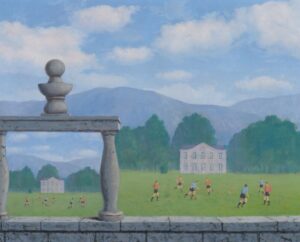
René Magritte – La Représentation
This is another rendition of the artist’s experiments with ideas of perception, creating impossible images by playing with the lenses or framing devices through which we see. Magritte had been experimenting with this subject since the early 1930s, as seen in his painting La condition humaine and his later 1964 painting Le soir qui tombe. However, Sotheby’s notes that La Représentation marks a departure from the artist’s other renditions of the theme, in that canvases placed on easels and panes of glass serve as tangible framing devices for observing something. However, in the work offered at Sotheby’s, it is not a physical surface that captures the impossible image, but rather an empty space.
It is almost as if the artist has taken the perspective of someone viewing the game from further down the stone ledge to the left of the viewer and placed that image in the negative space formed by the arch, for the viewer to see simultaneously with his own perspective, viewing the match straight on. The painting offered at Sotheby‘s made its auction debut on Thursday evening, having been kept in the same private collection since 1968. However, with an estimated range of $4 million to $6 million, the Magritte slightly underperformed, which is rather unusual for probably the most popular surrealist artist on the secondary market today.
Along with the Domínguez, there were several lots, the results of which may have surprised Sotheby’s specialists. Le Crapaud de Maldoror by Valentine Hugo was the first lot to cross the block on Thursday evening, estimated at no more than $150K. However, the kaleidoscope of greenery as well as the literary references of the subject seem to have emboldened several bidders as the bid shot right past specialists’ expectations, landing at $650K (or $825.5K w/p), or more than four times the high estimate.
Later on, a 1959 work by Hans Bellmer, Les Bas rayés, proved popular as well. Described in the catalogue notes as a “work of exquisite draftsmanship and potent eroticism”, the painting was assigned a maximum estimate of $400K prior to the sale. However, several interested parties pushed the final hammer price up to $850K (or $942K w/p).
There were no unsold lots on Thursday evening, giving Sotheby’s a 100% sell-through rate. However, this is not particularly surprising since 17 of the 24 lots, or 70% of the sale, were guaranteed properties. Seven lots sold within their estimates, giving Sotheby’s an accuracy rate of 29%. Impressively, a further 11 lots (46%) sold above their estimates, while 6 (25%) sold below. In total, the Exquisite Corpus evening auction brought in $82.1 million (or $98.1 million w/p) against a $66.7 million total minimum estimate.