
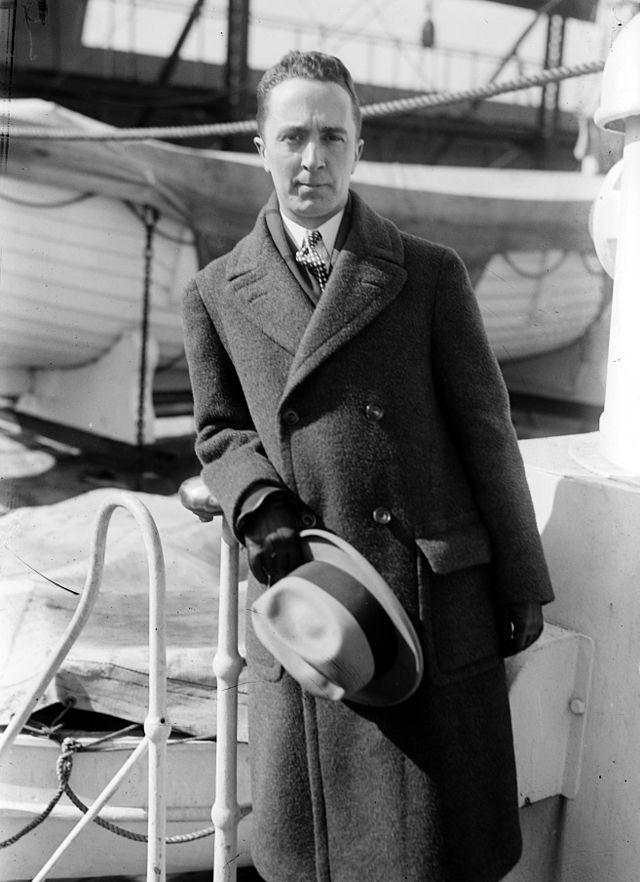
Norman Rockwell
The family of the American artist Norman Rockwell has called upon federal agencies to stop using the artist’s work in content promoting the Trump administration’s anti-immigration policies.
In recent months, government agencies have used parts of Norman Rockwell’s work on social media to create promotional material. Specifically, the Department of Homeland Security (DHS) began using images of Rockwell’s work on Twitter, Facebook, and Instagram in September, starting with the 1946 painting Working on the Statue of Liberty. The image is accompanied by the slogans “Protect Your Homeland. Defend Your Culture”, along with a URL where people can sign up to join Immigration & Customs Enforcement (ICE). This DHS agency has become infamous in recent months for its increasingly brutal and often illegal enforcement methods. The DHS has used several other Rockwell paintings in their posts, including Salute the Flag and And Daniel Boone Comes to Life on the Underwood Portable. The DHS’s social media pages have also used the work of several other artists, including Frederic Edwin Church, George Caleb Bingham, and Thomas Kinkade.
On November 2nd, the Rockwell family wrote an op-ed in USA Today condemning the DHS’s use of the artist’s work. Not only has the DHS used the work without the family’s approval, but the messages behind the posts run contrary to the artist’s personal beliefs. They wrote that he would be “devastated” to see that his work “has been marshalled for the cause of persecution toward immigrant communities and people of color.”
Norman Rockwell has a complicated legacy in American culture and politics. To many, Rockwell’s illustrations and paintings are emblematic of life in the United States in the early and mid-twentieth century. They are often lighthearted and wholesome glimpses of everyday life, whether at a lunch counter, a baseball game, or a scouting trip. He also created works that embody American political and social ideals. The most famous of these works is the Four Freedoms series, which celebrates President Franklin Roosevelt’s 1941 State of the Union address. The series includes Freedom from Want, which shows a loving family gathered around the dinner table, and Freedom of Speech, which depicts a lone man standing up in a crowd to voice his opinions.
However, there is a slightly darker side to Norman Rockwell’s legacy. The images he created are often used by extremists, including Christian nationalists, to yearn for a lost era where traditional family values reigned supreme. Of course, these are usually dog whistles and code words for the period before the Civil Rights Movement and the Immigration & Nationality Act. The Rockwell family’s USA Today article comments on this specifically: “The scarcity of people of color in Rockwell’s paintings has led those who are not familiar with his entire oeuvre to draw the conclusion that his vision was of a White America, free of immigrants and people of color. But nothing could have been further from the truth.” While one could certainly interpret a good portion of Rockwell’s work this way, there is an unfortunate explanation for this. One of Rockwell’s main employers was the Saturday Evening Post, which featured his illustrations on its cover 323 times. But the publication had some restrictions that often shaped the content of Rockwell’s work. The magazine’s editor, George Horace Lorimer, frequently ensured that illustrations excluded people of color. If they were included, it would only be as racist caricatures or as servants, waiters, porters, or other menial positions.
By the early 1960s, Rockwell had become frustrated with these restrictions, leading him to terminate his contract with the Saturday Evening Post to allow him greater creative liberty. As the Civil Rights Movement got underway in the late 1950s, Rockwell gradually made his support increasingly evident through his work. Probably his best-known painting on the subject of civil rights is The Problem We All Live With, which was featured as the centerfold in the January 14, 1964, edition of Look magazine. The work shows a small black schoolgirl flanked by a quartet of men in suits with their heads and shoulders cropped out by the top of the canvas. They all walk to the left in front of a wall marred by racist graffiti and thrown food. The painting is based on the integration of New Orleans public schools, when six-year-old Ruby Bridges had to be escorted into her elementary school by a group of deputy U.S. Marshals. Throughout the 1960s, Rockwell would create many other works commenting on the struggle for civil rights and changing social customs. The most striking of these works is Murder in Mississippi (Southern Justice), which commemorates three civil rights activists who were killed by local klansmen in retaliation for their efforts to register local Black Americans to vote.
Even Rockwell admitted that his work is not beyond criticism, that his upbringing, combined with the rules set by publications like the Saturday Evening Post, sometimes resulted in work that reinforced systems of intolerance and injustice. However, he recognized that he and others must strive to combat the “unjust prejudices” of others as well as ourselves.
The Rockwell family is not alone in calling on DHS to stop using artists’ work in its social media posts. The estate of Thomas Kinkade, whose work is similarly associated with quaint, idyllic representations of American life, similarly asked federal agencies to refrain from using the artist’s paintings.