
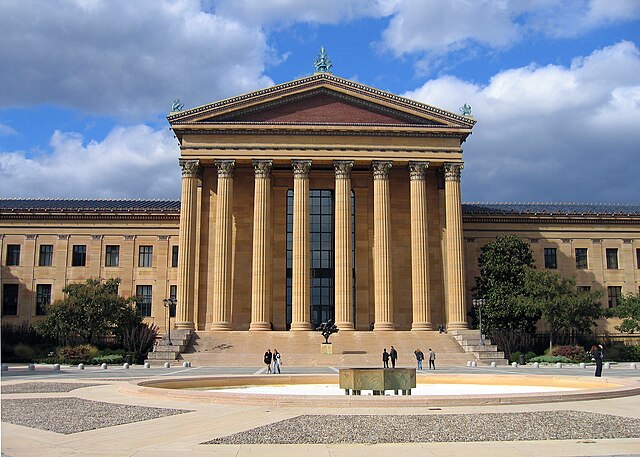
The Philadelphia Art Museum
Alexandra “Sasha” Suda is suing the Philadelphia Art Museum after she was allegedly wrongfully terminated as its director.
Last week, the Philadelphia Art Museum (formerly the Philadelphia Museum of Art) announced the firing of its director and chief executive, Sasha Suda, an NYU-trained art historian and curator who had held the position since 2022. She had formerly served as director at the National Gallery of Canada from 2019 to 2022. In her brief time as director of the museum, she sought to lead the museum in a different direction. When she took over the role, the museum was facing severe criticism over director Timothy Rub’s mishandling of sexual misconduct allegations against a former assistant director for interpretation. In her three years, Suda surpassed fundraising goals, oversaw staff unionization efforts, and worked to make the museum a more inclusive and diverse cultural institution. Through a collaboration with the Pennsylvania Academy of the Fine Arts (PAFA), she secured a major 2026 exhibition of the collection of Philadelphia Phillies principal owner John Middleton. She also made the museum more student-friendly, increasing student attendance nearly fivefold. Suda commented that many museums are run in an “object-oriented” way, while her style puts visitors at the center.
According to the board of trustees, an investigation had uncovered that Suda had allegedly “misus[ed] Museum funds for personal gain”. However, the board laid out its reasons after announcing Suda’s termination, a reversal of how it is often done. Less than a week after her firing, Suda filed a lawsuit against the Philadelphia Museum, citing “breaches of contract, bad faith, unfair treatment and abuse”. According to some sources, tensions had been rising between the director and some trustees, which Suda calls “a small, corrupt, unethical faction” in her civil complaint. In her lawsuit, Suda details how these board members foster “a culture of micromanagement and mistrust” at the museum.
Before her termination, Suda spearheaded a controversial rebranding that included the Philadelphia Museum’s name change. Suda mentioned in a statement that the name change, though small, was to reinforce the idea of the museum as “unabashedly Philadelphian”. While some trustees stated that Suda should have had the freedom to act within certain areas without needing to confer with the board, others were displeased that they were not sufficiently consulted. Wanting more than just consultation, some board members, however, allegedly sought to bypass Suda altogether on certain issues.
Former board chair Leslie Anne Miller, for example, insisted that the museum’s general counsel, Bill Petersen, be promoted to chief operating officer. When Suda balked, Miller decided to subvert the director, announcing Petersen’s promotion to the board despite that responsibility belonging solely to Suda. This was not the only time that Miller and other trustees supposedly undermined Suda’s leadership. During staff unionization, some board members labeled her “a socialist” for recognizing the grievances of striking employees. These opponents also objected to Suda’s inclusivity initiatives, which included the Philadelphia Museum’s greater involvement with community organizations to highlight local artists from diverse backgrounds. The supposed last straw was her resistance to lobbyist Melissa Heller being named a trustee. Heller is a friend of board chair Ellen Caplan and was considered by Suda to be “not a cultural fit for a board that needed collaboration and stability.” After an incident in which Heller accosted staff at a Bank of America museum event, Suda insisted that Caplan take action. The board chair, however, refused to investigate.
Luke Nikas, one of Suda’s lawyers, stated that the hostile trustees “commissioned a sham investigation to create a pretext for Ms. Suda’s termination. Ms. Suda fought for and believed in a museum that would serve Philadelphia and its people, not the egos of a handful of trustees.” According to Suda’s contract, the museum must pay her twice her annual salary plus benefits if it terminates her without cause. In Suda’s complaint, since the museum approved all the money given to her, there could not have been any misuse of funds. Therefore, there could not have been cause for termination. She also alleges that the trustees’ conduct and speech violate the contract’s non-disparagement section. Should the Court of Common Pleas find that the museum did not have cause to terminate Suda’s contract, they would have to pay her this severance.
James Abruzzo, a leadership consultant with experience with arts and culture organizations, commented on the situation, calling it “a case study in how a board should not act.” He also explained that Suda’s lawsuit exposes the Philadelphia Museum to several risks. These include the hesitance of potential donors should Suda’s allegations of incompetent governance prove to be founded. Also, the museum’s firing of a qualified, talented individual over what seems to be internal politics would make it difficult for the institution to find a successor. “If this is how arts leaders are treated, who in their right mind would take the job?”
Suda is requesting damages from the museum, as well as the severance pay owed to her according to her contract. When asked for a comment, a museum spokesperson said only that the lawsuit was “without merit”. The museum will be temporarily overseen by Louis Marchesano, deputy director of curatorial affairs and conservation.