
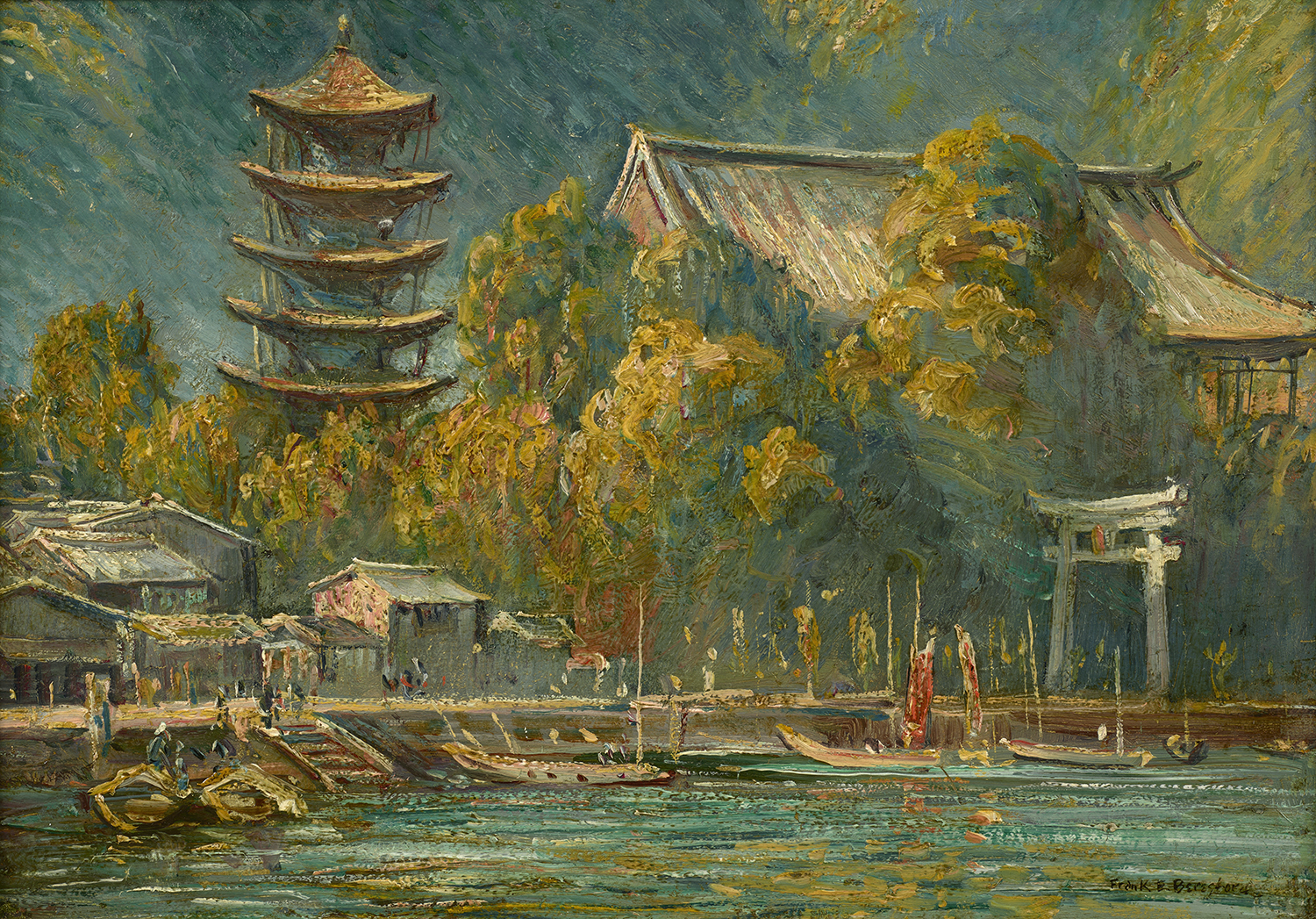
Miyajima by Frank Ernest Beresford
Miyajima shows a waterside scene on the titular island in Japan’s Inland Sea. Frank Beresford (1881 – 1967) attended the Royal Academy in London, with his efforts rewarded with scholarships that allowed him to travel extensively, particularly to Asia. Today, the island is better known as Itsukushima and is famous for its Shinto shrine on its northwestern coast.
Miyajima does not show the shrine’s iconic “floating” torii gate but instead focuses on two of the location’s other structures. On the left is the Gojunoto, or the Temple of the Five Roofs. In English, it is popularly known as the Five-Tiered Pagoda, and is dedicated to the Yakushi Buddha, the patron of medicine and healing. The structure in Beresford’s painting dates to 1533 and still stands today. To the right of the pagoda is the Senjokaku, the largest building on the island. It is also known as the Toyokuni Pavilion and was originally built as a Buddhist shrine where people could chant sutras for fallen soldiers. However, during attempts to solidify Shinto’s place as Japan’s dominant religion, Emperor Meiji removed the shrine’s Buddhist icons in the 1860s.
The way that Beresford captures the waterfront shows this part of the temple complex secluded among groves of maple trees. The leaves are mostly green with streaks of yellow, perhaps indicating that it is late summer. Only a handful of boats are bobbing in the water, with minute brushstrokes indicating a few figures mingling among the structures. Beresford likely had to wait until high tide to paint this part of the shrine from the water. Famously, as the tide goes out, the exposed sand forms a path between the shrine’s main building and the torii, allowing visitors to walk around the gate that would normally protrude from the water. But Beresford’s painting of the shrine from a wide angle, at a distance, gives the scene a bit of mystery. The viewer is somewhat distant from the buildings, reinforcing the artist’s and the audience’s roles as outsiders. It is unknown whether Beresford chose to paint from the water or was forced to by the rules governing foreigners at the shrine. Regardless of the reason, the work seems almost voyeuristic because of the distance. We’re just looking from afar, passing by, trying not to disturb the visitors on the shore before moving on to somewhere else.