
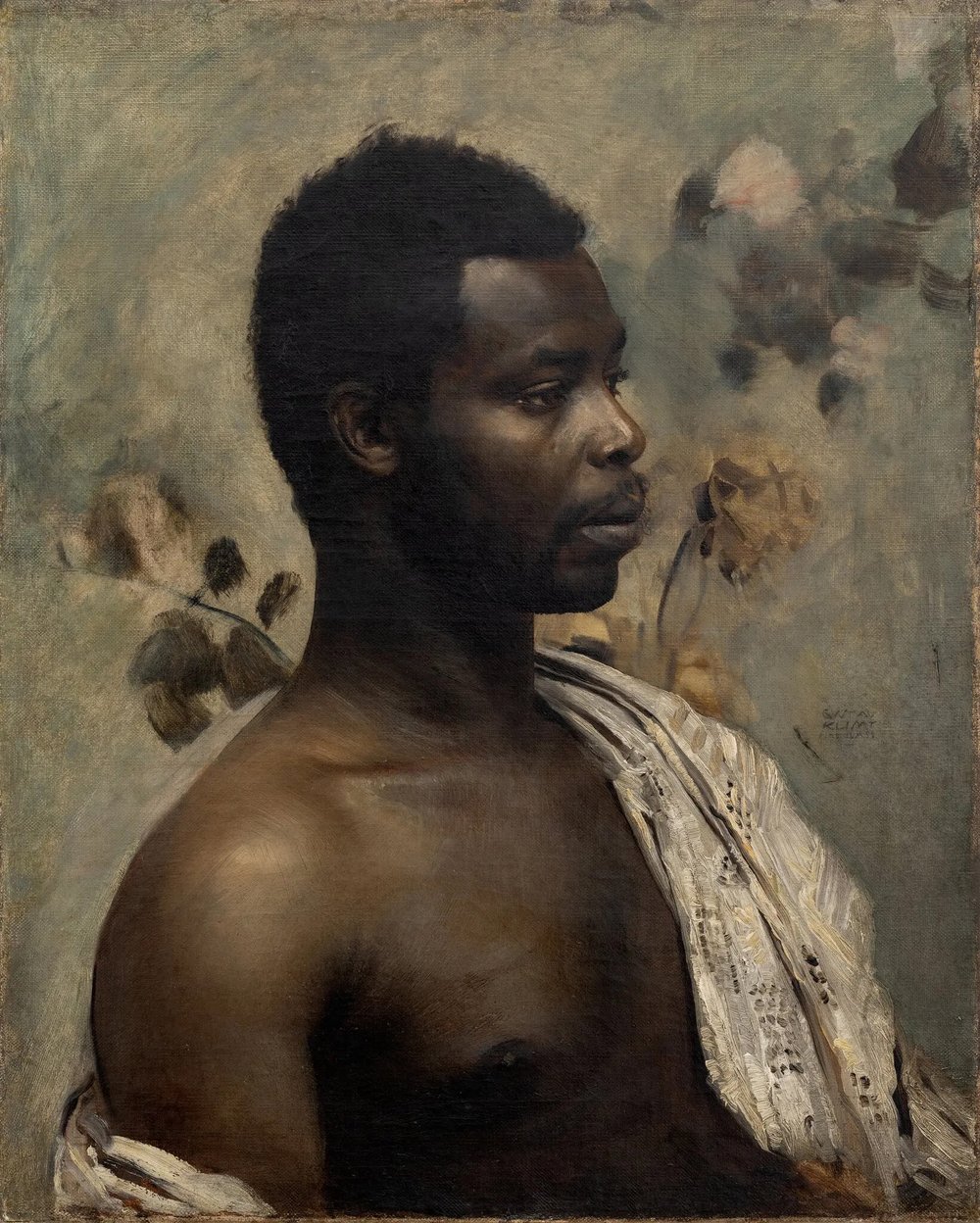
Portrait of Prince William Nii Nortey Dowuona by Gustav Klimt
A portrait of a West African prince by the Austrian painter Gustav Klimt has been seized by prosecutors in Vienna since it may have been improperly exported from Hungary.
Several months ago, I wrote about conspiracy theories circulating online claiming that Klimt’s Portrait of Prince William Nii Nortey Dowuona may have been smuggled from Hungary to Austria. However, these claims were only based on one art researcher’s Facebook posts. The Vienna gallery Wienerrothier & Kohlbacher (W&K), which acquired it from a private collector, dismissed the initial smuggling accusations and insisted they had gone through the proper channels to acquire it.
The painting itself is incredibly significant for several reasons. William Nii Nortey Dowuona, the painting’s subject, was a prince and ambassador of the Ga people of what is now Ghana. In 1897, he traveled to Vienna to participate in an exhibition on West African culture similar to the “human zoos” set up by colonizing European powers for residents of the metropole. Art historian Alfred Weidinger has remarked that the portrait marks a turning point in Klimt’s style. The portrait’s background features floral motifs, indicating an important step in “the evolution of his artistic language”. It is part of a transitional period, showing his increasing embrace of decorative elements in his portraiture. This would culminate in the artist’s Golden Phase works, like The Kiss and Portrait of Adele Bloch-Bauer II.
But it seems there was a small kernel of truth to the smuggling accusations, that the Klimt was allowed to be taken out of Hungary with little resistance from local cultural authorities. Standard practice in Hungary is that a work of art over 50 years old and valued at 1 million Hungarian forints (about €2,600 or $3,000) or more requires an export license. Monetarily and historically, the portrait is of immense value, so it is unlikely that such a license would have been granted.
But now, the same people who allowed the Klimt to leave Hungary are attempting to rectify their mistake. Hungarian authorities say that the painting was in such poor condition that they did not notice the stamp of Gustav Klimt’s estate. Furthermore, the artist’s name is visible on the frame under infrared light. Had they recognized these markings, the painting would not have been transported out of the country so easily. Hungarian authorities now argue that, because of this mistake, the original permission to export is invalid. And now, prosecutors in Vienna have acquiesced to Budapest’s request to seize the portrait.
W&K not only assert their legal ownership of the work but have also invoked a key provision of international art law. The portrait left Austria for the first time when its owner, Ernestine Klein, fled the country following Germany’s annexation of Austria in 1938. The Klein family, being Jewish wine merchants, sold or gave away many of their possessions before leaving for Monaco. They gave the Klimt to an acquaintance who later moved to Hungary and refused all requests by the Klein family to return it. When the painting resurfaced at TEFAF Maastricht in early 2025, W&K gave it a €15 million price tag, along with a disclaimer that a restitution agreement had been reached with the heirs of the Klein family. W&K therefore claim that the painting is subject to the principles established by the Washington Conference on Holocaust Era Assets in 1998. Under the Washington Principles, the painting would have been repatriated to Austria regardless of Budapest’s objections.