
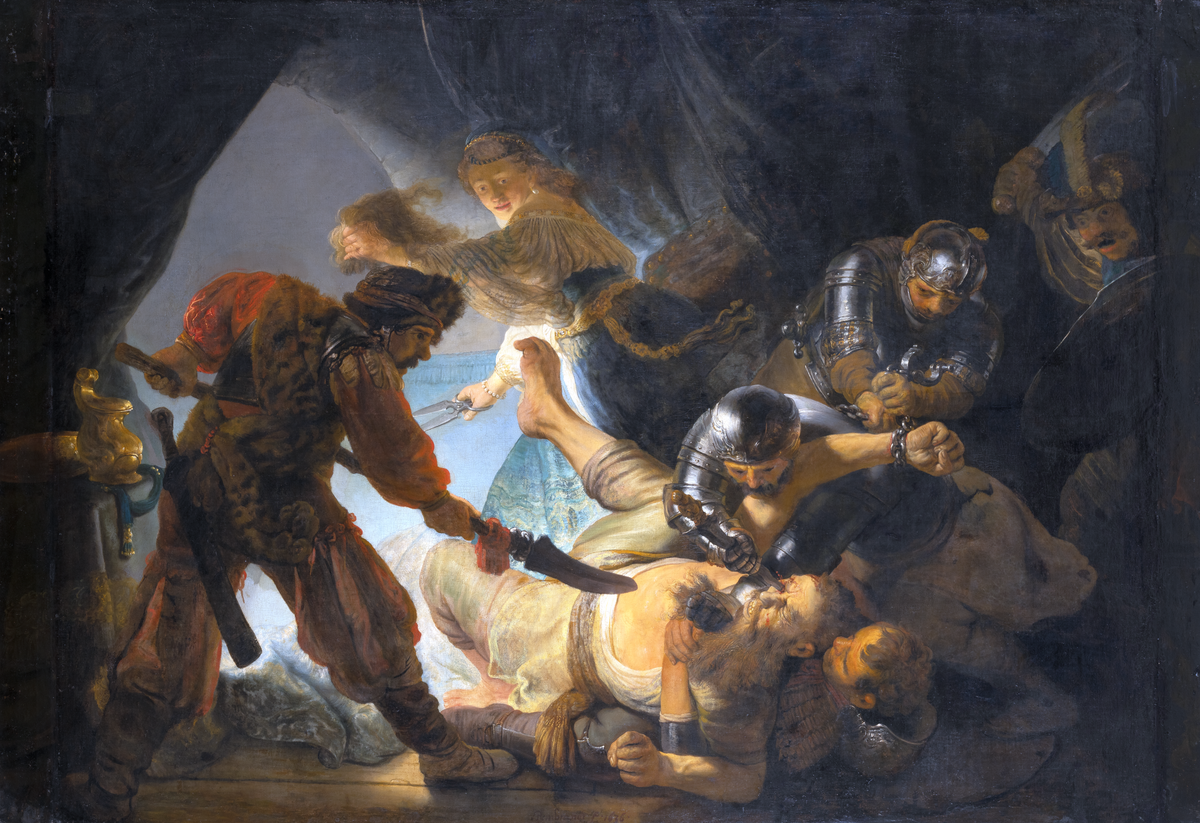
The Blinding of Samson by Rembrandt
Rembrandt’s Blinding of Samson, one of the artist’s most prominent religious works, is set to receive an extensive makeover.
The Blinding of Samson dates to 1636, in the early stages of Rembrandt’s peak. He mainly produced portraits at the time, but occasionally received commissions for historical or biblical subjects. The Blinding of Samson was not actually a commission, but rather a gift to the House of Orange, the most powerful family and de facto rulers of the Dutch Republic at the time. The Prince of Orange, Frederick Henry, had commissioned Rembrandt to create a series of paintings depicting Christ’s Passion, with The Blinding of Samson being given as an apology for running behind schedule. Only thirty years old at the time of the painting’s completion, Rembrandt relished the opportunity to create these sorts of works, as they allowed him to display his talents better. Before the mid-nineteenth century, large monumental canvases were reserved for paintings with historical or biblical subjects. Appropriately, The Binding of Samson measures just over two by three meters, or seven by ten feet. Though only a third the size of his famous group portrait, The Night Watch, The Blinding of Samson is nonetheless one of the largest canvases Rembrandt ever produced, and is one of the main highlights at the Städel Museum in Frankfurt. The painting depicts a scene from the Old Testament, where the Israelite hero Samson has been deceived by his lover, Delilah. In the Book of Judges, Samson tells Delilah that the covenant with God that gives him his strength is formed after swearing an oath never to drink wine and never cut his hair. As Samson slept in Delilah’s lap, she cut off his hair, robbing him of his strength and facilitating his capture by the Philistines, who subsequently gouged out his eyes. Typical of seventeenth-century historical or biblical paintings, the Philistines are not wearing historically accurate attire, but rather contemporary plate armor typical of Rembrandt’s time. Delilah is shown in the background, with a pair of scissors in one hand and Samson’s hair in the other.
The idea for the restoration project first came about in 2021, when the Städel Museum presented the exhibition “Rembrandt in Amsterdam: Creativity & Competition.” The show allowed researchers to examine The Blinding of Samson, revealing underdrawings and underpaintings that show the alterations Rembrandt made during the work’s creation. Museum specialists plan to view these hidden layers through X-ray imaging, infrared reflectography, looking at the canvas under ultraviolet light, microscopy, and micro-X-ray fluorescence analysis. After this data is collected, conservators will remove any paint applied to the canvas as part of previous restoration efforts. Finally, the museum will construct a new frame for the painting in the style of frames available to a Dutch artist in the 1630s. The complete restoration of the painting is estimated to take approximately three to four years, with a significant portion of the cost to be covered by Bank of America through its Art Conservation Project. Stephan Knobloch, the museum’s director of art technology and restoration, stated that they intend to restore the blinding of Samson “to its original intensity while ensuring the long-term preservation of the painting’s substance.” Similar to the ongoing restoration efforts of The Night Watch at the Rijksmuseum in Amsterdam, this new project will provide an opportunity for conservators and scientists to uncover new information about Rembrandt’s techniques in a transparent way.