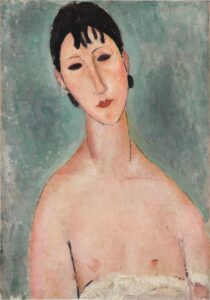
Elvire en buste by Amadeo Modigliani
On Friday, October 24th, Sotheby’s Paris hosted its Modernités sale, featuring mostly twentieth-century works by European and North American artists, including Jean Dubuffet, Roy Lichtenstein, and Jean Fautrier. The main draw, however, was a pair of portraits by the Italian modernist Amedeo Modigliani.
Elvire en buste and Raymond were both initially valued between €5.5 million and €7.5 million. Sotheby’s selected the former for its promotional materials and advertisements for the sale. The painting is a bust-length semi-nude portrait of a subject who appears in several of Modigliani’s works. Though the young woman’s identity remains unknown, she was most likely a local model living near Cagnes-sur-Mer, the town close to Nice where Modigliani and several other artists relocated in 1918 to escape the German siege of Paris.
During his time in the south of France, art historians note that Modigliani’s work reflected a synthesis of influences—from sixteenth-century Mannerism to the “structural rigor” of Cubism and the stylized forms of African art admired by modernists in early twentieth-century France. Despite being considered one of the highlights of Modigliani’s southern period, Elvire en buste had not been exhibited publicly for nearly sixty years, remaining instead in a series of private collections.
The work proved extremely popular with the bidders at Sotheby’s, blowing right past the already impressive high estimate and landing at the astronomical hammer price of €23 million / $26.7 million (or €26.98 million / $31.4 million w/p), or over three times the pre-sale high estimate. It is the most expensive painting by Modigliani sold at auction since 2023, when Portrait of Paulette Jourdain sold at Sotheby’s Hong Kong for $34.8 million w/p.
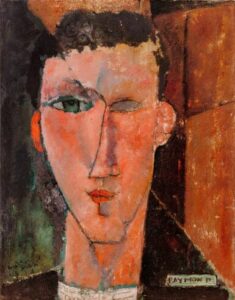
Raymond by Amadeo Modigliani
The other Modigliani portrait offered on Friday, Raymond, is believed to have been created in 1915, when the artist was still in Paris. According to several of the artist’s associates, including Jean Cocteau and André Salmon, the subject is the young writer Raymond Radiguet when he was only 12 years old. Even as an adolescent, Radiguet would regularly travel from his home in the suburbs of Paris to the city center. He would go on behalf of his father, who worked as a caricaturist and often sent his young son to deliver his work to newspapers and magazines. Though it would be several years before Raymond himself would have his poetry and novels published, he felt drawn to the French capital’s café culture, meeting many of the modern art pioneers who frequented such establishments. He would later be photographed by Man Ray and have his likeness carved as a bust by Jacques Lipchitz.
Modigliani created portraits of children during his career, but here we see something different. The portrait does not explicitly portray Radiguet as childlike. Rather, the work is more similar to Modigliani’s paintings of his artistic contemporaries, such as Pablo Picasso. According to Sotheby’s specialists, Modigliani’s strength as a portraitist was his ability to “seize an essence rather than an appearance.” Radiguet is sculptural and mature here, with a diagonal line bisecting his face, separating his eyes: one with a green pupil looking back at the viewer, the other dull and gray. Some have commented that this may reflect Modigliani’s well-known quote about the ability of artists to observe as well as express: “With one eye you look at the world, with the other, you look within yourself.” The artist’s division of the face may also refer to the subject’s fractured being, existing as an adolescent while also subverting the expectations of someone his age through independence and creativity.
Having remained in private hands since its creation, Raymond made its auction debut at Sotheby’s on Friday. Like Elvire en buste, Raymond also surpassed the high estimate, hammering at €8.8 million / $10.2 million (or €10.6 million / $12.4 million w/p).
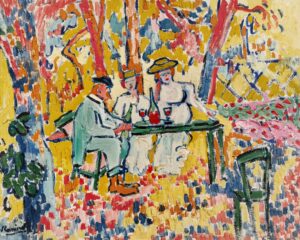
Le déjeuner champêtre, or Apéritif à la Grenouillère by Maurice de Vlaminck
And finally, a little bit of Fauvism to round out the top lots, a colorful work by Maurice de Vlaminck. While many may know him for his landscapes and views of village streets, it’s important to remember that Vlaminck was originally associated with the Fauves, being good friends with André Derain. Le déjeuner champêtre, also called Apéritif à la Grenouillère, shows three figures seated at a table enjoying a drink surrounded by a dazzling array of reds, pinks, and yellows in a distinctly post-Impressionist wonder. It serves as Vlaminck’s own foray in exploring the subject of leisure, which was popular among modern painters since the mid-nineteenth century.
La Grenouillère was a restaurant and cabaret on a pontoon boat moored on an island in the middle of the River Seine, less than ten miles west of Paris. Claude Monet and Pierre-Auguste Renoir had also painted scenes at La Grenouillère. Vlaminck then shows a trio of bourgeois Parisians fleeing the city for an afternoon to enjoy a drink by the water. The painting dates to 1906, only a year after the Fauves first exhibited at the Salon d’Automne in Paris. There, Vlaminck had his work shown alongside that of Derain, Henri Matisse, and Kees van Dongen.
Le déjeuner champêtre has been in very few hands since it left Vlaminck’s studio, first going to Vlaminck’s dealer Ambroise Vollard, who then left it to the collector Madeleine de Galéa. Her heirs were the ones who consigned the painting to Sotheby’s, where it made its auction debut. Le déjeuner champêtre was most recently featured in an exhibition focusing on the artist at the Museum Barberini in Potsdam just earlier this year. Estimated to sell between €2 million and €3 million, the Vlaminck hammered just beyond the low estimate at €2.15 million / $2.5 million (or €2.66 million / $3.1 million w/p).
Overall, Sotheby’s Modernités sale on Friday was a resounding success. Of the forty-one available lots, sixteen sold within their estimates (a 39% accuracy rate). Ten lots (24%) sold below estimate, while nine (22%) sold above estimate. With only six lots unsold, the sale achieved an 85% sell-through rate. Among the works that went unsold were an untitled painting by Joan Mitchell, estimated at €4 million or more, and one of Andy Warhol’s 1973 Mao Zedong portraits, estimated between €700,000 and €1 million.
While those results might have weakened an ordinary sale, the record-setting performance of the Modigliani portraits carried the day. The Modernités sale had been expected to bring in between €35.9 million and €50.7 million—but thanks to the exceptional Modigliani results, the final total surpassed even the high estimate, reaching €52 million / $60.5 million.

Modernités at Sotheby’s Paris
Elvire en buste by Amadeo Modigliani
On Friday, October 24th, Sotheby’s Paris hosted its Modernités sale, featuring mostly twentieth-century works by European and North American artists, including Jean Dubuffet, Roy Lichtenstein, and Jean Fautrier. The main draw, however, was a pair of portraits by the Italian modernist Amedeo Modigliani.
Elvire en buste and Raymond were both initially valued between €5.5 million and €7.5 million. Sotheby’s selected the former for its promotional materials and advertisements for the sale. The painting is a bust-length semi-nude portrait of a subject who appears in several of Modigliani’s works. Though the young woman’s identity remains unknown, she was most likely a local model living near Cagnes-sur-Mer, the town close to Nice where Modigliani and several other artists relocated in 1918 to escape the German siege of Paris.
During his time in the south of France, art historians note that Modigliani’s work reflected a synthesis of influences—from sixteenth-century Mannerism to the “structural rigor” of Cubism and the stylized forms of African art admired by modernists in early twentieth-century France. Despite being considered one of the highlights of Modigliani’s southern period, Elvire en buste had not been exhibited publicly for nearly sixty years, remaining instead in a series of private collections.
The work proved extremely popular with the bidders at Sotheby’s, blowing right past the already impressive high estimate and landing at the astronomical hammer price of €23 million / $26.7 million (or €26.98 million / $31.4 million w/p), or over three times the pre-sale high estimate. It is the most expensive painting by Modigliani sold at auction since 2023, when Portrait of Paulette Jourdain sold at Sotheby’s Hong Kong for $34.8 million w/p.
Raymond by Amadeo Modigliani
The other Modigliani portrait offered on Friday, Raymond, is believed to have been created in 1915, when the artist was still in Paris. According to several of the artist’s associates, including Jean Cocteau and André Salmon, the subject is the young writer Raymond Radiguet when he was only 12 years old. Even as an adolescent, Radiguet would regularly travel from his home in the suburbs of Paris to the city center. He would go on behalf of his father, who worked as a caricaturist and often sent his young son to deliver his work to newspapers and magazines. Though it would be several years before Raymond himself would have his poetry and novels published, he felt drawn to the French capital’s café culture, meeting many of the modern art pioneers who frequented such establishments. He would later be photographed by Man Ray and have his likeness carved as a bust by Jacques Lipchitz.
Modigliani created portraits of children during his career, but here we see something different. The portrait does not explicitly portray Radiguet as childlike. Rather, the work is more similar to Modigliani’s paintings of his artistic contemporaries, such as Pablo Picasso. According to Sotheby’s specialists, Modigliani’s strength as a portraitist was his ability to “seize an essence rather than an appearance.” Radiguet is sculptural and mature here, with a diagonal line bisecting his face, separating his eyes: one with a green pupil looking back at the viewer, the other dull and gray. Some have commented that this may reflect Modigliani’s well-known quote about the ability of artists to observe as well as express: “With one eye you look at the world, with the other, you look within yourself.” The artist’s division of the face may also refer to the subject’s fractured being, existing as an adolescent while also subverting the expectations of someone his age through independence and creativity.
Having remained in private hands since its creation, Raymond made its auction debut at Sotheby’s on Friday. Like Elvire en buste, Raymond also surpassed the high estimate, hammering at €8.8 million / $10.2 million (or €10.6 million / $12.4 million w/p).
Le déjeuner champêtre, or Apéritif à la Grenouillère by Maurice de Vlaminck
And finally, a little bit of Fauvism to round out the top lots, a colorful work by Maurice de Vlaminck. While many may know him for his landscapes and views of village streets, it’s important to remember that Vlaminck was originally associated with the Fauves, being good friends with André Derain. Le déjeuner champêtre, also called Apéritif à la Grenouillère, shows three figures seated at a table enjoying a drink surrounded by a dazzling array of reds, pinks, and yellows in a distinctly post-Impressionist wonder. It serves as Vlaminck’s own foray in exploring the subject of leisure, which was popular among modern painters since the mid-nineteenth century.
La Grenouillère was a restaurant and cabaret on a pontoon boat moored on an island in the middle of the River Seine, less than ten miles west of Paris. Claude Monet and Pierre-Auguste Renoir had also painted scenes at La Grenouillère. Vlaminck then shows a trio of bourgeois Parisians fleeing the city for an afternoon to enjoy a drink by the water. The painting dates to 1906, only a year after the Fauves first exhibited at the Salon d’Automne in Paris. There, Vlaminck had his work shown alongside that of Derain, Henri Matisse, and Kees van Dongen.
Le déjeuner champêtre has been in very few hands since it left Vlaminck’s studio, first going to Vlaminck’s dealer Ambroise Vollard, who then left it to the collector Madeleine de Galéa. Her heirs were the ones who consigned the painting to Sotheby’s, where it made its auction debut. Le déjeuner champêtre was most recently featured in an exhibition focusing on the artist at the Museum Barberini in Potsdam just earlier this year. Estimated to sell between €2 million and €3 million, the Vlaminck hammered just beyond the low estimate at €2.15 million / $2.5 million (or €2.66 million / $3.1 million w/p).
Overall, Sotheby’s Modernités sale on Friday was a resounding success. Of the forty-one available lots, sixteen sold within their estimates (a 39% accuracy rate). Ten lots (24%) sold below estimate, while nine (22%) sold above estimate. With only six lots unsold, the sale achieved an 85% sell-through rate. Among the works that went unsold were an untitled painting by Joan Mitchell, estimated at €4 million or more, and one of Andy Warhol’s 1973 Mao Zedong portraits, estimated between €700,000 and €1 million.
While those results might have weakened an ordinary sale, the record-setting performance of the Modigliani portraits carried the day. The Modernités sale had been expected to bring in between €35.9 million and €50.7 million—but thanks to the exceptional Modigliani results, the final total surpassed even the high estimate, reaching €52 million / $60.5 million.