
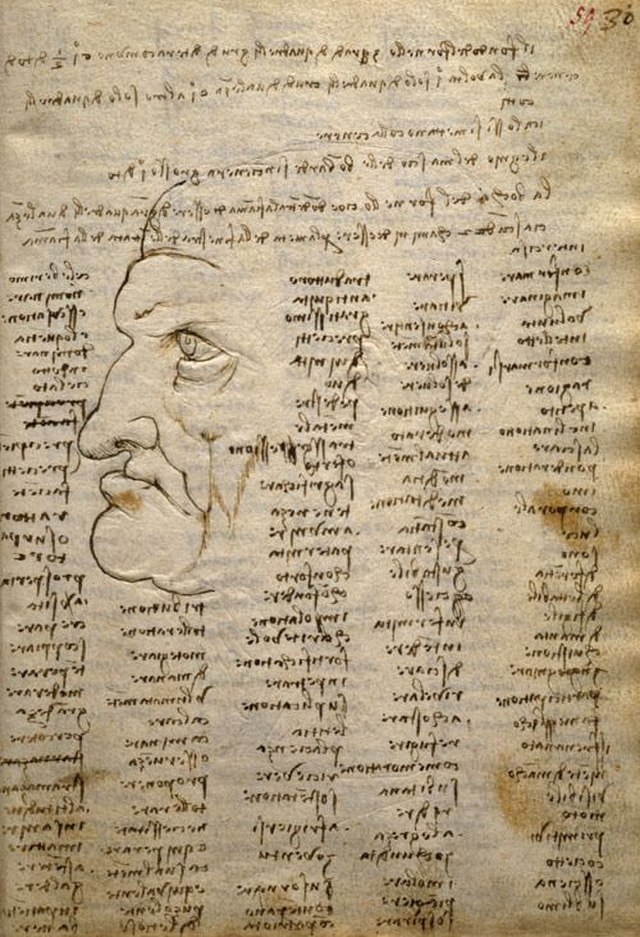
A page from Leonardo’s Trivulziano Codex
Through several art installations, a new project in Milan will focus on Leonardo da Vinci, his interest in words, and his impact on the Italian language.
Sabrina D’Alessandro is not a typical artist. Most of her work involves language, specifically studying words that are now rarely used in modern Italian. In 2009, she founded the Ufficio Resurrezione Parole Smarrite, or Lost Words Resurrection Office (URPS), an organization dedicated to preserving parts of the Italian vocabulary that have fallen out of common usage. They educate the public and raise awareness about these words by creating artworks and installations that are displayed in museums and public spaces. D’Alessandro and the URPS have showcased these works worldwide, including in museums and exhibition spaces in Milan, Siena, Vilnius, New York, Seoul, Singapore, and New Delhi. And now, installations and public artworks will not just be housed in a museum, but will be scattered throughout the city of Milan, using words found in Leonardo’s writings.
Leonardo da Vinci left behind many written works. Among them is a notebook called the Trivulziano Codex. This is a document, of which fifty-five of the original sixty-two pages survive, which shows Leonardo’s attempts at self-education. To expand his vocabulary, Leonardo wrote down eight thousand words he found in a variety of different books, the lists accompanied by annotations on their meanings. The codex is now housed in a library within Sforza Castle, the seat of the Dukes of Milan during the fifteenth and sixteenth centuries. In their project, Leonardo Parlante, D’Alessandro and the URPS have created sculptures and installations to be exhibited in the castle courtyards starting on November 1st. For the castle’s Courtyard of Arms, they created the word salvatica in large block letters made from terracotta, with related words carved into it. The word itself has more than one meaning, according to Leonardo. It is related to the modern Italian word selvatico, meaning wild or related to nature. However, Leonardo also wrote that the word refers to something that is saved, linking it to the concept of salvation. The castle’s Ducal Courtyard will feature two additional installations: the word “purità” made from terracotta, similar to salvatica. Meanwhile, vanagroria will be made out of polished steel. The former is an uncommon variant of purezza, meaning purity, while the latter is an archaic spelling of vanagloria, or vainglory. Both of these words will be placed at opposite ends of the courtyard’s central reflecting pool. It may be confusing how these words can be appropriately represented as sculptures using materials associated with their antonyms. However, purità being made of a form of clay and its placement by the reflecting pool is a reference to Leonardo’s writings on elephants. He once remarked that elephants are noble, honest animals. They “go down to the rivers, and there, solemnly cleansing themselves, they bathe, and so, having saluted the planet, return to the woods.” The terracotta sculpture, therefore, resembles the backs of elephants, caked with dust, ready to be washed away, purifying the animal like a ritual ablution. Meanwhile, the material and placement of Vanagroria is a commentary on vanity and the potential for self-reflection.
Along with the installations at Sforza Castle, D’Alessandro and the URPS plan to create posters and other works that will be displayed throughout Milan. These posters will feature words from the Trivulziano Codex accompanied by a brief quote from Leonardo, turning Milan into “a great philosophical and visual text that invites us to rediscover the riches of our language and reflect on themes such as knowledge, experiences, life, and freedom.” D’Alessandro’s work demonstrates how Leonardo’s writings have preserved vocabulary and other language forms that would have otherwise been lost to scholars and artists alike. The research behind Leonardo Parlante earned D’Alessandro a residency at the Casa degli Artisti in Milan, with some of her other work featured in the National Museum of Contemporary Photography’s Scrittura obliqua exhibition. The installations at Sforza Castle and the posters put up around Milan will be on view between November 1st and January 31st. On November 13th, Leonardo Parlante will be the subject of a discussion as part of the BookCity literary festival.